Best Forex Pairs for ICT Trading: Which Instruments to Focus On
How to choose pairs for ICT: EURUSD, GBPUSD, gold, USDJPY and indices compared by session, ATR volatility, spread and correlation.
The best forex pairs for ICT trading are liquid instruments whose active session matches the hours you can trade, with a spread that stays small next to your stop: for most traders that means EURUSD or GBPUSD, with gold, USDJPY or an index such as NAS100 or GER40 as a second market. There is no single best pair — the right choice depends on your Kill Zone, your risk and how the pair behaves around liquidity. This guide shows how to choose and how to confirm the choice with data from your own trades, for example in a free ICT trading journal from LSG Club.
What makes a pair good for ICT trading
ICT setups depend on clean liquidity runs, clear structure breaks and timely reactions to fair value gaps and order blocks. Some markets show these more often during the hours you trade; others are noisy, thin or dominated by one news source. Judge any instrument by the same checklist:
- Liquidity and depth — the deeper the market, the more cleanly swing highs and lows act as liquidity pools.
- Session fit — the instrument should be most active inside the Kill Zone you can actually trade.
- Volatility relative to ATR — enough movement per session to reach opposing liquidity, measured against the pair’s own average true range rather than a fixed pip number.
- Spread and costs — the spread should be a small fraction of a typical stop, including during the session open.
- Correlation — two highly correlated pairs are often the same trade twice, which doubles risk.
- Event sensitivity — how strongly the pair reacts to central bank decisions and scheduled data.
The best forex pairs and instruments for ICT, one by one
The instruments below are the ones ICT traders most often focus on. None of them is better in general; each suits a different schedule and temperament.
EURUSD
The most traded currency pair, with typically the tightest spreads. Structure tends to be orderly, sweeps of the Asian range during London are common, and the New York session often continues or reverses the London move. Its moves are moderate relative to its ATR, which makes it the usual starting point for learning ICT entries.
GBPUSD
Similar session behavior to EURUSD but with wider swings and sharper sweeps. Stops usually need to be wider in price terms, so position size must shrink accordingly. It reacts strongly to UK data and Bank of England decisions on top of US releases.
XAUUSD (gold)
Gold trades in the thousands of dollars per ounce, so its moves look large in price terms and spreads are wider than on major pairs. It often produces fast, deep liquidity raids and strong displacement in the London and New York sessions, and it reacts to US data, yields and the dollar. Size it by stop distance, never by habit. Session-specific behavior is covered in XAUUSD gold trading sessions and Kill Zones.
USDJPY
More active in the Asian session than the euro and pound pairs, which suits traders in Asian time zones. It is sensitive to US–Japan yield differences and to Bank of Japan decisions, and it can move abruptly if Japanese authorities intervene in the currency market — keep risk smaller around such periods.
Stock indices: NAS100 and GER40
Indices are not forex pairs, but many ICT traders use them for their strong session rhythm. NAS100 is most active around the US cash open at 09:30 New York time, inside the New York AM Kill Zone. GER40 moves most around the Frankfurt cash open at 09:00 local time, close to the London Kill Zone. Both can move quickly through levels, and contract sizes vary by broker, so check the value of one point before sizing.
Match instruments to your trading session
The biggest filter is time. ICT defines Kill Zones in New York time: Asian 20:00–00:00, London 02:00–05:00, New York AM 07:00–10:00. The LSG journal uses the same New York-time windows, so in UTC they move with US daylight saving: London is 06:00–09:00 UTC in summer and 07:00–10:00 UTC in winter. Pick the window you can trade consistently, then the instruments that are alive in it:
- Asian Kill Zone — USDJPY and other yen pairs; for euro and pound pairs this window mostly builds the range London later raids.
- London Kill Zone — EURUSD, GBPUSD, gold and GER40.
- New York AM Kill Zone — EURUSD, GBPUSD, gold and NAS100, especially around US data releases and the cash open.
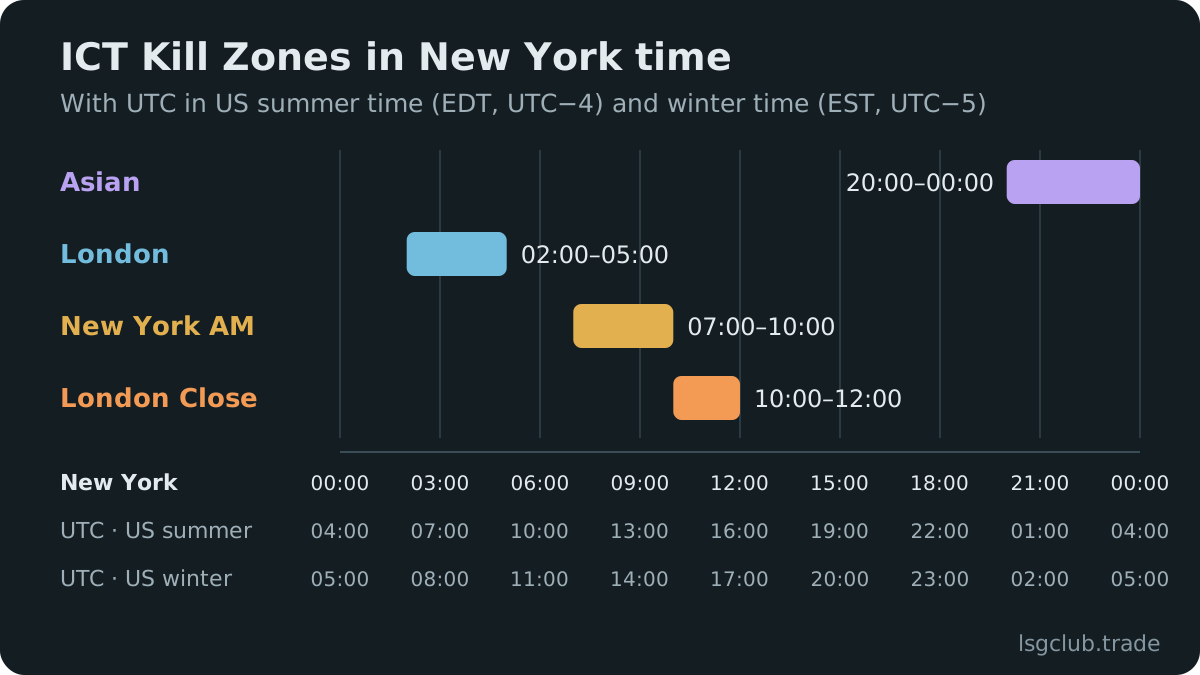
The Kill Zone trading guide explains what typically happens in each window and how to plan around it.
Measure volatility with ATR, not fixed pip numbers
Why ATR beats rules of thumb
Volatility changes over months, and any fixed figure for how many pips a pair moves goes out of date. The average true range (ATR) adapts. Compare today’s range with the 14-day daily ATR: if price has already covered most of its ATR before your Kill Zone, the remaining move to opposing liquidity is often limited, and a fresh entry has less room.
ATR in stops and position size
Use ATR to sanity-check a stop, not to place it. A stop beyond a sweep that is tiny relative to the instrument’s M5 ATR is likely to be hit by noise; a stop far larger than the H1 ATR suggests the entry is too early. The stop distance then sets the lot size, so a wider-ranging instrument means fewer lots for the same risk — see how to calculate position size in forex.
Spread and trading costs relative to your stop
Judge the spread as a percentage of your typical stop, not in pips. A spread that is negligible for a swing trade can eat a meaningful share of a tight M1 entry. Check it at the exact time you trade: spreads usually widen around the daily rollover, in the first minutes after major news and on thin holiday sessions. If the spread regularly takes a noticeable part of your risk, choose a cheaper instrument or a higher entry timeframe.
Correlation: EURUSD, GBPUSD and the DXY
EURUSD and GBPUSD usually move in the same direction because both are quoted against the dollar. The US Dollar Index (DXY), in which the euro is by far the largest component, tends to move opposite to both. Two practical consequences follow:
- Risk — a long on EURUSD and a long on GBPUSD at the same time are largely one bet on a weaker dollar; treat them as one position for risk purposes.
- Confirmation — ICT uses SMT divergence: if EURUSD sweeps a low but GBPUSD or the DXY fails to confirm the move, the sweep is more likely a raid than a real breakdown.
- Bias — the DXY’s own draw on liquidity is a useful cross-check for the daily bias on dollar pairs.
How to choose your ICT pairs step by step
- Write down the Kill Zone you can trade on most days, in one time convention.
- List the instruments active in that window and drop any with a spread that is large relative to your typical stop.
- Pick one primary instrument and mark its liquidity, structure and ATR every day for a few weeks before trading it.
- Trade one setup on that instrument, on demo first, with fixed risk per trade.
- Add a second, less correlated instrument only when the first is routine — for example gold or an index next to EURUSD.
- Review results by instrument every month and keep only what your data supports.
The last step decides it. Filter your journal by instrument and compare results in R, rule adherence and behavior per session; a pair that looks great on paper may not fit your schedule. The weekly trading review process shows how to turn that into a routine.
Correlated pairs are also a tool in themselves: SMT divergence compares EURUSD with GBPUSD, or US500 with NAS100, at the same highs and lows.
FAQ
What is the best forex pair for ICT beginners?
EURUSD is the usual starting point: deep liquidity, typically tight spreads and orderly structure during London and New York. It will not suit everyone — if you can only trade the Asian session, USDJPY may fit better.
How many pairs should an ICT trader focus on?
One or two while learning. Knowing how one instrument behaves around its sessions, news and liquidity is worth more than scanning many charts, and fewer pairs also make correlation risk easier to control.
Is gold good for ICT trading?
Many ICT traders like XAUUSD for its sharp liquidity raids and strong displacement. The same speed means wider spreads, bigger price swings and faster losses if size is wrong, so it suits traders who already follow a setup consistently on a calmer pair.
Can ICT concepts be used on indices and crypto?
Yes, the concepts describe price behavior, so they apply to NAS100, GER40 and crypto too. Indices follow their cash-session opens closely, while crypto trades around the clock and its liquidity varies by exchange, so time-based ICT tools need adapting there.