ICT Daily Bias: How to Determine Market Direction Every Day
A five-step ICT daily bias routine: draw on liquidity, premium and discount, previous day high and low, news, and the level that invalidates it.
ICT daily bias is your answer, written before the session opens, to one question: is today more likely to trade toward the liquidity above or the liquidity below? You find it by reading the higher-timeframe draw on liquidity, where price sits in its dealing range, and how the previous day’s high and low were handled, then defining the price that would prove you wrong. Members who write their daily plan in the LSG Club trading journal follow a routine like the one below, and it takes about fifteen minutes once it becomes habit.
What daily bias means in ICT
Daily bias is not a prediction of the close. It is the expected direction of the day’s main move, which in ICT terms means the expected draw on liquidity. A bullish bias says price is more likely to reach buy-side liquidity above than sell-side liquidity below today. Everything else — which Kill Zone to trade, which setups to take, which to skip — follows from that.
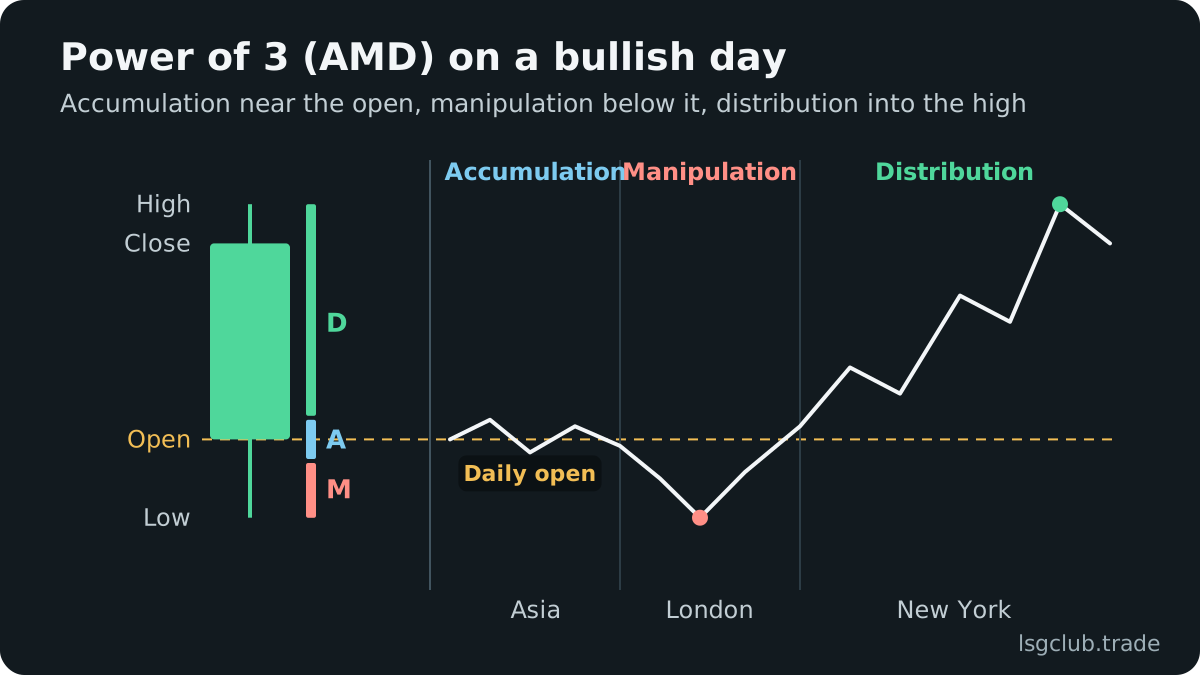
The bias also tells you what to expect early in the day. Under the Power of 3 template, a bullish day often opens, drops first to form its low (the Judas swing), and then expands higher. Knowing the bias in advance lets you treat that early drop as a buying opportunity rather than a reason to sell.
The ICT daily bias routine step by step
Run these steps in order before the London session. Each answer narrows the next.
- Find the higher-timeframe draw on liquidity on the weekly and daily chart.
- Locate price in premium or discount of the current daily dealing range.
- Read how yesterday’s candle treated the previous day high and low.
- Check the economic calendar for high-impact releases.
- Write the bias, the target and the price that invalidates it.
Step 1: Find the higher-timeframe draw on liquidity
Open the daily chart and ask where price is heading on a scale of days. Candidates are an untaken previous week high or low, relative equal highs or lows, or a large unfilled fair value gap. Pick the one price is moving toward and whose path is clear. If the weekly profile already points somewhere, the daily draw should usually agree with it.
Step 2: Locate price in premium or discount
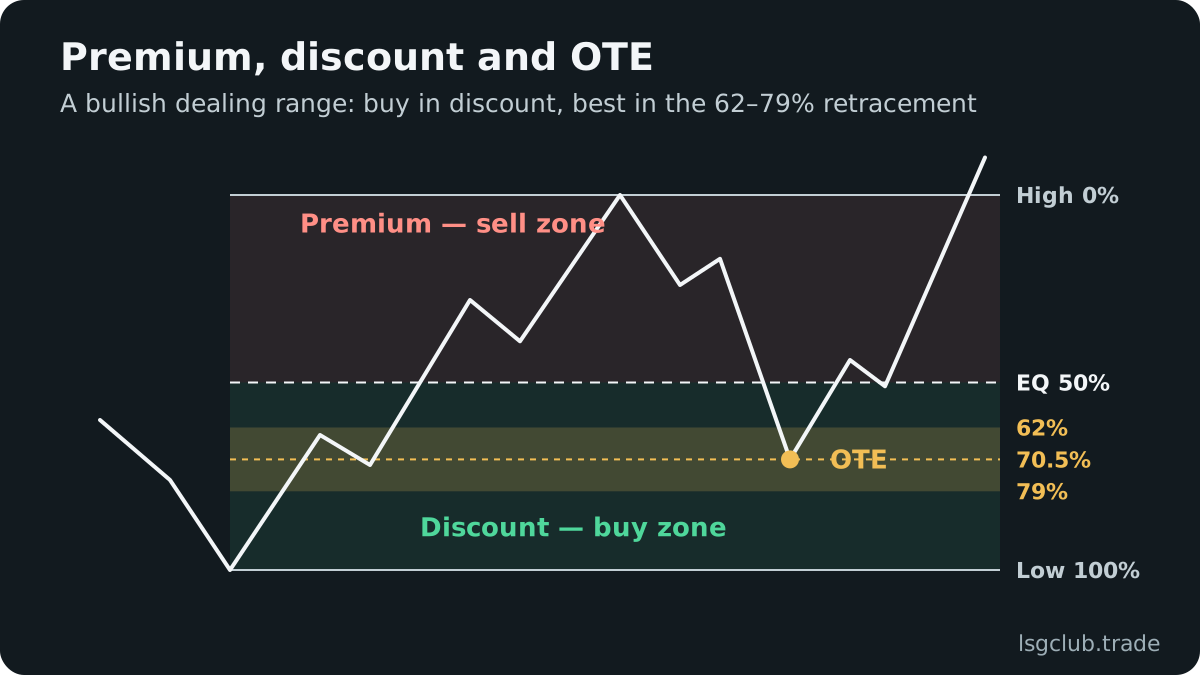
Measure the current daily dealing range from its swing low to its swing high. Above the 50% level (equilibrium) is premium; below it is discount. A bullish bias is stronger when price trades in discount, because buying cheap toward a higher target leaves room for the move. The article on premium and discount trading shows how to pick the range.
Step 3: Read the previous day high and low
Yesterday’s candle often tells you the most. If price ran above the previous day high and closed above it, buy-side was taken with acceptance and continuation higher is plausible. If it ran above the high and closed back below it, that was likely a buy-side raid, and a move down toward the previous day low becomes the expectation. The same logic applies in reverse to the low.
Step 4: Check the calendar
High-impact releases can create the day’s raid or reverse an otherwise clean bias. Note the time of every red-folder event for the currencies you trade. A bias is still valid on a news day, but entries close to the release need a plan, or none at all.
Step 5: Define what invalidates the bias
Write down one price that would prove the bias wrong — usually beyond the swing that the bias depends on. For a bullish bias that could be a daily close below the previous day low, or a market structure shift lower on H1 after the London session. A bias without an invalidation level turns into hope by the afternoon.
Applying the daily bias in the session
ICT uses the New York midnight opening price as a reference for the true day. On a bullish day, he looks to buy below the midnight open; on a bearish day, to sell above it. The idea is that the Judas swing pushes price to the "wrong" side of the open before the real move.
Entries are then taken inside the Kill Zones. ICT defines them in New York time: London 02:00–05:00 and New York AM 07:00–10:00. The LSG journal tags trades with the same New York-time windows, so in UTC they move with US daylight saving (London 06:00–09:00 UTC in summer, 07:00–10:00 in winter). Details for each window are in the Kill Zone trading guide.
- Bullish bias — wait for a sell-side raid below an Asian or early-London low, then a market structure shift up
- Bearish bias — wait for a buy-side raid above an Asian or early-London high, then a market structure shift down
- Target — the draw on liquidity from step 1, or the previous day high or low on the way there
- Stop — beyond the raided extreme, as described in the guide to the ICT liquidity sweep
Example: a bearish daily bias on GBPUSD
This is a hypothetical example for illustration. The weekly chart shows the previous week low untaken below. Yesterday price ran above the previous day high during New York and closed back below it, leaving a long upper wick. Price sits in the premium half of the daily range. Bias: bearish, target the previous week low, invalidation a daily close above yesterday’s wick high.
In the London Kill Zone, price rallies above the midnight open and above the Asian high, then shifts structure lower on M5. The trader sells the retracement into the M5 fair value gap with the stop above the London high. Price reaches the previous day low by New York and the trader takes partial profits there. The bias was never "price will fall today"; it was "a move toward sell-side is more likely, unless price closes above the wick high."
When there is no clear daily bias
Some days do not offer a bias, and recognizing that is part of the skill. Common signs:
- Price sits at equilibrium — no premium or discount edge in either direction
- Inside day — yesterday stayed within the day before, so neither side was tested
- Both previous day extremes were taken — the market already ran both pools
- Major news later in the day — the morning move may be undone in minutes
On those days, either stay out or trade only clean setups at the extremes of the range with reduced size. Skipping a day costs nothing; forcing a direction often does.
Common daily bias mistakes
- Changing the bias on every M5 candle — the bias comes from higher timeframes and should not flip on intraday noise
- Ignoring the invalidation — holding a bias after its level broke because the original analysis felt right
- Confusing bias with entry — a correct bias still needs a raid and a structure shift before an order
- Skipping the journal — without a written bias, you cannot measure how often your read was right
Write the bias, target and invalidation in your daily plan before London opens, then score it after the New York session: right, wrong, or no bias. Over a month that score tells you whether your trades or your analysis need work. The daily routine of an ICT trader shows where this fits into the rest of the day.
FAQ
Which timeframe is best for daily bias?
Use the weekly and daily charts to find the draw on liquidity and the dealing range, and H4 or H1 to refine the levels. Lower timeframes are for entries, not for bias. If the daily chart is unclear, a clear H4 structure can stand in, but treat the bias as weaker.
How long does it take to set a daily bias?
With practice, ten to fifteen minutes before the London session. Most of that time goes into marking the draw and the previous day levels. If it takes much longer, the chart is probably unclear, and that is information too.
What should I do if my daily bias is wrong mid-session?
Once the invalidation level breaks, stop trading in that direction for the day. Do not flip straight to the opposite bias on the same move; wait for a fresh raid and structure shift or step aside. Record the miss in your journal so you can review what you overlooked.
Can the daily bias be bullish while H1 is bearish?
Yes, and that is normal. A bullish day often begins with a bearish H1 leg that forms the low of the day. That leg is the manipulation phase, and the bias tells you to look for the turn rather than to sell it.