15 Non-Negotiable Trading Rules for ICT/SMC Traders
15 checkable rules for ICT/SMC traders: bias, Kill Zones, sweeps, risk limits and reviews, with a worked London session and a way to track compliance.
These 15 non-negotiable trading rules turn an ICT/SMC approach into a process you can repeat on a bad day as well as a good one. Each rule can be checked with a plain yes or no, comes with the reason behind it, and is grouped by when it applies: before the session, at entry, during the trade and after it. Adapt the numbers to your account and your setup, but keep the structure; at LSG Club rules like these live as a pre-trade checklist next to the trades they govern.
What Makes a Rule Non-Negotiable
A rule is a decision made in advance, while you are calm, so you do not have to make it under pressure. It has to be specific enough that someone reading your journal could tell whether you followed it. “Be patient” is not a rule. “No entry until price has swept the Asian high or low” is.
Non-negotiable does not mean permanent. Rules change, but only in a scheduled review and only on the evidence of your own trades. Mid-session, with a position open or a loss fresh in mind, the rules are fixed. That separation is what makes them useful.
Before the Session: Rules 1–4
- Rule 1: Write your daily bias before the open — one sentence with the direction, the draw on liquidity and what would invalidate it. For example: “Bullish toward the previous day high while price holds above Monday’s low.” If you cannot write that sentence, you do not trade the session. The daily bias tutorial walks through the process.
- Rule 2: Mark high-impact news and stand aside — releases such as CPI, NFP and rate decisions can widen spreads and jump through stops. Pick a fixed window, for example 15–30 minutes either side of the release, and open nothing inside it.
- Rule 3: Trade only inside your chosen Kill Zones — ICT defines London as 02:00–05:00 and New York AM as 07:00–10:00 New York time. The LSG journal tags trades with the same New York-time windows, so in UTC they move by an hour with US daylight saving. Pick one convention, and take no new entries outside the windows you trade. More detail in the Kill Zone trading guide.
- Rule 4: Mark your levels before price reaches them — previous day high and low, the Asian range, equal highs and lows, and unfilled higher-timeframe fair value gaps. A setup only counts at a level you marked before the session, not one you discovered while price was moving.
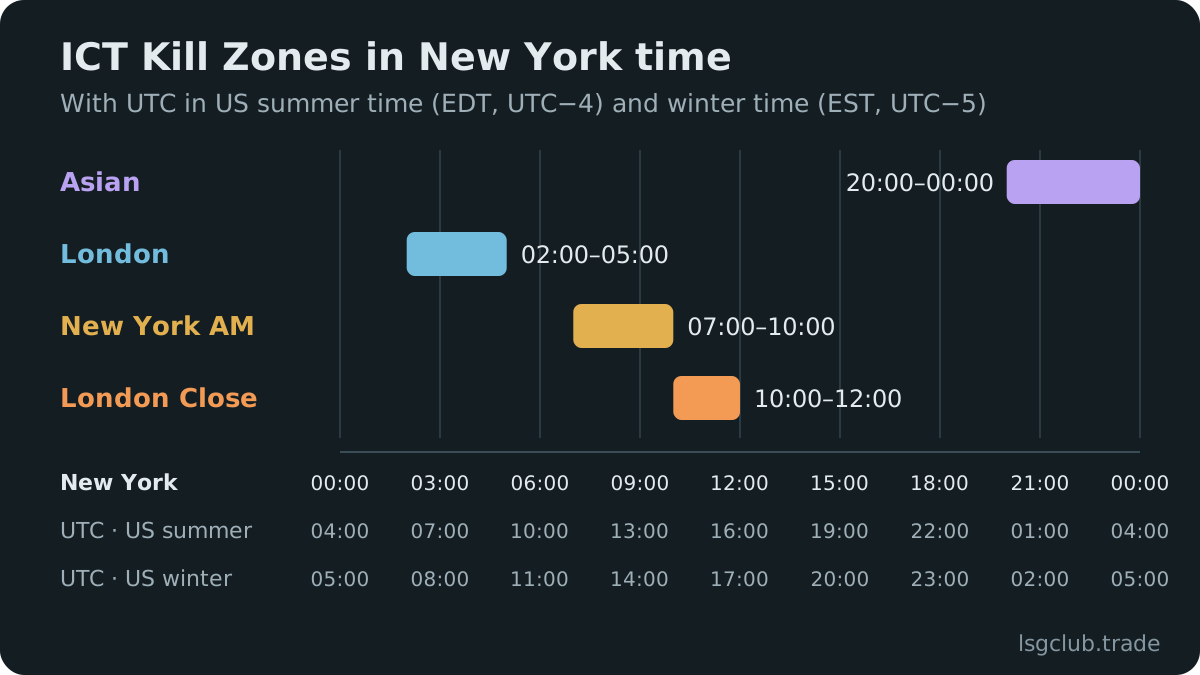
These four rules exist because most impulsive trades start with an unprepared chart. When the bias, the news times, the time window and the levels are written down before the open, the session becomes a matter of waiting for price to come to you.
At Entry: Rules 5–9
- Rule 5: No entry without a liquidity sweep — for a long, price must first trade below a marked low and take the sell-side liquidity resting there; for a short, above a marked high. A level that has not been raided is still a target, not an entry. See how a liquidity sweep works.
- Rule 6: Require a structure shift with displacement — after the sweep, price must break the most recent swing in the opposite direction with a strong, decisive move that leaves a fair value gap behind. A slow drift through the swing does not qualify.
- Rule 7: Buy in discount, sell in premium — measure the dealing range you trade from; longs only below its 50% equilibrium, shorts only above it. Entries in the wrong half of the range give poor risk-reward by construction.
- Rule 8: Set stop and target before the order — the stop goes beyond the sweep extreme, the target at a named liquidity level, and the ratio after costs must meet your written minimum. The article on risk-reward in ICT trading shows how to calculate it.
- Rule 9: Risk a fixed, small percentage — for example 0.5–1% of the account per trade, with position size calculated from the stop distance. Conviction does not change the size; it only changes how you feel about the trade.
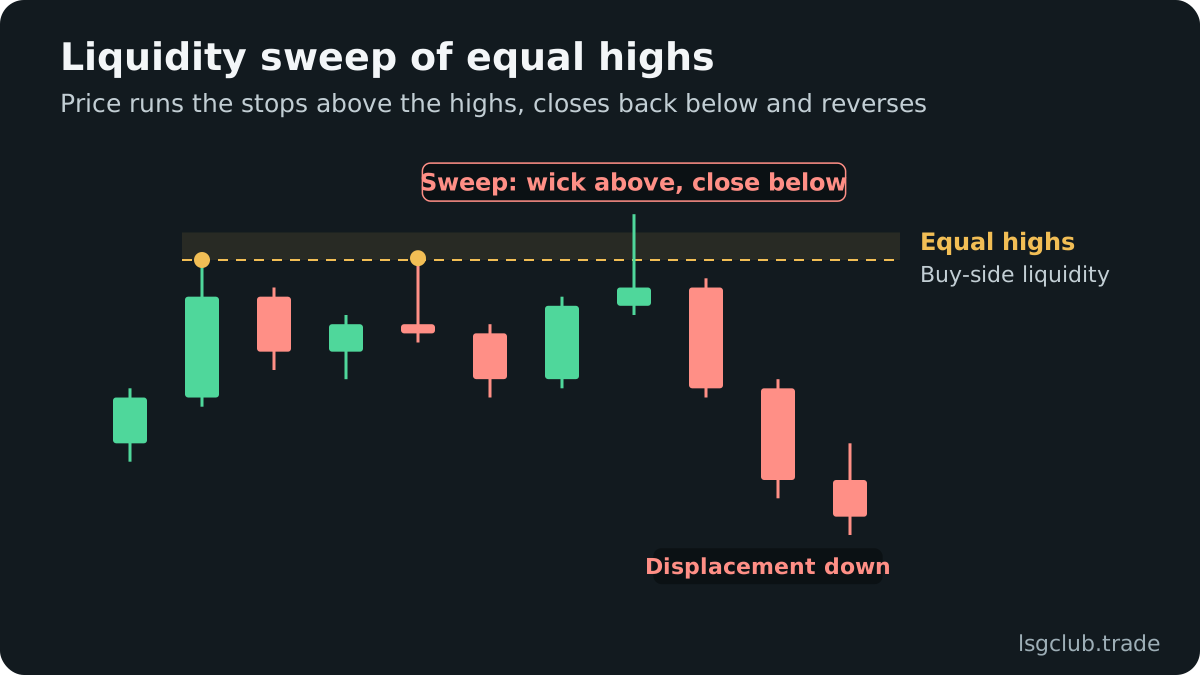
Rules 5 to 7 describe the setup itself: sweep, shift, location. Rules 8 and 9 make sure every trade has a defined loss before it starts. If any of the five is a “no”, the order is not placed, however good the chart looks.
During the Trade: Rules 10–12
- Rule 10: Never widen the stop — a stop can be tightened by a rule you wrote in advance, never moved further away. Widening a stop turns a planned 1R loss into an unplanned one and breaks every number in your journal.
- Rule 11: Manage by the plan, not the P&L — partial closes and break-even moves are decided before entry and written down. Staring at a one-minute chart after entry is how traders talk themselves out of good trades and into bad exits.
- Rule 12: Respect a daily loss limit and a trade cap — for example, stop for the day after a 2% loss or after two losing trades in one session. In a prop challenge, set your personal limit tighter than the firm’s. A typical two-step challenge has a daily loss limit of around 5%, but rules differ and change, so check your firm’s current terms.
The trade cap matters as much as the loss limit. After two losses, the next trade is rarely taken for its own merit; it is taken to win back the money. A hard stop removes that decision entirely.
After the Trade: Rules 13–15
- Rule 13: Log every trade before taking the next one — the chart with entry, stop and target, the setup, which rules were followed and how you felt. Logged later, details blur and losing trades get quietly rationalized.
- Rule 14: Review weekly, and change rules only there — one fixed slot each week to read your trades, check compliance and decide whether any rule needs adjusting. The weekly trade review process gives a structure for it.
- Rule 15: Never rewrite the system during a losing streak — losing streaks are part of any edge. With a 40% win rate, the chance that any given six trades all lose is about 4.7% (0.6 to the power of six), so over a few hundred trades such streaks are expected. Judge the system on a large sample, not on the last week.
A Worked Example: One London Session
Preparation Before the Open
Here is a hypothetical EURUSD session run through the rules. Before the open, the bias reads: “Bullish toward the previous day high; invalid below the previous day low.” The Asian high and low are marked, and the calendar shows no high-impact news inside the London window (rules 1–4).
Sweep, Shift and Entry Zone
During the London Kill Zone, price trades below the Asian low and takes the sell-side liquidity there (rule 5). It then rallies hard through the last M15 swing high and leaves a fair value gap (rule 6). That gap sits below the 50% level of the range from the previous day high to the sweep low, so it is in discount (rule 7). The stop goes a few pips below the sweep low, the target is the previous day high, and the ratio after costs is about 1:3 (rule 8).
Size, Management and Logging
Say the account is $10,000 and the plan risks 1%, so $100. With a 15-pip stop and roughly $10 per pip on a standard lot, the size is about 0.66 lots (rule 9). Price dips back toward entry before moving; the stop stays where it is (rule 10). Whatever the outcome, the trade is logged before anything else happens (rule 13).
The Same Session Without a Structure Shift
Now change one detail: price sweeps the Asian low but never breaks structure. Then there is no trade. Most of the time, the job of these rules is to say no.
How to Track Rule Compliance
Score Every Trade
Give every trade a compliance score: rules followed out of rules that applied. Then split your results into two groups, fully compliant trades and trades where at least one rule was broken, and compare them. If the rule-breaking trades lose money while compliant trades do not, the problem is discipline, not the strategy. If both groups lose, the strategy itself needs work.
Fix the Rule You Break Most
Track which rule breaks most often. Usually one or two rules account for most of the damage, and fixing the worst one is worth more than tightening all fifteen. The rules themselves belong in your written ICT trading plan, next to your setup definition and risk limits.
Common Mistakes With Trading Rules
- Too many rules — a 40-item checklist nobody runs is worse than ten rules you check every time.
- Vague wording — “avoid choppy markets” cannot be checked; “no trade if the Asian range is untouched by the end of the Kill Zone” can.
- Rules that contradict each other — for example, a minimum 1:3 ratio combined with a target that must be the nearest liquidity.
- Exceptions for high conviction — the trade you were sure about still has an uncertain outcome.
- Copying someone else’s numbers — risk limits and session choices should fit your account, schedule and temperament.
- Not recording compliance — without it, you cannot tell a broken strategy from broken discipline.
Quick Daily Checklist
- Bias written with draw on liquidity and invalidation.
- News times marked; stand-aside window set.
- Kill Zone chosen; levels marked before the open.
- Sweep, structure shift and correct zone confirmed before entry.
- Stop, target, ratio and size calculated before the order.
- Daily loss limit and trade cap known; trade logged before the next one.
No set of rules removes the risk of loss; trading always carries it. Rules make that risk defined and your results readable. If you want a place to keep them, create a free journal account and turn this list into a checklist you tick before every trade.
FAQ
How many trading rules should an ICT trader have?
Enough to cover preparation, entry, management and review, and few enough that you can check the ones for a single trade in under a minute. The fifteen here are grouped by phase, so at entry you only run five of them. If your list keeps growing, merge or drop the rules your review shows you never break.
What should I do after breaking a trading rule?
Close or manage the trade by the plan, then log it with the rule you broke. Do not try to make up for it with the next trade. In the weekly review, look at how often that rule breaks and what it costs in R before deciding on a fix.
Do these rules work for a prop firm challenge?
Yes, with one adjustment: set your personal daily loss limit and trade cap tighter than the firm’s, so a normal losing day never comes close to a breach. Firms set and change their own limits, so read your firm’s current terms and write those numbers into rule 12.