ICT Trading Plan Template (With a Filled-In Example)
A blank ICT trading plan template to copy, the same template filled in for one trader — sessions, bias, setup, risk and review — and a rule-change policy that stops you rewriting the plan mid-week.
This page is a working document, not a theory lesson. It gives you a blank ICT trading plan template you can copy line by line, then the same template filled in for one fictional trader so you can see what finished answers look like, and finally a short set of rules for keeping the plan stable once it is written. Print it, paste it into a notebook, or keep it next to your trades in a free ICT trading journal from LSG Club.
If you are looking for the individual rules an ICT trader should follow, they are collected in 15 trading rules for ICT/SMC traders. The hour-by-hour day is covered in the ICT trader daily routine, and the fields you log after each trade are in the ICT trading journal template. This article ties those pieces into one document with blanks to fill in.
What a Trading Plan Template Has to Do
A template is useful only if the finished plan can be checked against real trades. Every blank below is designed to produce an answer that is either a number, a time, a list or a yes/no condition. "Trade with discipline" cannot be checked; "maximum two trades per session" can. When you fill in the template, test each answer by asking: after a trade, could I tell from my journal whether I followed this line? If not, rewrite it.
Three properties separate a usable plan from a wish list:
- Complete — it answers what, when, how much and what next, so nothing is decided in the middle of a session.
- Short — two pages at most. A plan you cannot reread in five minutes before the open will not be reread.
- Versioned — it carries a version number and a date, and every change is logged with a reason, so results can be compared before and after.
The Blank ICT Trading Plan Template
Copy the ten sections below as they are. Fill in each blank with your own value; where you have no answer yet, write "not decided" rather than leaving it empty, because an empty line is the one you will improvise on.
Part A: Header and Scope
- Plan version: ___ · Valid from: ___ · Next scheduled review: ___.
- Account: ___ (personal / prop challenge / funded) · Account currency: ___ · Starting balance: ___.
- Instruments I trade: ___ (no more than three).
- Instruments I never trade: ___ (and why: spread, news exposure, no experience).
- Clock convention for every time in this plan: ___ (New York time or UTC).
Part B: Time and Calendar
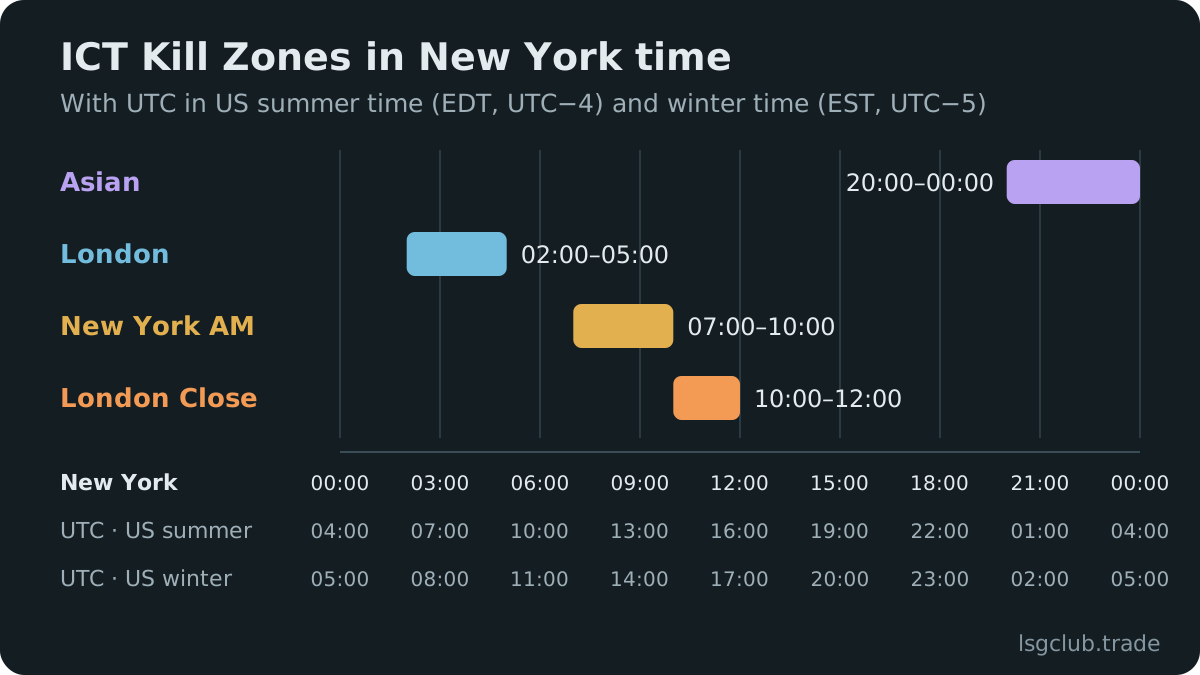
- Sessions I trade: ___ (for example the London or New York AM Kill Zone, with start and end time).
- Trading days: ___ · Days I only review: ___.
- High-impact news rule: no new entries ___ minutes before and ___ minutes after; open trades are ___ (held / closed / stop moved).
- Days off by rule: ___ (for example bank holidays, the day of a central bank decision, the last trading days of the year).
- Maximum screen time per day: ___ hours.
Part C: Bias Process
- Timeframes I read, in order: ___ → ___ → ___.
- Question I answer on the highest timeframe: ___ (for example, which liquidity is the draw this week).
- Question I answer on the middle timeframe: ___ (for example, which side of yesterday’s range was taken).
- Question I answer on the lowest bias timeframe: ___ (for example, premium or discount of the current dealing range).
- Bias sentence written by: ___ (time) · Format: direction, target, invalidation.
- No-bias rule: if I cannot write the sentence, I ___ (observe only / trade half size / skip the day).
Part D: Setup Definition
- Setup name (one setup per plan version): ___.
- Required context: ___ (bias, session, location).
- Trigger sequence on the chart, step by step: 1 ___ · 2 ___ · 3 ___.
- Entry: order type ___ · entry level ___.
- Stop: placed at ___ · maximum stop distance ___.
- Target: ___ · minimum risk-reward after costs: 1:___.
- The setup is invalid if: ___.
Part E: Risk Limits
- Max risk per trade: ___ % of balance (position size comes from the stop distance).
- Max trades per session: ___ · per day: ___.
- Daily stop: ___ losses or ___ %, whichever comes first.
- Weekly stop: ___ % · what I do for the rest of the week: ___.
- Max positions open at once: ___ · correlated instruments counted as one: yes / no.
- Prop or broker limits I must stay inside: daily ___ %, overall ___ %, other ___.
Part F: Trade Management
- After entry I may: ___ (nothing / take a partial at ___ / move the stop at ___).
- Time stop: close the trade if ___ (for example, not in profit by the end of the session).
- Weekend and overnight rule: ___.
- Things I never do with an open trade: ___ (widen the stop, add to a loser, re-enter an invalidated idea).
Part G: Routine Anchors
- Preparation starts at ___ and takes ___ minutes.
- Charts are closed by ___ whatever happens.
- Personal stop conditions (no trading that day): ___ (tired, ill, upset, rushed, after ___).
Part H: Journal and Review
- Each trade is logged within ___ minutes of closing, with fields: ___.
- Each trade is scored for plan compliance: ___ (yes / no per section, or a 0–5 score).
- Daily review: ___ minutes, at ___.
- Weekly review: day ___, questions ___.
- Monthly statistics: expectancy in R, win rate, average winner and loser, max drawdown, compliance rate.
Part I: Rule-Change Policy
- Rules may change only on: ___ (a fixed day, for example Saturday or Sunday).
- A rule may change only after at least ___ trades under the current version.
- Every change is written in the change log with: date, old rule, new rule, reason, the journal data behind it.
- One change per review at most · a change takes effect from: ___ (the next trading week).
- Emergency exception: only to reduce risk, never to increase it.
Part J: Signature Line
End the template with one sentence you sign and date: "I trade this plan as written until the next scheduled review." It sounds formal, and that is the point — it turns the plan from notes into a commitment you can be measured against.
A Filled-In ICT Trading Plan Example
Below is the same template completed for a fictional trader, Dana. Dana has a full-time job in Central Europe, a $10,000 personal account and about two hours free every morning. Every value is an illustration of a coherent plan, not a recommendation; your numbers should come from your own account, schedule and journal.
Dana’s Scope and Calendar
- Plan version 3 · valid from 5 October · next scheduled review Saturday 31 October.
- Account: personal, USD, starting balance $10,000.
- Instruments: EURUSD and GBPUSD. Never traded: XAUUSD and indices (wider stops than the account size allows at her risk level).
- Clock: New York time for every time in the plan, because ICT and the journal both define the Kill Zones in New York time, so the plan never changes; after each clock change she checks her local hours in the Kill Zone time converter.
- Session: London Kill Zone, 02:00–05:00 New York time (06:00–09:00 UTC in US summer, 07:00–10:00 in winter). Trading days Monday to Thursday; Friday is review only.
- News: no new entries from 30 minutes before to 30 minutes after a high-impact release for EUR, GBP or USD; an open trade keeps its stop and target.
- Days off by rule: the day of an ECB or BoE rate decision, and 24 December to 2 January.
- Screen time: no more than two hours, 01:30–03:30 New York time on most days.
Dana’s Bias Process
- Weekly → daily → H4, in that order, every trading morning from 01:30 New York time.
- Weekly: which side of last week’s range is the likely draw on liquidity.
- Daily: whether yesterday’s high or low was taken, and which remains as the target.
- H4: whether price sits in premium or discount of the current dealing range.
- Bias sentence written by 01:50 New York time, for example: “Bullish toward yesterday’s high while price holds above the Asian low; invalid below the H4 swing low at 1.0820.”
- No-bias rule: if the weekly and daily answers disagree, Dana observes only and logs the day as “no bias”.
How to read each timeframe is a topic of its own; Dana’s method follows the ICT daily bias tutorial. What matters for the plan is that the order and the questions are fixed, so the bias comes out the same way on a calm day and on a stressful one.
Dana’s One Setup
- Name: London sweep and shift.
- Context: a written bias, inside 02:00–05:00 New York time, at least one Asian range extreme still untouched.
- Trigger: 1 · price sweeps the Asian high or low against the bias. 2 · on M5, price breaks the last swing in the bias direction with a displacement candle. 3 · that leg leaves a fair value gap.
- Entry: limit order at the near edge of the fair value gap, placed only if the gap sits in discount for a long or premium for a short.
- Stop: 2 pips beyond the sweep extreme. Maximum stop distance 20 pips; a wider stop means no trade.
- Target: the opposing Asian range extreme or the liquidity named in the bias sentence, whichever is nearer. Minimum 1:2 after spread and commission.
- Invalid if: the sweep happens before 02:00 New York time, the shift has no displacement, the order is not filled by 04:30 New York time, or price closes beyond the stop level on M5 before the fill.
The criteria for a genuine structure shift are explained in market structure shift entry rules, and the entry array itself in the fair value gap trading strategy. Dana’s plan does not repeat that theory; it only states which version of it she trades.
Dana’s Risk Limits
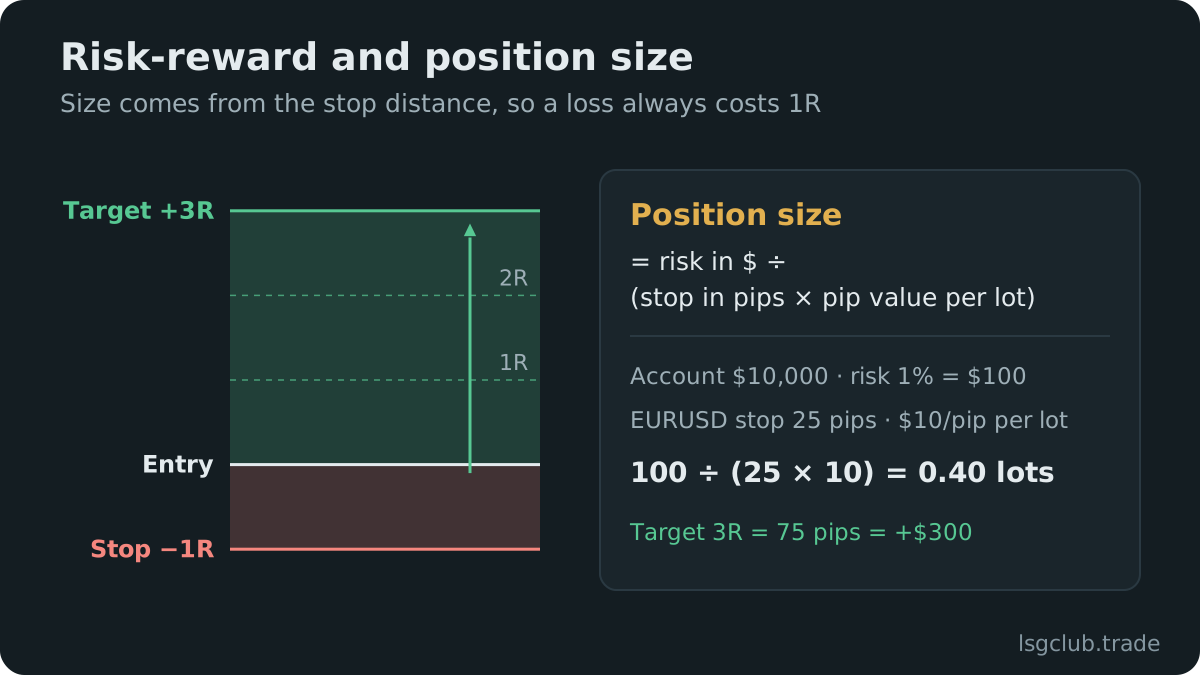
- Risk per trade: 0.75 % of the current balance, so $75 at $10,000.
- Position size from the stop: with a 15-pip stop on EURUSD, where one standard lot is worth about $10 per pip, the size is $75 ÷ (15 × $10) = 0.5 lots.
- Max two trades per session, two per day.
- Daily stop: 2 losses or 1.5 %, whichever comes first.
- Weekly stop: 3 % — after it, the rest of the week is chart study and review, no live trades.
- One position open at a time; EURUSD and GBPUSD are treated as one exposure, so no second trade while the first is open.
For other instruments and account currencies, the method is in how to calculate position size, and the free position size calculator does the arithmetic before the order goes in.
Dana’s Management, Routine and Review
- Management: no partials and no break-even move in version 3 — the trade reaches the stop or the target. Time stop: close at 05:00 New York time if the trade is open and not at least 1R in profit.
- Never: widen the stop, add to a losing position, re-enter the same idea after it was invalidated, hold through the weekend.
- Routine anchors: preparation 01:30–01:50 New York time, charts closed at 05:00 New York time. No trading after fewer than six hours of sleep or after an argument that morning.
- Journal: each trade logged within 15 minutes, with before and after screenshots, the bias sentence, setup steps ticked and a compliance score for each plan section.
- Reviews: 10 minutes daily at 05:15 New York time; weekly review on Saturday morning; monthly statistics on the first Saturday of the month.
- Rule changes: Saturdays only, after at least 30 trades under the current version, one change per review, logged with the reason.
Keeping the Plan Stable
The most common way a good plan fails is not that it is wrong, but that it keeps changing. After two losses on Tuesday the stop becomes "a little wider", on Wednesday a second setup appears, and by Friday nobody — including the trader — knows which rules produced the week’s result. A rule-change policy exists to stop exactly that.
Change Rules Only on a Fixed Day
Choose one day outside your trading days, typically Saturday or Sunday, and make it the only day the plan can be edited. During the week the plan is read-only. If an idea for a change appears on Tuesday, write it in a "proposals" list at the bottom of the plan and leave it there until the weekend. Most proposals written in the heat of a session look different two days later; the ones that still make sense on Saturday are worth discussing.
Wait for a Minimum Sample
A rule judged on five trades is judged on noise. Even a setup with a positive expectancy can lose four or five times in a row, and the win rate vs risk-reward relationship explains why short streaks say little. Set a minimum, such as 20–30 trades under the current version, before any rule about the setup, the stop or the target may change. Risk limits are the exception, and only in one direction: you may always reduce risk early, never raise it early.
Write Every Change Down With Its Reason
Keep a change log at the end of the plan. Each entry is one line:
- Date and new version number — for example "31 October, version 4".
- Old rule and new rule — quoted exactly, so the difference is unambiguous.
- Reason — what the journal showed, with the numbers: "time stop at 08:00 cut 6 of 34 trades, average result of those 6 was −0.4R".
- What would make you reverse it — the result after the next sample that would send you back to the old rule.
This log is what makes a plan improvable. Without it, you cannot compare version 3 with version 4, because you do not remember which trades were taken under which rules. With it, the weekly process described in how to do a weekly trade review has something concrete to test.
The Plan as Protection From Yourself
The deeper purpose of a stable plan is that it protects you on the days your judgement is worst: after a loss, after a missed move, when you are tired. On those days you do not have to decide anything; you only have to check whether the plan allows the trade. Many of the errors listed in common mistakes ICT traders make — revenge entries, moved stops, extra setups — are rule changes made mid-week without anyone calling them that.
How to Fill In the Template in One Evening
- Start from constraints, not from charts — write Part A and Part B first, from your schedule, account and the hours you are actually free.
- Pull the setup from your journal — if you already trade, describe the setup that has the most logged trades, not the one you would like to trade.
- Set risk limits from the worst case — ask what a run of eight losses would do to the account at your chosen risk per trade, and lower the number until the answer is acceptable.
- Leave management simple in version 1 — no partials and no break-even rules until the journal shows a reason for them.
- Write the rule-change policy before the first trade — it is far easier to agree to it while nothing is at stake.
- Read the whole plan aloud once — any line you would hesitate to follow tomorrow morning needs rewording now.
If you want ready-made columns for the journal side of the plan, the free trading journal template downloads as a CSV you can open in a spreadsheet or import into a journal.
A plan does not remove the risk of loss; trading always carries it. What it does is make every decision traceable, so the journal can tell you which part of the plan works and which part needs changing. If you want plan and journal in one place, open a free journal account.
FAQ
What is the difference between an ICT trading plan template and a trading journal template?
The plan template is written once per version and says what you will do: instruments, sessions, setup, risk and the rule-change policy. The journal template is filled in after every trade and records what you actually did. You need both, and the journal fields should mirror the plan sections so each trade can be scored against the plan.
How long should a filled-in trading plan be?
One to two pages. The example in this article fits on about one and a half. If yours runs longer, it usually contains theory that belongs in separate notes; keep only the decisions and link to the explanations.
How many trades do I need before changing a rule?
There is no universal number, but fewer than 20 trades under the same rules rarely tells you much. Many traders use 20–30 for a setup rule and a full month for a routine rule. The exception is risk: you can lower it at any time, but raising it should wait for the scheduled review.
Should a prop challenge have its own trading plan?
Usually the same plan with a different Part E. Copy the firm’s daily and overall loss limits from its current terms and set your own, tighter limits inside them. Firms’ rules differ and change over time, so check them before each new challenge.