The Complete Daily Routine of an ICT Forex Trader
A session-by-session ICT routine: pre-market bias and levels, Kill Zones in New York time and UTC, news checks, execution rules and the post-session journal.
The daily routine of an ICT forex trader is built around time: prepare before the session, trade only inside one chosen Kill Zone, and journal the result before the day ends. Done the same way every day, it turns ICT concepts into a repeatable process and keeps impulsive trades out of the hours you are not prepared for. Below is a session-by-session routine, with times in New York and UTC, that you can adapt and track in LSG Club’s free trading journal.
Why an ICT trader needs a fixed daily routine
ICT trading is time-based. Liquidity is taken and real moves start at predictable parts of the day, so a trader who sits at the screen whenever it is convenient ends up trading the quiet hours where setups are weakest. A routine also separates analysis from execution: the bias is formed before the session, when you are calm, and the session is only for waiting for price to confirm it.
A routine does not have to be long. For most traders it is a short prep block, one trading window and a short review. What matters is that the steps are the same every day, so the journal can show which step fails when results slip.
Kill Zone times: New York and UTC
ICT defines the Kill Zones in New York local time, and the LSG Club journal uses the same New York-time windows, so in UTC they shift by an hour when US daylight saving time starts or ends. Know which clock your tools use before you plan the day.
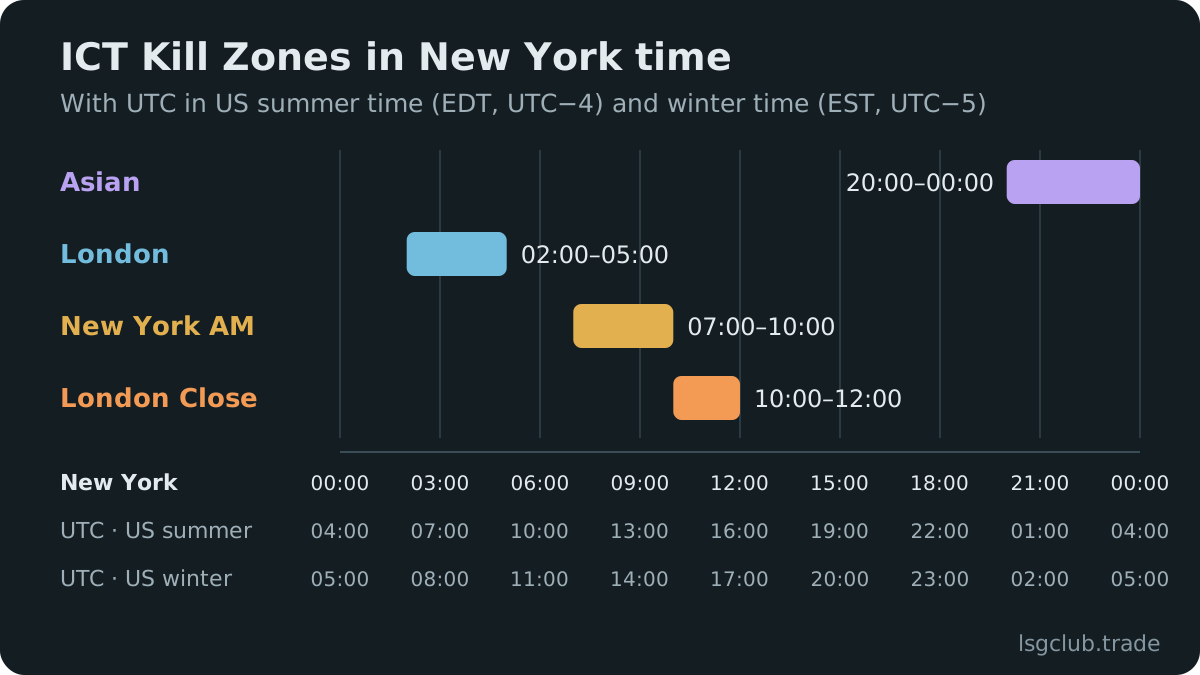
- Asian Kill Zone — 20:00–00:00 New York time (00:00–04:00 UTC in summer, 01:00–05:00 in winter). Often builds the range whose highs and lows become the next session’s liquidity.
- London Kill Zone — 02:00–05:00 New York time (06:00–09:00 UTC in summer, 07:00–10:00 in winter). Frequently produces the Judas swing that raids one side of the Asian range.
- New York AM Kill Zone — 07:00–10:00 New York time (11:00–14:00 UTC in summer, 12:00–15:00 in winter). Overlaps with 08:30 US data releases and the 09:30 equity open.
Pick one Kill Zone as your main window, or two at most. Trying to trade all three means trading tired and spreading your sample across different market behaviors. Our Kill Zone trading guide explains what typically happens in each window.
Pre-market preparation
Start 30–60 minutes before your Kill Zone. The goal is to arrive at the session with a written plan: bias, levels, scenario and the conditions that cancel it.
Daily bias and draw on liquidity
Work top-down. On the daily and H4 charts, ask where price is most likely to go next: the draw on liquidity. That is usually an old high (buy-side liquidity), an old low (sell-side liquidity) or an unfilled fair value gap. Note whether price is trading in premium or discount of the current dealing range, measured from its 50% equilibrium. The ICT daily bias tutorial walks through this step in detail.
Mark the key levels
- Previous day high and low — the most common liquidity targets and raid points.
- Asian range high and low — the levels a London Judas swing often sweeps first.
- New York midnight opening price — a reference for premium and discount within the day.
- H1 and H4 fair value gaps and order blocks in the direction of your bias — where you expect to enter.
- Equal highs or equal lows nearby — obvious resting liquidity that price may run before reversing.
News check
Check the economic calendar for high-impact releases on the currencies you trade. Key US data such as CPI and Nonfarm Payrolls is typically released at 08:30 New York time, and FOMC statements at 14:00 New York time. Decide in advance: no new entries in the minutes around the release, and no holding a tight stop through it. On FOMC days many ICT traders simply skip the session.
Execution inside the Kill Zone
During the window your job is to wait for the market to confirm the plan, not to find a reason to trade. A typical ICT sequence looks like this:
- Wait for a raid on the liquidity you marked — for a long, a sweep of a low such as the Asian low or previous day low.
- Look for a market structure shift on a lower timeframe (M5–M15): a displacement candle that breaks the most recent short-term high.
- Mark the fair value gap or order block that the displacement left behind, ideally in discount for a long or premium for a short.
- Enter on the return into that zone, with the stop beyond the swing that took the liquidity.
- Size the position from the stop distance and your fixed risk percentage, then set the target at the draw on liquidity.
- If the window ends without a valid setup, stop. No trade is a valid outcome of the routine.
Set hard limits before the session starts: a maximum number of trades (often one or two) and a daily loss at which you close the platform. The Power of 3 model is useful context here: the manipulation phase is the sweep you wait for, and the distribution phase is the move you want to be in.
Post-session journal routine
Journal within an hour of the session ending, while you still remember why you did what you did. Skipped trades and no-trade days get an entry too, because they show whether your filters work.
- Log each trade with entry, stop, target, result in R and the Kill Zone it was taken in.
- Attach the chart and mark the sweep, the structure shift and the entry zone.
- Compare the trade to your morning plan: was it the scenario you wrote, plan B or something unplanned?
- Note one emotion or state that influenced you, such as hesitation, FOMO or boredom.
- Write one sentence on what to repeat or change tomorrow.
This takes ten to fifteen minutes. It is also the raw material for the weekly trading review, where patterns across many days become visible.
Weekly preparation
Once a week, usually on the weekend, step back from the daily chart. Mark the weekly high and low and the higher-timeframe draw on liquidity, list the week’s high-impact events, and think about the likely weekly profile: whether the high or low of the week may form early, midweek or around a major release. The guide to the ICT weekly profile covers those templates. Finish by reviewing the previous week’s trades and setting the one rule you will focus on.
Example daily routine for a New York session trader
This is an example schedule in New York time; shift it to your own time zone and to the Kill Zone you trade.
- 06:00 — Read the overnight Asian and London price action; note which liquidity has already been taken.
- 06:15 — Daily bias, levels and news check; write the plan with one scenario, a plan B and the invalidation.
- 07:00–10:00 — New York AM Kill Zone: execution only, no new analysis; no entries in the minutes around an 08:30 release.
- 10:00 — Close the platform if no trade is open; manage any open position by the plan.
- 10:30 — Journal the session and set one note for tomorrow.
A London trader follows the same structure with prep before 02:00 New York time, which falls in the morning in Europe. The detailed ICT trading plan template shows how to write the rules this routine executes.
Tools that support the routine
The LSG Club journal is built for this workflow and is free for every club member: daily and trading plans, pre-trade checklists, a setup playbook, every trade on a real chart with its stop and target, and a behaviour report that shows which sessions, holding times and trade-of-the-day numbers cost money. The Telegram bot @lsgclubbot sends a morning brief, Kill Zone and news alerts, today’s P&L against your limits and a weekly report. As a separate club contribution, the club’s AI also publishes an ICT-style session plan before the Asian, London and New York sessions, with bias, scenario, plan B and invalidation. It is analysis, not financial advice, and any plan can fail. You can explore the journal with sample data in the demo.
FAQ
What time do ICT traders trade?
Most ICT traders focus on the London Kill Zone (02:00–05:00 New York time) or the New York AM Kill Zone (07:00–10:00 New York time). Many trade only one of them. Outside those windows they prepare, manage open trades or stay flat.
How long should pre-market preparation take?
Around 30–60 minutes is enough once the routine is familiar. If it takes much longer, the analysis is probably too complicated. A good test is whether you can write the plan in four lines: bias, key level, scenario and invalidation.
Should I trade on high-impact news days?
You can, but decide your rule in advance. Common choices are to wait until the release has passed and a fresh structure forms, or to skip days like FOMC entirely. Spreads widen and price can sweep both sides around big releases, which makes tight stops unreliable.
What if no setup appears in the Kill Zone?
Then the routine worked. Log the day as no trade, note what was missing, and close the platform. Forcing a trade after the window is one of the most common ways disciplined plans fall apart.