Forex Trading Psychology: Mastering Emotions in Trading
Control trading emotions with pre-set limits, a pre-trade checklist and a psychology journal that shows what each emotional pattern costs you in R.
Good forex trading psychology does not mean you never feel fear, greed or frustration while you trade; you will feel them, and that is normal. What you can do is stop those feelings from making the decisions: fix your risk and limits in advance, put a checklist between the impulse and the entry, and use a journal to measure which emotional patterns cost you money. This article, written for the LSG Club trader community, walks through each step with examples you can copy into your own routine.
What Emotional Trading Looks Like in Your Data
Emotions are hard to observe in the moment but easy to spot afterwards, because each one leaves a recognisable trace in your trades. Once you know the traces, your journal becomes a mirror.
- FOMO — entries taken after the displacement has already run, far from the fair value gap or order block you planned to use, usually with a wider stop and a worse reward-to-risk.
- Revenge trading — a new trade within minutes of a loss, often larger, often on a pair or in a session outside your plan.
- Fear of giving back profit — winners closed well before target, or the stop moved to break-even before price has left the entry zone, so normal pullbacks take you out.
- Hope — the stop moved further away, or removed, once the trade goes against you. One such trade can erase several winners.
- Overconfidence — position size creeping up after a winning streak, or trades taken outside your window because the market "feels easy".
- Boredom — trades in the middle of a range, between sessions, with no liquidity taken and no structure shift.
- Hesitation — valid setups skipped after a few losses, then chased later at a worse price.
Notice that every pattern ends in something measurable: entry location, stop distance, time since the last loss, size, exit before target. That is what makes psychology workable. You cannot measure a feeling directly, but you can measure what it did to the trade.
Why Decisions Made in Advance Hold Up Better
The problem is rarely that you do not know your rules. It is that you are asked to apply them at the worst moment: a position open, money moving, a recent loss on your mind. The fix is to move the decisions to a calm moment. Size, limits and entry conditions decided the evening before are not up for negotiation during the session.
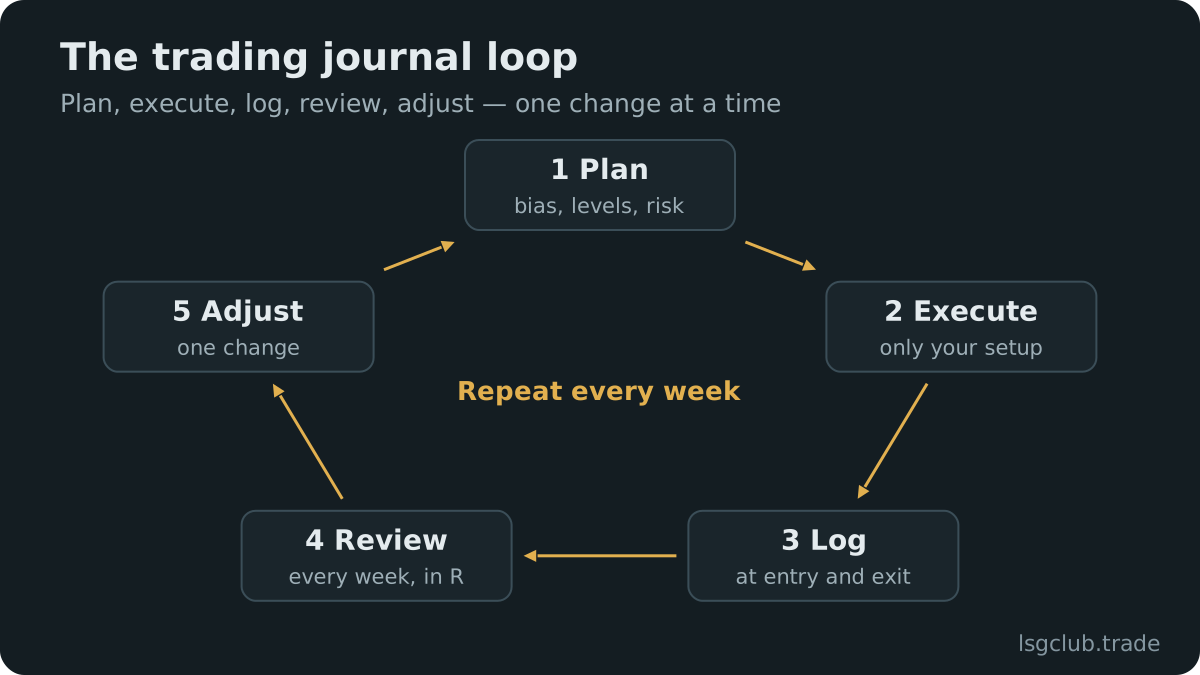
This is why the most useful psychology tools in trading are boring: a fixed risk per trade, a daily loss limit, a maximum number of trades, a window of hours and a checklist. Each one removes a decision from the emotional moment. Write them into your ICT trading plan so they exist on paper, not only in your head.
Set Your Pre-Commitments
Here is a concrete set you can adapt. The numbers are an example, not a recommendation for your account; choose values you can follow on your worst day, not your best.
- Risk per trade — a fixed 0.5–1% of the account. Example: on a $10,000 account at 1%, every trade risks $100, and the position size comes from the stop distance, not from how confident you feel.
- Daily loss limit — for example −2% or two losing trades, whichever comes first. When it is hit, the platform closes for the day.
- Maximum trades per session — for example two. A third attempt in the same session is where revenge entries tend to live.
- Trading window — only inside the Kill Zones you chose. ICT defines London as 02:00–05:00 and New York AM as 07:00–10:00 New York time; pick one convention and keep it.
- Weekly circuit breaker — for example, after a 4% drawdown within a week, finish the week on demo and do a full review.
Position sizing should be mechanical: risk in dollars divided by the stop’s value per lot. If you still size by feel, the position size guide shows the formula with worked numbers.
The Pre-Trade Checklist
A checklist works because it puts a pause between the urge and the click, and because it makes broken rules visible. Keep it short enough to complete in under a minute. A typical ICT checklist looks like this:
- Daily bias and the draw on liquidity were written down before the session
- Price is in discount for longs or premium for shorts, relative to the current dealing range
- Liquidity was taken: sell-side below a low for longs, buy-side above a high for shorts
- A market structure shift with displacement followed the sweep
- Entry is at the planned fair value gap, order block or OTE level, not at market after the move
- The stop sits beyond the swing that made the sweep, and the target meets your minimum reward-to-risk
- The time is inside your Kill Zone and no high-impact news is due within your buffer
- You are within your daily loss limit and trade count
If any line is a no, there is no trade. If you take it anyway, log it as a broken rule. Both outcomes give you data. For a complete rule set, see the non-negotiable rules for ICT traders.
What to Write in a Forex Trading Psychology Journal
Psychology notes only help if they are short, consistent and written at the time. Four moments are enough.
Four Moments to Record
- Before the session — hours of sleep, a 1–5 rating of how calm and focused you feel, and anything unusual: a bad night, an argument, money pressure.
- Before each trade — one sentence on why, and whether the checklist passed in full.
- After each trade — plan followed yes or no, the strongest emotion you felt, and what you did with it.
- End of day — one thing you did well and one thing to do differently tomorrow.
Tags Instead of Free Text
Use a fixed set of tags for emotions and mistakes instead of free text, for example fomo, revenge, moved-stop, early-exit and outside-window. Tags can be counted and filtered; long paragraphs cannot.
Turn Notes Into Numbers
After a few weeks you can measure what your emotions cost. Split your trades into two groups, those that passed the checklist and those tagged with a broken rule, and compare the total and average result in R.
Example: Plan Trades vs Broken-Rule Trades
Over 40 trades, 31 followed the plan and made +6.2R in total, while 9 broke a rule and lost −7.5R. The broken-rule trades did not just underperform; they turned a positive month into a negative one. Seeing that in your own numbers persuades far more than any advice.
Patterns to Check Next
Then look for patterns: the result of the next trade after a loss, results by your pre-session rating, by time of day and by holding time. Treat small groups with caution; ten trades can point at a pattern but cannot prove it. Review these numbers weekly, as described in the weekly trading review process, and work on one behaviour at a time.
A Reset Protocol After a Bad Day
Bad days happen in every strategy, and trading always carries the risk of loss. What matters is that one bad day does not become a bad week. Agree on the reset in advance:
- Stop at the limit — close the platform when the daily limit is hit, even if a "perfect" setup appears ten minutes later.
- Review before the next session — open every trade from the bad day on the chart and label each one as a valid loss or a broken rule.
- Reduce size after a streak — for example, halve the risk per trade after three consecutive losses, and return to normal after two trades taken fully by plan.
- Change one thing — if the review finds a rule problem, change one rule and note the date. Do not rebuild the system after a single day.
Common Mistakes
- Relying on willpower — if the only thing between you and a revenge trade is resolve, the trade will happen sooner or later. Use limits and a checklist.
- Journaling only the losses — you need the good trades too, to see what following the plan looks like.
- Rating emotions days later — memory rewrites feelings to fit the result. Rate before the trade and right after it.
- Treating a valid loss as a mistake — a trade that followed every rule and lost is not a psychological failure; it is the cost of the strategy.
- Raising risk to win it back — this is revenge trading with extra steps.
The article on mistakes ICT traders make in their first year covers more of these with fixes, and trading journal habits that build consistency helps you keep the routine going once the first motivation fades.
FAQ
How do I stop revenge trading?
Take the decision away from the moment after a loss. A daily loss limit, a maximum number of trades per session and a fixed pause after every losing trade do more than resolve. Tag the first trade after each loss in your journal so you can see whether those trades really perform worse.
Can a trading journal improve my trading psychology?
It will not change what you feel, but it shows what those feelings cost. Once broken-rule trades and their result in R sit next to the trades that followed the plan, the case for discipline comes from your own numbers. That is usually more persuasive than any rule you read.
How long before a psychology journal shows useful patterns?
A few weeks of consistent notes is usually enough to see the first hints, such as weaker results after a loss or on low-rated days. Treat a pattern built on ten or fifteen trades as a question to watch, not a conclusion, and confirm it with more data before changing your rules.
Should I keep trading after a big loss?
Not in the same session if the loss hit your daily limit; that is what the limit is for. Review the trade on the chart first and decide whether it was a valid loss or a broken rule. A valid loss needs no change; a broken rule needs one specific fix before the next session.