Trading Journal Habits: How Consistency Builds Edge Over Time
When to log, the minimum fields, a weekly review rhythm and habit triggers that keep a trading journal going long enough to reveal your edge.
Good trading journal habits are small, fixed routines: a one-line plan before the entry, the core fields within minutes of the close, and one review a week. Kept together in the LSG Club trading journal or anywhere else, they turn scattered trades into a dataset you can actually judge your edge on. This guide covers when to log, the minimum fields, the weekly rhythm, the triggers that make it automatic and what to do after you miss a day.
The habit matters more than the template. A perfect template filled for ten days and then abandoned tells you nothing, while a short template filled for every trade over three months tells you which setups, sessions and behaviors pay you and which ones cost you.
Why trading journal habits decide whether you find an edge
An edge is a statistical property of a repeated behavior. You cannot see it in one trade, or in a week of trades with three different setups mixed together. You see it only when the same setup is logged the same way, under the same conditions, often enough that a pattern survives the noise.
That is why consistency beats depth. Twenty trades with bias, setup, Kill Zone and R recorded every time can answer a real question, such as whether your London entries outperform your New York entries. Twenty trades where half the fields are missing cannot. The habit is the thing that produces comparable data.
There is a second payoff. Writing the plan before the entry slows you down at exactly the moment impulsive trades happen. That pause is often the first place a journal pays off, before any statistics exist. The effect is covered in more depth in our piece on using a journal to manage trading psychology.
When to log: three moments in every trading day
Most journaling fails because it is left for "later", and later becomes the weekend, when memory has already rewritten the trade. Tie logging to three fixed moments instead.
Before the entry
Write one line before you click: the daily bias, the draw on liquidity you expect price to reach, the setup and where the stop goes. For example: "Bullish bias, draw on the previous day high, sell-side swept in London, entry in the M5 fair value gap, stop below the sweep low." If you cannot write that line, you do not have a trade yet.
Within minutes of the close
Fill the result fields while the trade is still fresh: exit reason, result in R, whether you followed the plan and one honest sentence about how you felt. Waiting until the evening invites rationalizing a rushed exit as "risk management".
At the end of the session
Close the day with a short summary: trades taken, rules kept or broken, and one observation about the market. On days with no trades, log that too, with the reason. A no-trade day where you waited correctly for a setup that never came is a disciplined day and belongs in the record.
The minimum fields that keep the habit alive
Long templates kill habits. Start with a minimum set you can complete in two or three minutes per trade, and add fields only when a specific question needs them. A fuller ICT layout is described in our ICT trading journal template; this is the floor, not the ceiling.
- Instrument and direction — for example, XAUUSD long.
- Daily bias and draw on liquidity — the higher-timeframe story the trade belongs to.
- Setup name — one label from a fixed list, such as "London sweep + FVG" or "OTE pullback".
- Kill Zone or session — London, New York or outside a Kill Zone; state which time convention you use.
- Entry, stop and target — enough to calculate planned risk-reward.
- Result in R — profit or loss divided by the initial risk.
- Plan followed — yes or no, with the rule broken if no.
- One screenshot — the entry timeframe with the stop and target marked.
Use the same labels every time. "FVG", "fvg entry" and "gap" are one setup to you but three categories to any filter. A fixed setup list is what makes the weekly review possible.
Habit triggers that make journaling automatic
Habits stick when they hang on something that already happens every day. You do not need motivation; you need a cue that is impossible to miss.
- Chart open — opening the platform is the cue to write the daily bias before looking at lower timeframes.
- Order ticket — no order goes in until the pre-trade line exists; keep the journal tab next to the terminal.
- Position closed — the close is the cue for the result fields, before you look at any other chart.
- Session end — the end of your Kill Zone is the cue for the daily summary and the platform shutdown.
- Fixed weekly slot — the same day and hour each week for the review, booked like an appointment.
Reduce friction wherever you can. If entry and exit data are copied by hand, the habit is fragile. Importing the broker report, or letting the journal sync with the account, leaves you only the fields that need judgment. The daily routine of an ICT trader shows where these cues fit around the sessions.
The weekly review rhythm
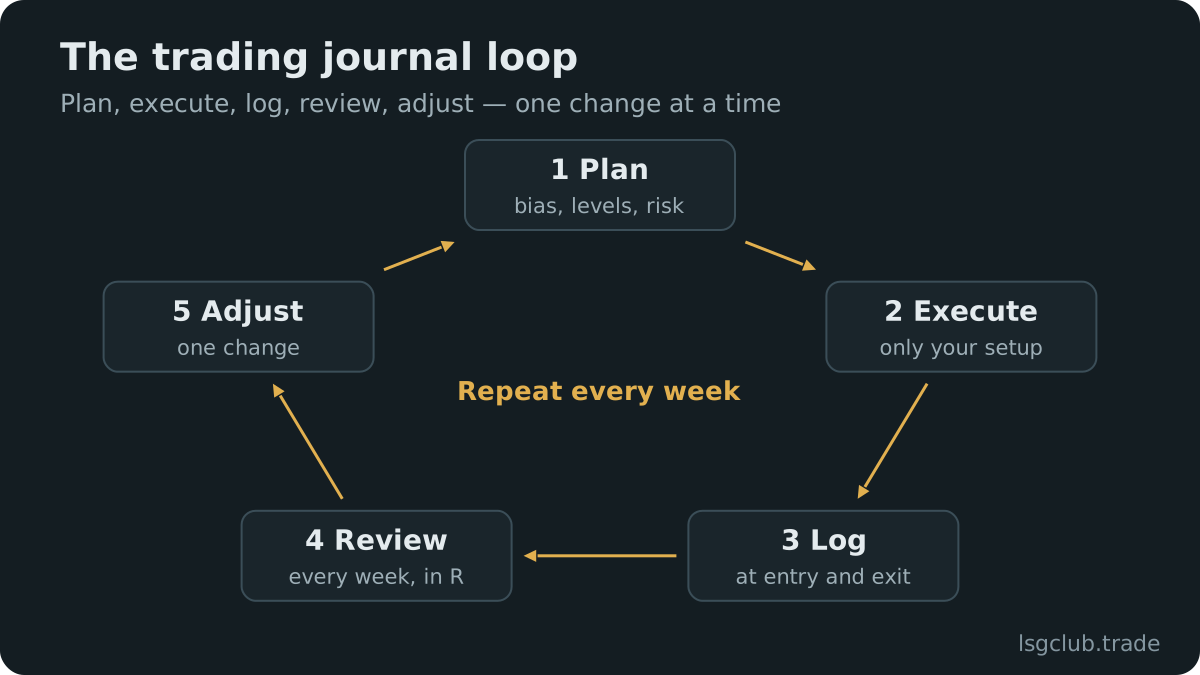
Daily logging collects the data; the weekly review is where it becomes decisions. Keep it short so it actually happens. A full process is in our guide to doing a weekly trading review; the core loop looks like this.
- Check completeness first: every trade has all minimum fields and a screenshot. Fill gaps before analyzing anything.
- Total the week in R, not only in money, so position size changes do not distort the picture.
- Split results by setup and by session. Note which group carried the week and which one dragged it.
- List every rule break and its cost in R. One recurring break is usually the cheapest improvement available.
- Replay the two or three biggest trades, winners and losers, on the chart and compare them with the pre-trade line.
- Write one change for next week, specific enough to check: "No entries after the New York Kill Zone ends", not "be more patient".
Read numbers with caution. A week is a small sample, and a setup that lost three times in a row may still be sound. Judge setups over dozens of trades and use the weekly review mainly for behavior, which you can fix immediately. Our explainer on win rate versus risk-reward covers which numbers to watch as the sample grows.
What to do after a missed day
Missing a day is normal. Abandoning the journal because of one gap is the real failure. Treat the gap as a data problem with a fixed recovery routine.
- Do not try to reconstruct feelings or reasons you no longer remember; mark those fields as "not recorded".
- Recover the hard data from the broker history: entries, exits, times and results. Importing the report fills this in one step.
- Add screenshots from the chart history so the trade can still be reviewed visually.
- Note why the day was missed. If the same cause repeats, fix the cue rather than relying on willpower.
- Resume with the next trade at full standard. One missed day should never become a missed week.
If gaps keep happening, shrink the template rather than skipping days. A three-field entry logged every time is worth more than an eight-field entry logged when you feel like it.
How consistent data turns into edge: an example
Example, with illustrative numbers rather than real results: a trader logs every trade for twelve weeks with the minimum fields. The weekly totals look random, with some weeks up and some down. When the review splits trades by session, a pattern appears: entries inside the London Kill Zone after a sell-side or buy-side sweep produce a positive average R, while entries taken after the New York Kill Zone has ended are negative on average and include most of the rule breaks.
Nothing in that discovery required a new indicator. It came from logging the session field the same way every time. The trader adds one rule, no new entries after the New York Kill Zone, and the next twelve weeks are logged the same way to check whether the change held. That loop of log, review, change one thing, measure again is what "building edge over time" means in practice. Past results still do not guarantee future ones, and the new rule needs its own sample before you trust it.
Common mistakes that break the journaling habit
- Logging only winners — the losing trades carry most of the information about rule breaks.
- Changing the template every week — data before and after the change cannot be compared.
- Writing essays — long notes feel productive but slow the habit down until it stops.
- Reviewing money instead of R — a bigger position size can hide a worse process.
- Skipping no-trade days — patience is part of the edge, and it disappears from the record.
- Judging a setup on five trades — small samples swing widely; decide on behavior first and setups later.
Most of these show up in our list of mistakes ICT traders make in their first year, and the journal is usually where they are first noticed.
FAQ
How long does it take to build a trading journal habit?
There is no fixed number of days. What helps is making the habit small and tying it to cues that happen anyway, such as opening the chart and closing a position. Judge yourself on completeness: if every trade for a month has all minimum fields, the habit is in place.
Should I journal trades on a demo account?
Yes. Demo trades build the same routine and test whether a setup is worth trading live. Keep demo and live trades in separate accounts in the journal so results are never mixed.
What is the minimum I should log for each trade?
Instrument, direction, setup, session, entry, stop, target, result in R, whether the plan was followed and one screenshot. That is enough to answer which setups and sessions work for you. Add more fields only when a specific question needs them.
How often should I review my trading journal?
Log daily and review weekly, with a longer monthly look at setups once you have enough trades. Weekly reviews are best for behavior and rule breaks; setup statistics need larger samples before they mean much.