ICT Kill Zone Times: New York, UTC, London and Kyiv
Every ICT Kill Zone in New York time, UTC, London and Kyiv time for summer and winter, the clock-change weeks when they move, and which pairs trade in each.
ICT Kill Zone times are written in New York time, but most traders do not live in New York, and twice a year the clocks of the US and Europe change on different weekends. This page, written for the LSG Club trader community, is a times reference: every ICT Kill Zone in New York time, then in UTC, London time and Kyiv time for summer and winter, the weeks in March and October when the usual conversion is wrong by an hour, which pairs move in which window, and a short routine for keeping your session clock correct all year.
ICT Kill Zone times at a glance
A Kill Zone is a time window, not a price level: the hours when a major financial centre opens and order flow is heaviest. ICT defines every window in New York local time, and New York time is the only version that never changes. The standard set:
- Asian Kill Zone — 20:00–00:00 New York time, the evening before the trading day. Tokyo and Sydney are trading; the range built here is often raided later.
- London Kill Zone — 02:00–05:00 New York time. The European open, with the London cash open inside it at 03:00 New York time in most weeks.
- New York AM Kill Zone — 07:00–10:00 New York time. US data at 08:30 and the equity open at 09:30, while London is still trading.
- London Close Kill Zone — 10:00–12:00 New York time. European desks square positions; used more for exits and late reversals than for new entries.
- New York PM — the afternoon session after the New York lunch. Its best-known use is the 14:00–15:00 hour of the ICT Silver Bullet, which has its own guide, so it is not repeated here.
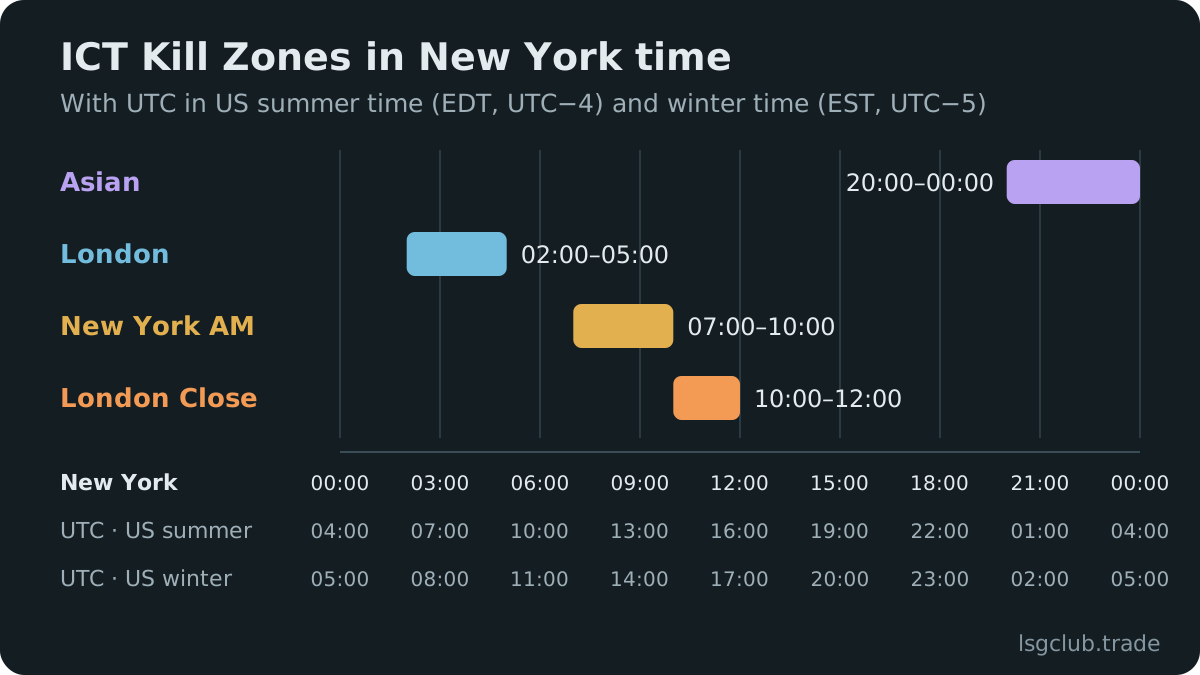
Everything below is a conversion of these New York hours. If you only remember one rule, remember this one: the windows are fixed on the New York clock, so everyone else’s clock has to move around them.
Kill Zone times in UTC, London and Kyiv time
New York is UTC−4 in summer (EDT) and UTC−5 in winter (EST). London is UTC+1 in summer (BST) and UTC+0 in winter (GMT). Kyiv is UTC+3 in summer (EEST) and UTC+2 in winter (EET). Because all three cities move their clocks by one hour in the same direction, the result is simple once you see it: London and Kyiv times stay the same all year, and only UTC moves.
Summer: US and Europe both on daylight saving time
From the last Sunday of March to the last Sunday of October (outside the transition weeks covered in the next section):
- Asian Kill Zone — 20:00–00:00 New York · 00:00–04:00 UTC · 01:00–05:00 London · 03:00–07:00 Kyiv.
- London Kill Zone — 02:00–05:00 New York · 06:00–09:00 UTC · 07:00–10:00 London · 09:00–12:00 Kyiv.
- New York AM Kill Zone — 07:00–10:00 New York · 11:00–14:00 UTC · 12:00–15:00 London · 14:00–17:00 Kyiv.
- London Close Kill Zone — 10:00–12:00 New York · 14:00–16:00 UTC · 15:00–17:00 London · 17:00–19:00 Kyiv.
- New York PM Silver Bullet hour — 14:00–15:00 New York · 18:00–19:00 UTC · 19:00–20:00 London · 21:00–22:00 Kyiv.
Winter: US and Europe both on standard time
From the first Sunday of November to the second Sunday of March:
- Asian Kill Zone — 20:00–00:00 New York · 01:00–05:00 UTC · 01:00–05:00 London · 03:00–07:00 Kyiv.
- London Kill Zone — 02:00–05:00 New York · 07:00–10:00 UTC · 07:00–10:00 London · 09:00–12:00 Kyiv.
- New York AM Kill Zone — 07:00–10:00 New York · 12:00–15:00 UTC · 12:00–15:00 London · 14:00–17:00 Kyiv.
- London Close Kill Zone — 10:00–12:00 New York · 15:00–17:00 UTC · 15:00–17:00 London · 17:00–19:00 Kyiv.
- New York PM Silver Bullet hour — 14:00–15:00 New York · 19:00–20:00 UTC · 19:00–20:00 London · 21:00–22:00 Kyiv.
Compare the two lists: the London and Kyiv columns are identical, while every UTC time is one hour later in winter. In winter UTC and London time are the same clock, which is why many older references write Kill Zones in GMT and are silently an hour off for half the year when read as UTC. The two US anchors inside the New York AM window follow the same pattern: the 08:30 data release is 12:30 UTC in summer and 13:30 UTC in winter, and the 09:30 equity open is 13:30 UTC in summer and 14:30 UTC in winter.
Traders in Asia and on fixed-offset clocks
If your country does not use daylight saving time, the picture flips: your local Kill Zone times move twice a year and UTC is your only guide. Tokyo (UTC+9, no clock change) is a good example:
- Asian Kill Zone — 09:00–13:00 Tokyo in US summer, 10:00–14:00 Tokyo in US winter.
- London Kill Zone — 15:00–18:00 Tokyo in US summer, 16:00–19:00 Tokyo in US winter.
- New York AM Kill Zone — 20:00–23:00 Tokyo in US summer, 21:00–00:00 Tokyo in US winter.
The same applies to traders in India, Singapore, the Gulf, most of Africa and South America. Southern-hemisphere cities such as Sydney change their clocks in the opposite season, which makes their conversions move on yet another set of dates.
The clock-change weeks: when Kill Zones move
The US switches to daylight saving time on the second Sunday of March and back on the first Sunday of November. The UK and the EU, including Ukraine, switch on the last Sunday of March and the last Sunday of October. For two to three weeks in spring and one week in autumn, New York is on summer time while Europe is on winter time. The dates for the next two years:
- Spring 2026 — 8 March to 28 March: New York already on EDT, London and Kyiv still on winter time.
- Autumn 2026 — 25 October to 31 October: London and Kyiv back on winter time, New York still on EDT until 1 November.
- Spring 2027 — 14 March to 27 March.
- Autumn 2027 — 31 October to 6 November, until the US changes on 7 November.
In those weeks the gap between New York and Europe is one hour smaller than usual: New York is four hours behind London instead of five, and six hours behind Kyiv instead of seven. UTC times are the summer ones, but European local times are one hour earlier than in the lists above:
- Asian Kill Zone — 00:00–04:00 UTC · 00:00–04:00 London · 02:00–06:00 Kyiv.
- London Kill Zone — 06:00–09:00 UTC · 06:00–09:00 London · 08:00–11:00 Kyiv.
- New York AM Kill Zone — 11:00–14:00 UTC · 11:00–14:00 London · 13:00–16:00 Kyiv.
- London Close Kill Zone — 14:00–16:00 UTC · 14:00–16:00 London · 16:00–18:00 Kyiv.
A trader in Kyiv who sits down at 09:00 for the London Kill Zone in the second week of March has already missed the first hour of it. A trader in London who expects the 08:30 New York release at the usual 13:30 is an hour late: in those weeks it prints at 12:30 London time. Most timing errors in session journals come from exactly these weeks.
Which clock to follow in those weeks
There is a real ambiguity here. The London cash open stays at 08:00 London time, so during the gap weeks it falls at 04:00 New York time rather than 03:00, still inside the 02:00–05:00 window but later in it. US data and the US equity open stay fixed in New York time. If you follow ICT’s definition literally, keep the New York hours and convert. If your trading revolves around the European open itself, some traders keep the London Kill Zone anchored to the London clock for those weeks. Either choice is defensible; mixing them is not. Pick one, write it in your plan, and log trades the same way.
Logging trades through a clock change
Session statistics break quietly when the conversion changes but your tagging does not. If you tag trades by hand from your local clock, a London Kill Zone trade at 08:30 Kyiv time in a gap week is a real London trade, while the same 08:30 in July is before the window opened. Store trade times in UTC, convert with the rules for that date, and do not copy last month’s session hours into this month’s plan without checking.
What each Kill Zone is used for
The windows do different jobs in an ICT day. Knowing the job tells you what to look for and what to leave alone.
Asian Kill Zone: the range
For EUR and GBP pairs Asia is usually a range-building window. Its high and low become resting liquidity that the next session often runs, so the practical task is to mark them. JPY, AUD and NZD pairs are different: their home markets are open, local data is released, and Asia is a full trading session for them.
London Kill Zone: the first real move
London often produces the first decisive move of the day, frequently after a run on the Asian high or low against the daily direction. That false start is the Judas swing of the Power of 3 model, and the run itself is a classic liquidity sweep. On many days the high or the low of the day forms here.
New York AM Kill Zone: continuation or reversal
New York either extends the London move or reverses it, and US data at 08:30 is often the trigger. Both centres are open, so liquidity is at its deepest. On release days many traders wait for the data candle to close before reading structure.
London Close Kill Zone: taking profit
As European desks close out, moves from the morning often retrace. Many ICT traders use this window to manage or exit positions opened earlier rather than to start new ones.
Which pairs are active in which Kill Zone
A pair moves most when the home market of at least one of its currencies is open. A brief map:
- Asian Kill Zone — USDJPY, AUDUSD, NZDUSD, AUDJPY and other yen and antipodean pairs; EUR and GBP pairs mostly for marking the range.
- London Kill Zone — EURUSD, GBPUSD, EURGBP, EURJPY, GBPJPY and the European crosses; gold and the DAX also wake up here.
- New York AM Kill Zone — EURUSD, GBPUSD, USDJPY, USDCAD (Canadian and US data often land together at 08:30), gold and US indices.
- London Close Kill Zone — mainly the same EUR and GBP pairs, usually retracing the morning move.
Gold has its own session behaviour, especially around US data and Fed days; the XAUUSD trading sessions guide covers it. If you are still choosing what to watch, the best forex pairs for ICT trading article explains how to keep the list short.
ICT New York time and the journal’s Kill Zone tags
The LSG journal tags every trade with its Kill Zone automatically from the entry time, and it uses ICT’s own New York-time windows, so in UTC they move with US daylight saving exactly like the tables above:
- Asian — 20:00–00:00 New York, the evening before: 00:00–04:00 UTC in summer, 01:00–05:00 UTC in winter.
- London — 02:00–05:00 New York: 06:00–09:00 UTC in summer, 07:00–10:00 UTC in winter.
- New York — 07:00–10:00 New York: 11:00–14:00 UTC in summer, 12:00–15:00 UTC in winter.
Because the tags follow the New York clock, a London trade in January and one in July land in the same bucket even though their UTC hours differ, and the March and October gap weeks are handled too. The journal has no London Close tag: a trade in that window counts as outside a Kill Zone. Trades logged before 29 October 2026 keep the fixed UTC tags they got then and are counted in the matching zone. To see ICT’s windows on a specific date in your own city, use the free Kill Zone time converter: plan the day with it, and compare your results by Kill Zone in the journal.
Finding the Kill Zones on your own clock
- Open the Kill Zone time converter; it picks up your browser’s time zone, and you can choose any other.
- Set the date you are planning for. Every offset comes from the time zone database for that date, so transition weeks are handled for you.
- Note the windows you actually trade in your plan, in your local time, next to the date.
- Add the fixed New York anchors you care about, such as 08:30 data and the 09:30 equity open, converted for the same date.
- Repeat after every clock change in the US, in Europe or in your own country, not only once a year.
A weekly Kill Zone routine
Session timing is a weekly job, not a daily one. A short routine that keeps it right:
- On Sunday, check whether any clock change happened or happens this week in New York, Europe or your country.
- Write this week’s local times for the one or two Kill Zones you trade; three windows a day is a schedule for fatigue.
- Mark high-impact releases from the economic calendar that fall inside those windows and decide in advance whether you trade through them.
- Each day, mark the range the next window is likely to raid: the Asian high and low before London, the London high and low before New York.
- When your window ends without a qualifying setup, stop. The next window is a new decision.
- At the end of the week, review results by Kill Zone, not only by pair.
The full day around this, from preparation to review, is described in the daily routine of an ICT trader.
Kill Zone timing mistakes
- Reading "GMT" Kill Zone tables as UTC in summer — from mid-March to early November, while New York is on summer time, they put every window an hour late.
- Converting once and never again — the US and European clock changes alone move your local times up to four times a year.
- Ignoring the gap weeks — in March and late October, European traders who keep their usual hours start an hour late.
- Mixing conventions — planning in ICT New York hours but reviewing by fixed UTC hours, or the other way around, without knowing which you used.
- Treating the window opening as a signal — the start of a Kill Zone is a reason to watch, not a reason to enter.
Measure your own Kill Zone results
Which window suits you is a question your own data answers. Log trades with correct times for a few dozen trades and compare results by session. The LSG journal tags each trade’s session automatically and its behaviour report shows which sessions and hours cost you money; the Telegram bot @lsgclubbot can send session and news alerts so you do not have to watch the clock. You can see the reports with sample data in the journal demo.
Kill Zones sit inside the wider trading sessions: forex session times in EST and UTC lists when the Asian, London and New York sessions open and close and where they overlap.
FAQ
What are the ICT Kill Zone times?
In New York time: Asian 20:00–00:00, London 02:00–05:00, New York AM 07:00–10:00 and London Close 10:00–12:00. In UTC that is 00:00–04:00, 06:00–09:00, 11:00–14:00 and 14:00–16:00 during US daylight saving time, and one hour later in winter.
What time is the London Kill Zone in London time?
07:00–10:00 London time for most of the year, both in summer and in winter. In the weeks when the US has changed its clocks and the UK has not, it is 06:00–09:00 London time.
What are the Kill Zone times in Kyiv time?
Asian 03:00–07:00, London 09:00–12:00, New York AM 14:00–17:00 and London Close 17:00–19:00 Kyiv time, summer and winter. During the March and late-October transition weeks each window starts one hour earlier.
Do Kill Zones change with daylight saving time?
Not in New York time, which is how ICT defines them. In UTC they move by one hour when the US changes its clocks. In London and Kyiv they stay the same except for the transition weeks, and in countries without daylight saving they move twice a year.
Is the Silver Bullet a Kill Zone?
No. The Silver Bullet uses one-hour windows at 03:00, 10:00 and 14:00 New York time, partly inside and partly after the Kill Zones. The Silver Bullet guide covers them.
Which Kill Zone hours does the LSG journal use?
ICT’s own New York-time windows: Asian 20:00–00:00, London 02:00–05:00 and New York 07:00–10:00, tagged from the entry time and shifting in UTC with US daylight saving. For the exact windows on a given date in your own time zone, use the Kill Zone time converter.