ICT Silver Bullet Strategy: Times, Rules and the Entry Model
The three ICT Silver Bullet windows in New York and UTC time and a step-by-step playbook: preparation, entry, stop, target, management and a worked example.
The ICT Silver Bullet strategy trades one repeatable setup in three 1-hour windows: 03:00–04:00, 10:00–11:00 and 14:00–15:00 New York time. Inside each hour you wait for a liquidity raid, a displacement and a fair value gap, then enter on the retrace with a stop beyond the raid and a target at the next pool of liquidity. This is the practical playbook: preparation, entry, stop, target, management and how each window differs, with every trade measured in LSG Club’s free trading journal.
How the Silver Bullet strategy is built
Three windows give you three chances a day at the same pattern, not three hours of screen time to fill. Most traders pick one or two windows that match their timezone and ignore the rest. The windows are a time filter: they do not create the setup, they decide when you are allowed to take one. Outside them, the same pattern is simply not a Silver Bullet trade.
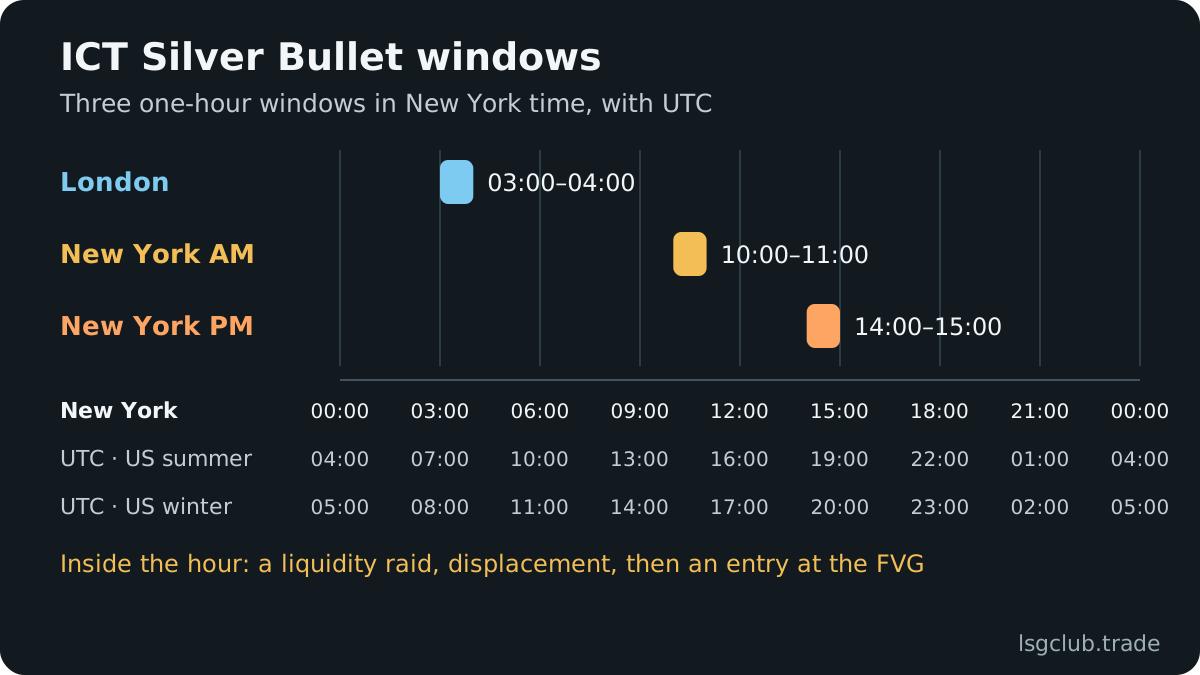
ICT Silver Bullet times in New York and UTC
ICT defines the windows in New York local time, so they move against UTC when the US changes its clocks. US daylight saving time (EDT, UTC−4) runs from the second Sunday of March to the first Sunday of November; the rest of the year is EST (UTC−5).
- London Silver Bullet, 03:00–04:00 New York: 07:00–08:00 UTC in US summer time, 08:00–09:00 UTC in winter. It sits inside the London Kill Zone, when Europe is fully open.
- New York AM Silver Bullet, 10:00–11:00 New York: 14:00–15:00 UTC in summer, 15:00–16:00 UTC in winter. It starts half an hour after the US equity open and is the window most traders mean by "the Silver Bullet".
- New York PM Silver Bullet, 14:00–15:00 New York: 18:00–19:00 UTC in summer, 19:00–20:00 UTC in winter. Volume is thinner, and on Federal Reserve days the 14:00 statement lands at its start.
These hours are not the Kill Zones. The New York AM Kill Zone runs from 07:00 to 10:00 New York time, so the AM Silver Bullet begins exactly where that Kill Zone ends. To see every window in your own time zone for any date, use the free Kill Zone time converter; the Kill Zone trading guide covers the session windows in full.
Preparation before the window opens
The trade is decided before the hour starts. When the window opens you should only be waiting for confirmation, not forming an opinion.
- Set the bias on the daily and 4-hour charts. Know whether you are looking for longs or shorts today, and why. The daily bias tutorial shows one way to do it.
- Mark the draw on liquidity: the level price is most likely to reach next, such as the previous day high or low, the session high or low, or an untouched higher-timeframe gap.
- Mark the short-term liquidity that could be raided first: the highs and lows formed in the hour or two before the window, and for the AM window, the extremes since the 09:30 equity open.
- Check the calendar. If a high-impact release lands inside or right before the window, decide in advance whether you skip it.
- Fix your risk per trade and the maximum number of attempts per window, usually one, before you see a single candle.
Step-by-step Silver Bullet entry
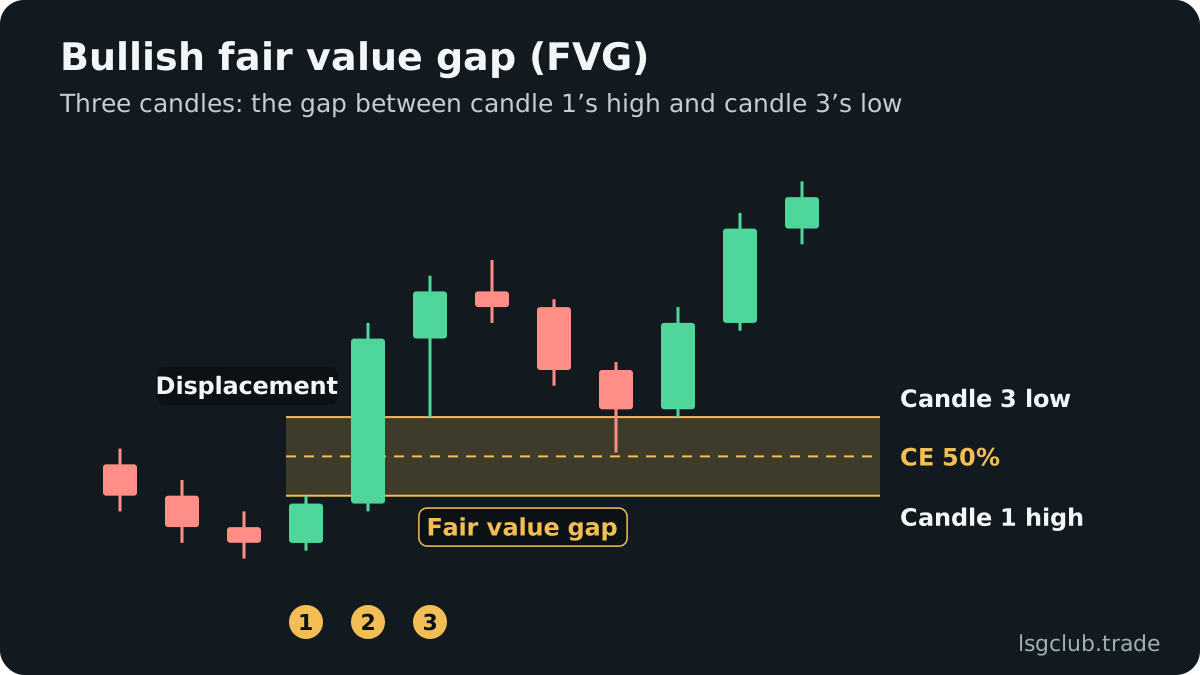
Step 1: Wait for the raid
With a bullish bias you want price to run below a short-term low inside the window, taking the sell stops resting there. With a bearish bias you want a run above a short-term high. A raid in the direction of your bias is not the trigger; it often means price is simply moving toward the draw without giving you an entry. The liquidity sweep guide shows how to tell a genuine raid from a breakout.
Step 2: Confirm displacement and the gap
After the raid, price should reverse with a fast, one-sided move that breaks the nearest short-term swing in your direction. On the 1-minute or 5-minute chart that move leaves a fair value gap. Mark the gap from the high of the first candle to the low of the third (for a bullish gap), or the reverse for a bearish one. A gap that forms without a raid before it belongs to the general fair value gap strategy, not to this model.
Step 3: Place the entry
The conservative entry is a limit order at the start of the gap, the first price touched on the retrace. A deeper entry at the gap’s midpoint gives a better price but more missed trades. Choose one method and keep it; switching between them trade by trade makes your results impossible to read. If price does not return to the gap before the hour ends, cancel the order.
Step 4: Set the stop
The structural stop goes beyond the extreme of the raid: below the low that swept sell-side liquidity for a long, above the high that swept buy-side liquidity for a short. A tighter alternative is beyond the first candle of the gap, which improves R but gets stopped more often by normal noise. Size the position from the stop distance, never the other way round. The position size guide has the formula.
Step 5: Choose the target
The first target is the nearest opposing liquidity: the high or low on the other side of the window, or the session extreme. The final target is the draw on liquidity you marked before the session. If the first target sits closer than about two times your risk, the setup does not pay for its losing days; the risk-reward guide explains why the ratio has to be set before entry.
Managing the trade after entry
- Partial at the first target — taking part of the position at the first opposing liquidity lowers the cost of a reversal; decide the share in advance.
- Break-even with a reason — move the stop only after price has made a new short-term swing in your favour, not after a fixed number of pips.
- Time stop — if the trade has not moved meaningfully by the end of the window, the displacement probably failed; consider closing rather than hoping.
- One attempt per window — if the first entry is stopped, the hour is done. A second raid in the same window is where revenge trades are born.
- Daily limit — stop for the day after a set loss in R, regardless of how many windows remain.
How each Silver Bullet window trades
London window, 03:00–04:00
This hour falls inside the London Kill Zone. The raid often targets the Asian range high or low, or an extreme made in the first hour of London. Euro and pound pairs are the natural instruments. Moves can be large because the London open often sets the high or low of the day, so the room to target is usually generous, but stops need to clear the Asian range noise.
New York AM window, 10:00–11:00
The most traded window. US data at 08:30 and the equity open at 09:30 have already created fresh highs and lows, which become the liquidity the window raids. Index futures, gold and dollar pairs all tend to be active. On days with a 10:00 data release the first minutes can be erratic; many traders wait for the release candle to finish before reading the raid.
New York PM window, 14:00–15:00
Volume is lower, London is closed, and the day’s range is often largely set. Setups here tend to be smaller retracements toward a level left untouched in the morning. On Federal Reserve days the 14:00 statement and the press conference that follows make this window a news event rather than a model window; skipping it is a reasonable rule.
Worked example: a long in the AM window
Hypothetical example for illustration. GBPUSD has a bullish daily bias with the draw on the previous day high. At 09:30 the market dips and forms a low; at 10:12 price breaks below it, triggering the sell stops, then rallies through the 10:05 swing high within four 1-minute candles, leaving a bullish fair value gap.
A buy limit sits at the top of the gap. The stop goes a little below the 10:12 low: 12 pips of risk, which is 1R. Price retraces into the gap at 10:24 and fills the order. The first target, the high made at 09:40, is 26 pips away, a little over 2R, and half the position closes there. The rest runs toward the previous day high, 44 pips from entry, or about 3.7R. Had price returned to the gap at 11:05 instead, there would be no trade, because the window had closed.
Mistakes that break the strategy
- Entering on the raid itself — catching the spike without waiting for displacement turns a defined model into a guess.
- Trading against the bias because the window offered a gap — the clock does not override the higher timeframe.
- Moving the stop inside the raid to fit a bigger position — the stop belongs where the idea is wrong, and the size follows from it.
- Taking setups with no room — a perfect gap 8 pips below the target is a bad trade at any risk.
- Mixing windows in one statistic — London, AM and PM behave differently, so record them separately.
Testing the Silver Bullet in your journal
Write the model into your setup playbook with the exact rules you use: entry at the gap edge or midpoint, stop at the raid or the gap. Then journal every trade with its window and result in R. After a few dozen trades per window, the numbers show which hour fits you. The LSG journal’s optimal RR and break-even replays run your actual trades on real candles, so you can see whether a different target or stop rule would have changed the outcome. Trading carries risk, and no rule set removes it; the point of testing is to know your numbers before you increase size.
FAQ
What time is the ICT Silver Bullet?
There are three windows in New York time: 03:00–04:00, 10:00–11:00 and 14:00–15:00. The 10:00–11:00 window is the one most traders refer to. In UTC it is 14:00–15:00 during US daylight saving time and 15:00–16:00 in winter.
Does the entry have to happen inside the hour?
Yes. The raid, the displacement, the fair value gap and the entry all belong to the window. The trade can stay open after the hour and run to its target, but a first entry taken after the window has closed is outside the model.
Is the Silver Bullet the same as a Kill Zone?
No. Kill Zones are broader session windows when activity is typically highest, such as 07:00–10:00 New York time for the New York AM Kill Zone. The Silver Bullet is a one-hour window with its own entry pattern, and the AM window starts when that Kill Zone ends.
Which Silver Bullet window is best to trade?
There is no universal answer. The New York AM window is the most popular because the morning data and the equity open create plenty of liquidity to raid. The right window for you is the one you can trade alert and whose results hold up in your own journal.
What timeframe should I use for Silver Bullet entries?
Bias comes from the daily and 4-hour charts. The raid, displacement and gap are usually read on the 1-minute to 5-minute chart. Lower timeframes give tighter stops but more false gaps, so pick one and stay with it.
Where do I put the stop loss on a Silver Bullet trade?
The structural place is beyond the extreme of the liquidity raid. A tighter stop beyond the first candle of the fair value gap is an option, but it gets hit more often. Whichever you use, size the position from that distance.
Can I trade all three windows on the same day?
You can, but each window should be a separate decision with its own setup, and a daily loss limit should apply across all three. Many traders find that one or two windows suit their schedule and results better than trading all of them.