ICT Turtle Soup Pattern: How to Trade False Breakouts
How to fade false breakouts of obvious highs and lows with ICT Turtle Soup: context, entries, stops, targets and the conditions where it fails.
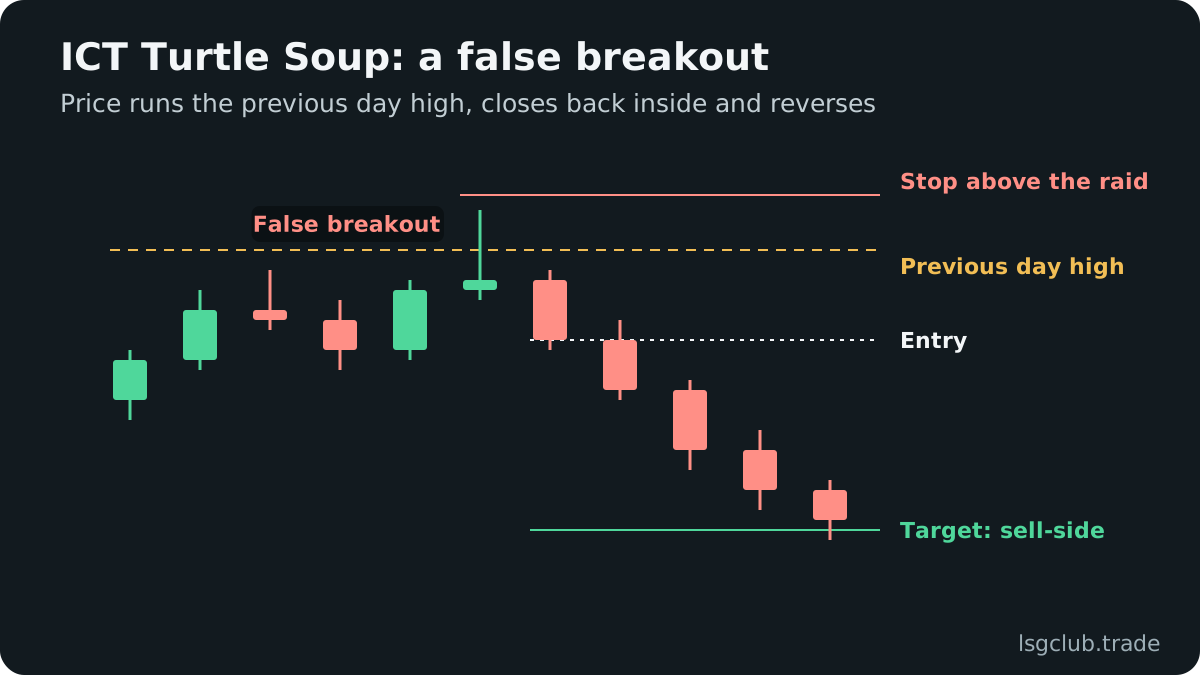
The ICT Turtle Soup pattern is a fade of a false breakout: price runs just beyond an obvious high or low, triggers the stops and breakout orders resting there, then closes back inside the range, and you trade the return. The edge, when there is one, comes from context: which level was raided, when it happened and whether the higher timeframe supports a reversal. This guide from LSG Club’s free trading journal covers the origin of the name, ICT’s version of the setup, entries and stops, and the conditions in which Turtle Soup fails.
Where the Turtle Soup name comes from
The Turtle traders of the 1980s were trained to buy new 20-day highs and sell new 20-day lows. In the 1990s Linda Bradford Raschke and Laurence Connors published a counter-strategy and called it Turtle Soup: when a market makes a new 20-day low but the previous 20-day low is several sessions old, wait for price to trade back above that old low and buy, with a stop under the new low. The short side mirrors it at highs.
The original idea was mechanical and built on daily bars. What survived into ICT’s teaching is the core observation: breakouts of widely watched levels are crowded, and when a crowded breakout fails, the trapped orders fuel the move back the other way.
How ICT reframes Turtle Soup
ICT drops the 20-day rule and treats Turtle Soup as a raid on liquidity. Above every obvious high sit buy stops from short sellers and buy-stop entries from breakout traders: buy-side liquidity. Below every obvious low sits sell-side liquidity. A Turtle Soup is the run through that pool and the failure to hold beyond it. In ICT’s language it is close to a liquidity sweep, with the emphasis on fading the false break.
The levels that attract the most orders are the ones every chart shows:
- Previous day high and low — the most common Turtle Soup level for intraday traders.
- Relative equal highs or lows — two or more touches at nearly the same price, a textbook pool of resting stops.
- Asian range high and low — often raided during the London session.
- Previous week high and low — larger raids that can define the weekly high or low, as described in the ICT weekly profile guide.
- Obvious session extremes — the London high or low raided in New York, for example.
Not every obvious level is the target, though. Small, tempting levels inside a range often act as bait, which the inducement article covers.
The ICT Turtle Soup setup step by step
The setup has three parts: context, the raid and the confirmation. Skipping the first part is the most common reason the pattern looks good in screenshots and poor in a journal.
Context: bias and draw on liquidity
A Turtle Soup short makes sense when the higher timeframe points down: price is in the premium of the H4 or daily range, the daily bias is bearish and the next draw on liquidity is below. Fading a raid on a high in a market that is clearly drawn higher is fighting the order flow. The daily bias tutorial explains how to set that direction before the session.
The raid
Price trades beyond the level, usually with one or two fast candles, ideally into a higher-timeframe premium or discount array such as an old fair value gap or order block. The raid should come during an active window. ICT focuses on the Kill Zones, for example London 02:00–05:00 or New York AM 07:00–10:00 New York time; the LSG journal tags trades with the same New York-time windows.
The confirmation
The raid candle, or the next one, closes back inside the range. Conservative traders then wait for a market structure shift: a displacement break of the short-term swing in the reversal direction, leaving a fair value gap to enter from.
- Before the session, mark the obvious highs and lows and decide which side your bias favors fading.
- Wait for price to trade through the level inside your time window.
- Require a close back inside the range; a close beyond the level that holds is a breakout, not a soup.
- Choose your entry: on the close back inside (aggressive) or on the retracement into the fair value gap after a structure shift (conservative).
- Place the stop beyond the extreme of the raid, with a buffer for spread.
- Target the opposite side of the range or the next liquidity pool in the direction of your bias.
Entries, stops and targets
- Aggressive entry — at the close of the candle that swept the level and closed back inside; best price, highest chance of being caught by a second push.
- Conservative entry — after the structure shift, at the fair value gap or order block of the displacement leg; fewer trades, more missed moves, clearer invalidation.
- Stop — beyond the raid extreme; if price trades there again, the raid did not hold and the reversal premise is gone.
- First target — equilibrium of the range, the 50% level, where partial profits are common.
- Final target — the opposite side of the range or the next external pool in the direction of the bias.
Size the position from the stop distance, not from a fixed lot. Raids on volatile instruments such as gold can extend well beyond the level before turning, so measure the stop in relation to ATR and accept a smaller position when the raid is wide.
Worked example: Turtle Soup at the previous day’s high
Example for illustration only. EURUSD has been trending lower on the daily chart, and the previous day closed near the middle of its range. The previous day high also lines up with a pair of relative equal highs from earlier in the week, a clear buy-side pool. The bias for the day is bearish, with sell-side liquidity below the weekly low as the draw.
In the London Kill Zone price rallies through the previous day high by a few pips, prints a long upper wick and the M15 candle closes back below the level. An aggressive trader sells that close with a stop above the wick. A conservative trader waits: twenty minutes later price breaks the M5 swing low that started the final push up, with displacement, and leaves a fair value gap. The conservative entry is a sell limit in that gap, the stop above the raid high and the first target at the midpoint of the previous day’s range.
The setup can be valid and still lose. If price returns above the raid high, both trades are stopped and the day is treated as a breakout day, which is exactly why the stop exists.
When Turtle Soup fails
- Trend days — when price breaks a level with displacement and keeps closing beyond it, the break is genuine; fading it is fighting the move.
- Against the higher timeframe — a raid on a high in a market drawn toward higher liquidity is often a pause before continuation.
- Around high-impact news — spikes through levels are common and the close back inside can reverse again within minutes.
- Levels that are not obvious — a random intraday high has little resting liquidity, so there is nothing to fuel the reversal.
- Repeated tests — a level that has already been raided twice in the session has usually been cleared.
Turtle Soup is closely related to the breaker block: after a successful raid and structure shift, the order block that failed often becomes a breaker you can use for the entry.
Journaling Turtle Soup trades
Record which level was raided, how far price traded beyond it, the session, whether the higher-timeframe bias agreed and which entry you used. Log the setups you skipped as well. After enough trades the journal shows whether aggressive or conservative entries suit you, which levels produce clean raids on your instruments and which sessions you should ignore. Trading carries risk, and only your own sample can tell you whether this pattern adds anything to your results.
FAQ
What is the Turtle Soup pattern in ICT?
It is a false breakout of an obvious high or low: price runs the liquidity resting beyond the level, then closes back inside the range. ICT traders fade that failed break when it agrees with their higher-timeframe bias and happens inside an active session.
Is Turtle Soup the same as a liquidity sweep?
They describe the same event from different angles. A liquidity sweep is the run on stops beyond a level; Turtle Soup names the trade that fades it. In practice traders use the terms almost interchangeably.
Where should the stop go on a Turtle Soup trade?
Beyond the extreme of the raid, plus a buffer for spread. If price trades back through that extreme, the false breakout has become a real one and the trade idea is invalid.
Which timeframe works best for Turtle Soup?
Mark the levels on daily and H4, where the obvious highs and lows live, and time the entry on M5 to M15. Swing traders can apply the same logic with daily levels and H1 entries.