ICT Inducement: How Market Makers Trap Traders Before the Real Move
How ICT inducement uses equal highs and lows, trendlines and session extremes to trap early entries, and the rules that keep you out of the trap.
ICT inducement is a small, obvious pool of liquidity that price takes out first, pulling traders into early entries before it moves to the real level. Members of the LSG Club trader community learn to treat that first tempting setup as a question, not a signal: whose stops does it create, and where will price go to collect them? This article explains how inducement works, which liquidity pools it uses, and the rules that keep you out of the trap.
What ICT inducement means
Inducement is a lure. Price offers a move that looks like a valid entry — a pullback into a zone, a neat double bottom, a clean trendline bounce — so traders enter and place stops in the predictable spot. Those stops then become liquidity that price runs through on the way to its actual objective.
ICT describes this as engineered liquidity: the market builds pools on purpose by letting retail patterns form. The short label "IDM" comes mostly from Smart Money Concepts teaching built on ICT ideas, where inducement is usually the first internal pullback high or low before price reaches a point of interest such as an order block. Both schools describe the same behavior: the first obvious level is often there to be taken.
Inducement is not a separate setup you trade on its own. It is the reason a setup that looks right fails, and a filter that tells you to wait one more step. If the basics of liquidity are new to you, start with the guide to the ICT liquidity sweep and come back here.
Liquidity pools that work as inducement
Any level where many traders place stops can serve as inducement. These are the ones that appear most often on intraday charts.
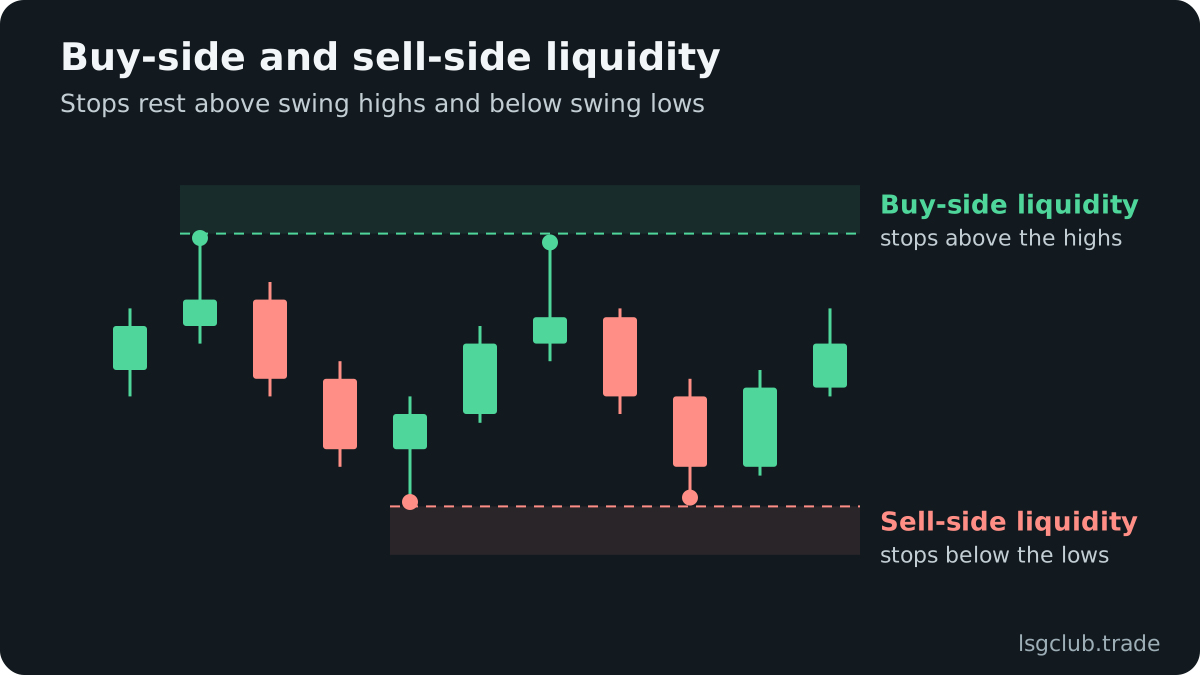
Equal highs and equal lows
Two or three swing points at almost the same price look like strong support or resistance. Traders buy the double bottom with stops just under it, or sell the double top with stops just over it. ICT calls these relative equal highs and lows and treats them as targets: the cleaner the line, the more stops it collects.
Trendline liquidity
A rising trendline with three neat touches invites buyers at each touch, each with a stop below the line. That gives a staircase of sell stops just beyond the trendline. When price finally breaks it with speed, those stops become fuel. In ICT’s view, a too-perfect trendline is more of a liquidity pool than real support.
Session highs and lows
The Asian range high and low, and later the London high and low, are watched by almost every intraday trader. A London open that pushes through the Asian high and stalls is a classic example: early breakout buyers are induced, and the real London move often goes the other way. Session ranges are covered in more detail in the Kill Zone trading guide.
Internal and external range liquidity
External range liquidity sits beyond the high and low of the current dealing range. Internal range liquidity sits inside it: minor swing points, fair value gaps, small pullbacks. Inducement is almost always internal. Price takes an internal pool to shake out early traders, then heads for external liquidity or a higher-timeframe point of interest.
How an inducement trap unfolds
The sequence below shows a bearish case. Flip every direction for a bullish one.
- The higher-timeframe bias is bearish and an order block sits above price in premium.
- Price rallies, then pulls back to form a minor higher low well below that order block.
- Traders read the higher low as bullish structure, buy it, and put stops under it.
- Price trades down through the minor higher low, triggering those stops. Early sellers who shorted the dip now feel confirmed.
- Instead of continuing down, price reverses and rallies into the order block in premium, stopping out the early sellers as well.
- From the order block, price displaces lower with a market structure shift — this is the move the bias pointed to.
Two groups lost money before the real move: the buyers of the minor low and the sellers who jumped in too early. Both supplied liquidity. The trader who waited for price to reach the premium zone entered once, at a better price, with a clear invalidation.
Example: inducement before a London reversal
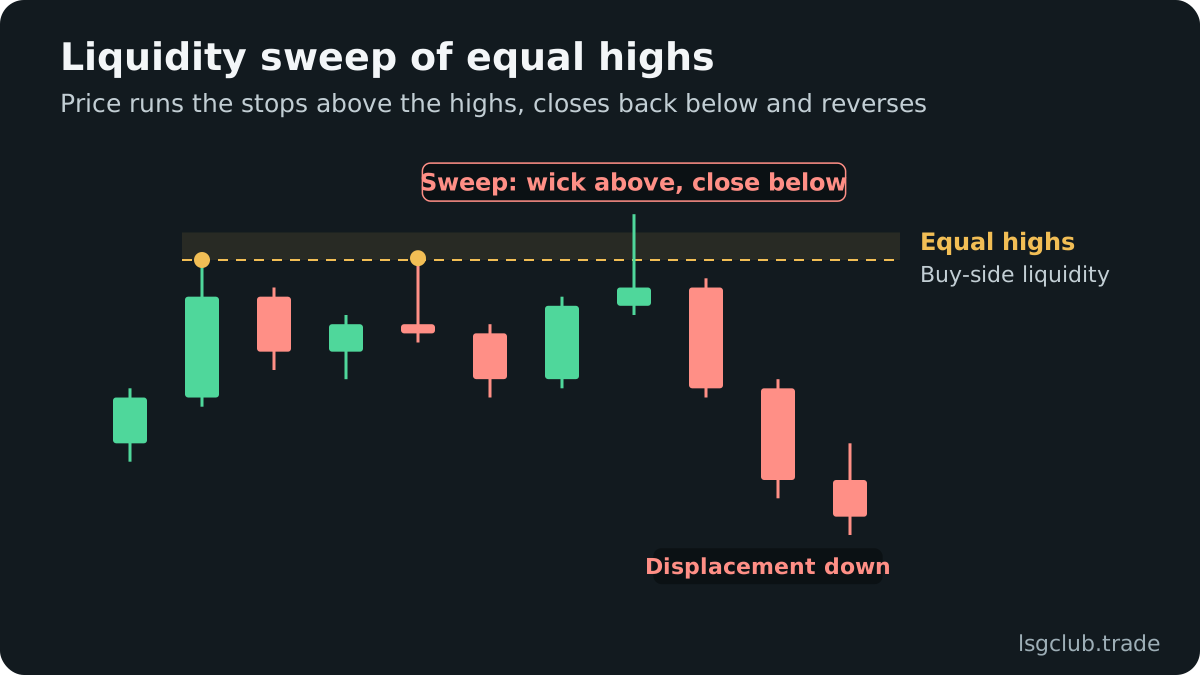
This is a hypothetical example for illustration. GBPUSD has a bearish daily bias and an H1 bearish order block sits just above the previous day high. During Asia price drifts up and leaves two equal highs below that order block. At the London open price breaks the equal highs, and M5 breakout buyers enter with stops under the last small swing.
Price continues up into the H1 order block, wicks into it, and then drops back below the equal highs with a strong M5 candle that leaves a fair value gap. The equal highs were the inducement; the order block plus the previous day high was the real level. A short from the fair value gap with the stop above the wick high fits the plan. A short taken at the equal highs themselves would have been stopped out first.
How to avoid being induced
You cannot always tell inducement from a real level in advance, but a few habits remove most of the damage.
Wait for the obvious pool to be taken
If there is clean, untouched liquidity between price and your entry zone, expect it to be run first. Equal lows sitting just above your bullish order block are a warning: price will often take them before reaching the block. Let that happen, then judge the reaction.
Demand a structure shift after the raid
A touch of the zone is not an entry. Ask for a market structure shift with displacement after the liquidity is taken. The CHoCH vs BOS guide explains which breaks count as a real change in character and which are just internal noise.
Filter entries with premium and discount
Inducement usually sits on the wrong side of the dealing range. Buying in premium or selling in discount puts you right where induced traders get trapped. Restrict longs to discount and shorts to premium, as described in the article on ICT premium and discount, and many induced setups drop out on their own.
- Mark external liquidity first — know where price is ultimately going before judging inner levels
- Count the obvious stops — if you can see a pool easily, assume others can too
- Skip the first touch — the first test of a zone after a trend change is a common inducement
- Keep your stop off the crowd — beyond the real extreme, not just under the most visible line
Reviewing inducement in your journal
Tag every losing trade where the stop was hit and price then moved in your original direction. If those trades cluster around equal highs and lows or session extremes, inducement is costing you. Note what the real level was and how many points above or below your entry it sat. Over a few weeks you will see whether waiting for the second level would have improved your results. The list of common ICT trader mistakes shows several related patterns worth tagging too.
FAQ
What is inducement in SMC trading?
In Smart Money Concepts, inducement (IDM) is usually defined as the first pullback high or low that forms before price reaches a point of interest. Price is expected to take that pullback’s liquidity before the point of interest becomes valid. It is a stricter, rule-based version of the ICT idea of engineered liquidity.
Is inducement the same as a liquidity sweep?
They are related but not identical. A liquidity sweep is the action of price running through a pool. Inducement is the pool that was built to be swept before the main move, so taking an inducement level is one kind of sweep, usually of internal liquidity.
Does every setup need an inducement first?
No. Some moves start straight from a higher-timeframe level without a visible lure. Treat inducement as a probability filter: when an obvious pool sits in front of your zone, waiting for it to be taken tends to give a cleaner entry. When there is none, the usual confirmation rules still apply.
How do you spot trendline liquidity?
Look for three or more clean touches of a straight line with no deep breaks. Each touch invites entries with stops just beyond the line. The cleaner and more obvious the trendline, the more likely it is to be broken as a liquidity run rather than respected.