CHoCH vs BOS in Trading: What Is the Difference?
How to tell a Change of Character from a Break of Structure: swing marking, internal vs swing structure, timeframes and a worked example.
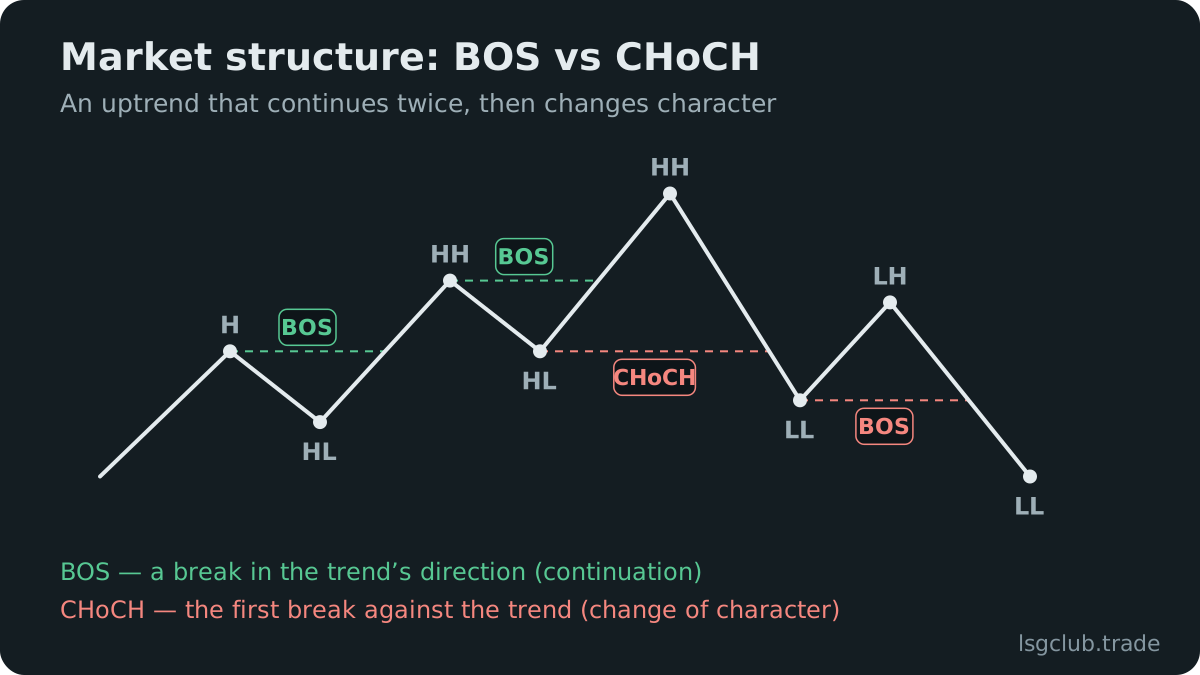
CHoCH vs BOS comes down to one question: does the break go with the current trend or against it. A Break of Structure (BOS) takes out a swing point in the direction of the trend and says the trend is still in control; a Change of Character (CHoCH) breaks the swing that was protecting the trend and is the first sign that control may be changing hands. This guide from the LSG Club trader community shows how to mark the swings correctly, tell the two apart on any timeframe and decide which one deserves your attention.
What BOS and CHoCH mean
Both terms describe price closing beyond a confirmed swing high or swing low. In a bullish market price makes higher highs and higher lows; in a bearish market, lower highs and lower lows. Which swing gets broken decides the label. If you are new to this vocabulary, the Smart Money Concepts beginner’s guide covers the wider framework.
Break of Structure (BOS)
A BOS is a continuation break. In an uptrend, price closes above the last higher high; in a downtrend, below the last lower low. It confirms that the dominant side is still pushing, and it creates a new protected swing behind it: the higher low that launched a bullish BOS, or the lower high that launched a bearish one. The full definition, with internal and swing breaks and the wick-or-close rule, is in what BOS means in trading; this article is about telling the two breaks apart.
Change of Character (CHoCH)
A CHoCH is the first break against the trend. In an uptrend, price closes below the most recent higher low, the swing the buyers had to defend. In a downtrend, price closes above the most recent lower high. It does not prove a reversal; it says the old sequence of higher highs and higher lows (or lower lows and lower highs) is broken and the market now has to show which side takes over.
CHoCH vs BOS: the key differences on the chart
- Direction — a BOS breaks with the trend, a CHoCH breaks against it.
- Swing that is broken — a BOS takes out the latest extreme (higher high or lower low); a CHoCH takes out the protected swing (the higher low in an uptrend, the lower high in a downtrend).
- Frequency — a healthy trend prints many BOS in a row and only one CHoCH at the turn.
- What it asks of you — after a BOS you look for pullback entries with the trend; after a CHoCH you stop adding with the old trend and wait for the new side to prove itself.
- What follows — a real CHoCH is usually followed by a BOS in the new direction; without that follow-through it is often just a deep pullback.
In ICT’s own vocabulary the event closest to a CHoCH is the market structure shift. The difference is in the context ICT demands, a liquidity sweep and displacement, which is covered in the ICT market structure shift guide.
How to mark swing points before you label anything
Most arguments about CHoCH and BOS are really arguments about which swings count. If the swings are marked inconsistently, the labels will be too. Use one fixed procedure and apply it every time.
- Pick the timeframe whose structure you are reading and stay on it while you mark.
- A swing high is a candle with a lower high on each side of it; a swing low is a candle with a higher low on each side. Ignore candles that do not meet that rule.
- A swing only becomes structure once price has moved away from it far enough to break the opposite swing. A small pause inside a leg is not a new high or low.
- Mark the latest extreme (the high or low that would be broken by a BOS) and the protected swing (the one that would be broken by a CHoCH). Two lines, nothing more.
- Wait for a candle body to close beyond a line before you label the break. A wick through the line is a liquidity grab, not a structure break.
Internal vs swing structure
Every leg of a trend contains smaller legs. Smart money traders separate the two layers so that a minor wiggle is not mistaken for a trend change.
Swing structure
Swing structure is made of the major highs and lows that define the trend on your chosen timeframe. A swing CHoCH, for example a close below the last H4 higher low, is a significant event: it changes how you treat every lower-timeframe signal that follows.
Internal structure
Internal structure is the sequence of smaller highs and lows inside one swing leg. During a bullish swing pullback, internal structure is bearish by definition: it makes lower highs and lower lows until the pullback ends. An internal CHoCH back to bullish is often the signal that the pullback is finished and the swing trend is resuming. Internal breaks also create inducement, small obvious levels that pull traders in early, which the ICT inducement article explains in detail.
The practical rule: trade internal signals only in the direction of swing structure, or from a clear higher-timeframe level where you expect the swing trend to turn.
Which timeframe to read structure on
There is no single correct timeframe, but there is a correct order. Read swing structure on a higher timeframe first, then look for the break that times your entry on a lower one. A common stack for intraday traders is D1 or H4 for direction, H1 or M15 for the setup and M5 or M1 for the trigger. Swing traders shift everything up one or two steps.
A bullish CHoCH on M5 inside a clean H4 downtrend is usually a pullback, not a reversal. The same M5 CHoCH, printed after price has reached an H4 discount zone or swept an obvious H4 low, carries more weight because the higher timeframe gives it a reason. This is how structure connects to forming a daily bias: the bias comes from higher-timeframe structure and the draw on liquidity, and lower-timeframe breaks only time the entry.
Worked example: a bullish CHoCH after a downtrend
Example for illustration only. EURUSD on H1 has been making lower lows and lower highs for three sessions. Each new low is a bearish BOS; the most recent lower high, formed during the previous London session, is the protected swing for sellers.
During the next London session price drops below the previous day’s low, sweeping the sell-side liquidity resting there, and then reverses sharply. The rally closes an H1 candle above the protected lower high. That close is the bullish CHoCH. It leaves a fair value gap in the impulsive leg and an identifiable last down-close candle before the rally, the potential order block.
Nothing is confirmed yet. A trader using this framework would wait for price to retrace into the gap or the order block in the lower half of the new leg, then look for the first bullish BOS above the CHoCH high as evidence that buyers are now building higher highs. If price instead closes back below the sweep low, the CHoCH failed and the downtrend is intact. The order block entry rules and the fair value gap strategy cover the entry part in more depth.
CHoCH or BOS: which comes first in a reversal
In a reversal the two breaks arrive in a fixed order. The CHoCH comes first: price closes through the protected swing of the old trend. Then the market pulls back, often into the order block or fair value gap left by the break, and the first BOS in the new direction follows. That BOS is what turns a counter-trend break into a new trend.
Read the sequence, not the single label. A CHoCH without a following BOS is an unconfirmed idea. A BOS in the old direction after a CHoCH cancels the reversal and the trend resumes. Waiting for the pullback and the confirming BOS costs some of the move, but it removes most of the trades that would have been stopped out by a deep pullback.
Common mistakes when reading CHoCH and BOS
- Labeling every minor high — marking swings that do not meet the swing rule produces a CHoCH every hour and makes the concept useless.
- Mixing timeframes — calling an M5 break a trend change while H4 structure is untouched.
- Trading the CHoCH candle itself — entering at market on the break usually means buying the top of the impulse; the better price comes on the retracement.
- Ignoring the sweep — a CHoCH that follows a liquidity grab has a reason behind it; one that appears in the middle of a range often does not.
- Never invalidating — every structure trade needs a level where the idea is wrong, normally beyond the swing that produced the break.
How to journal structure breaks
Tag each trade with the break that triggered it (internal or swing, BOS or CHoCH), the timeframe it printed on, whether a sweep came first, and whether the break closed with displacement. After a few dozen trades you can filter by tag and see which combinations actually worked for you instead of relying on memory. The journal demo shows how trades sit on a real chart with stop and target zones, which makes the post-trade review of a structure break much faster.
For the change of character on its own — internal vs swing CHoCH, valid vs fake ones and entries after it — see what is CHoCH in trading.
FAQ
Is CHoCH the same as MSS in ICT?
They describe a similar event: the first break against the prevailing structure. ICT’s market structure shift adds context, a sweep of liquidity before the break and displacement through the swing. Many traders use CHoCH for any counter-trend break and reserve MSS for breaks that meet those extra conditions.
How do I tell a CHoCH from a deep pullback?
You cannot at the moment of the break. A CHoCH becomes a reversal only when price pulls back and then makes its first BOS in the new direction; if the old trend breaks structure again instead, it was a pullback. Mark both outcomes in your journal and you will learn how often each happens on your pairs and timeframe.
Is CHoCH or BOS more important for entries?
They serve different trades. A BOS supports continuation entries on pullbacks within an established trend; a CHoCH is the starting point for reversal ideas. Neither is an entry signal by itself, both need a price level to enter from and a defined invalidation.
Can a CHoCH fail?
Often. A CHoCH that is not followed by a BOS in the new direction is frequently just a deep pullback in the old trend. That is why many traders wait for the retracement and the first confirming break instead of acting on the CHoCH alone. Trading involves risk, and no structure signal removes it.