Smart Money Concepts (SMC) Trading: Complete Beginner's Guide
A learning path for Smart Money Concepts: the first five concepts in order, one simple setup, demo practice, journaling and beginner mistakes.
Smart Money Concepts (SMC) trading is a way of reading price through liquidity and market structure: where stop orders cluster, how price raids them, and which zones it returns to before the next move. This beginner’s guide gives you a learning path rather than a list of terms — the first five concepts in the order that makes sense, one simple setup, a demo phase and a journaling routine. It is the same path many newer members of the LSG Club trader community follow before they risk real money.
What Smart Money Concepts trading is and is not
SMC assumes that large participants need liquidity to fill big orders, and that the easiest liquidity sits where retail traders put their stops: just above highs and just below lows. Price often runs those levels, then moves in the opposite direction. SMC trading tries to wait for that run and join the move that follows.
It is a model, not a view into bank order books. Nobody sees institutional orders on a retail chart, and every SMC setup can fail. SMC grew largely out of ICT (Inner Circle Trader) teaching, so you will see the same ideas with slightly different names. What SMC gives a beginner is structure: clear rules for where to look, when to act and where the trade is wrong.
The first five SMC concepts to learn
Learn these in order and spend a few days on each, marking them on past charts before you move on. Each builds on the previous one.
1. Market structure: swings, BOS and CHoCH
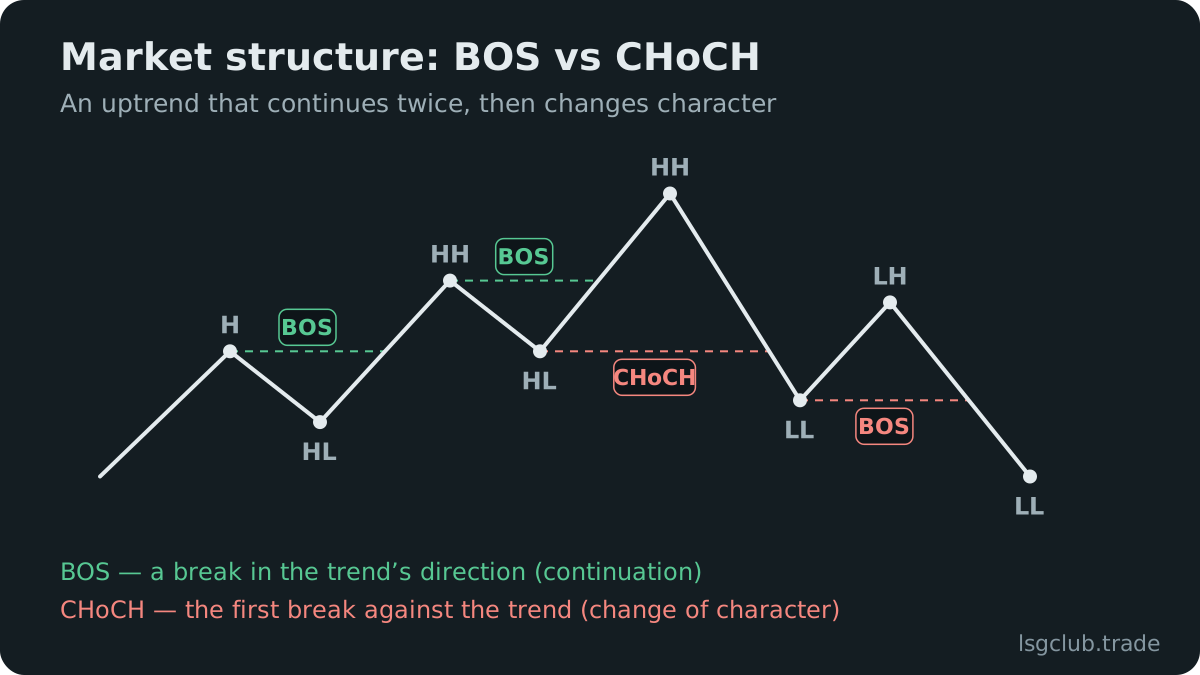
An uptrend makes higher highs and higher lows; a downtrend makes lower highs and lower lows. A break of structure (BOS) is a candle close beyond the last swing in the trend’s direction. A change of character (CHoCH) is the first break against it. Start on H1 and mark only clear swings — the ones you would notice without zooming in. The difference is explained in CHoCH vs BOS: reading smart money structure.
2. Liquidity: buy-side and sell-side
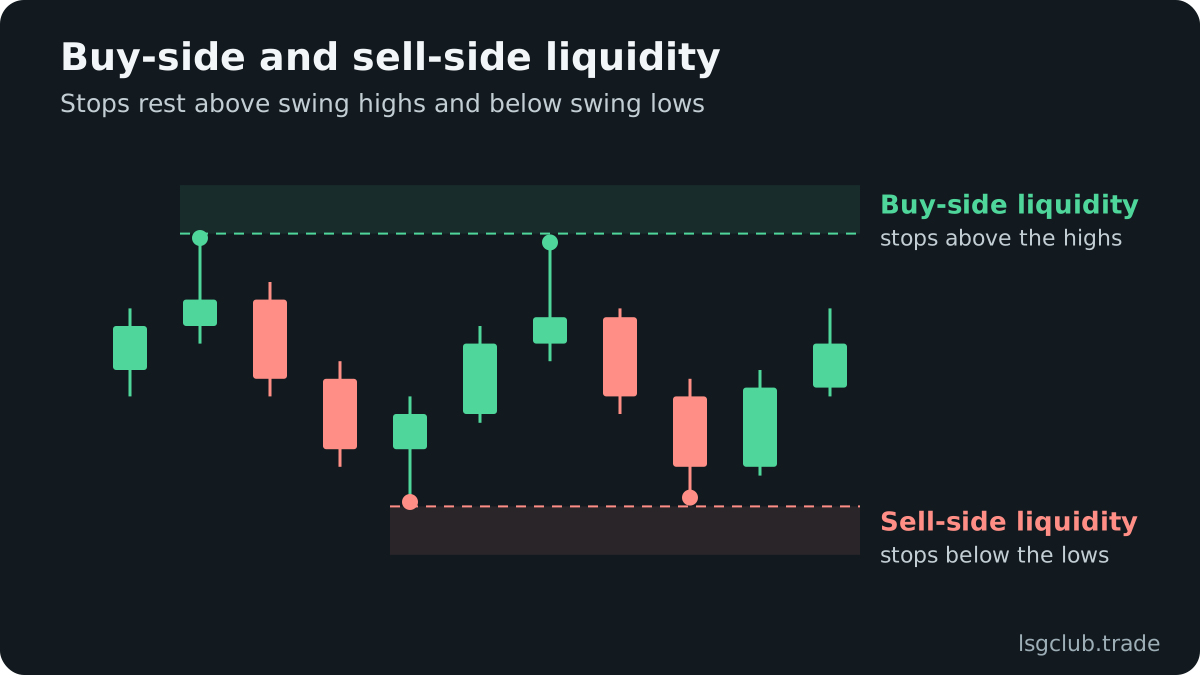
Buy-side liquidity rests above highs, sell-side liquidity below lows. Equal highs, equal lows and the previous day’s high and low are the most obvious pools. When price trades through one and quickly returns, that is a liquidity sweep. Read what a liquidity sweep is and how to trade it before you take any reversal trade.
3. Order blocks
An order block is the last opposing candle before a strong move that breaks structure — the last down-candle before a bullish break, for example. Beginners mark far too many. Keep only the ones that caused a break of structure and left an imbalance behind. The order block entry rules cover how to refine and trade them.
4. Fair value gaps
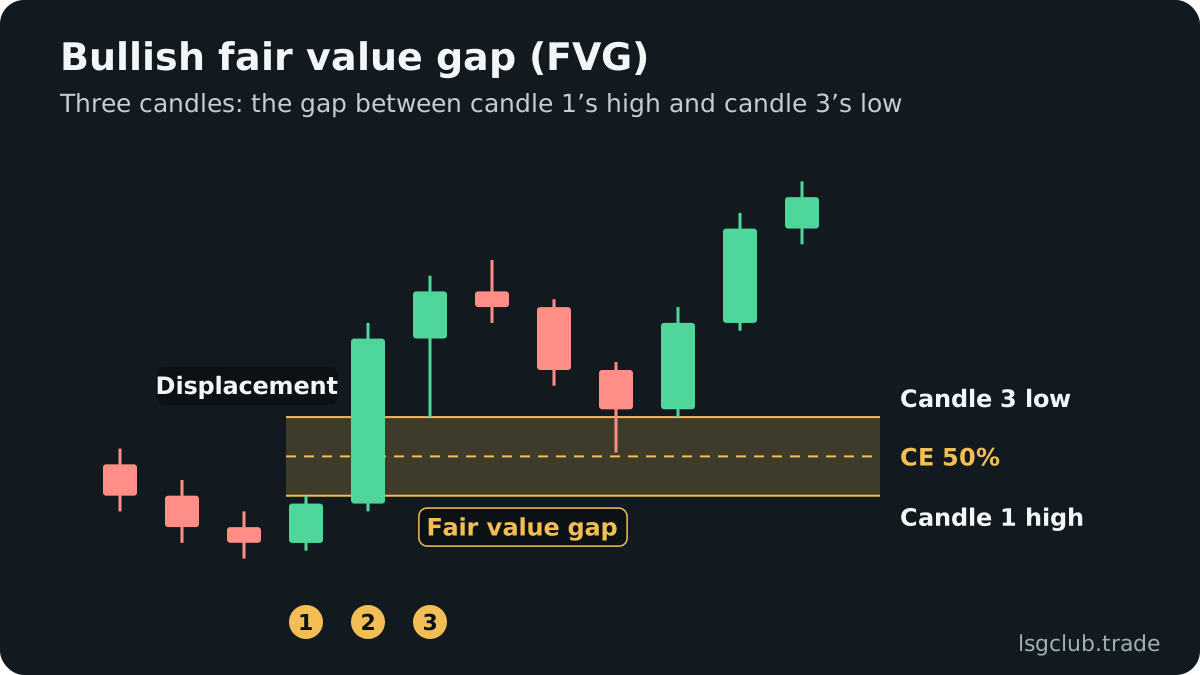
A fair value gap (FVG) is a three-candle pattern in which the wicks of the first and third candles do not overlap. It shows that price moved one way with little opposition. Price often returns to fill part of the gap, which makes it a natural entry area. See the fair value gap trading strategy for the details.
5. Premium and discount
Draw a range from a swing low to a swing high. The 50% level is equilibrium; above it is premium, below it is discount. Look for buys in discount and sells in premium. This one filter removes many poor entries — the full method is in ICT premium and discount zones.
A simple first SMC setup
Once the five concepts make sense, combine them into one setup and trade nothing else for a while. The version below is deliberately plain: one higher-timeframe direction, one sweep, one confirmation, one entry zone.
Context on H4 and H1
Decide the direction on H4: is structure bullish or bearish, and which obvious liquidity pool is price most likely heading toward? Then mark the current H1 range and note whether price is in premium or discount. If the picture is unclear, there is no trade today.
Trigger on M15 or M5
Wait for price to sweep liquidity against your direction — for a long, a run below a recent low. Then wait for a CHoCH back in your direction, made by a strong candle that leaves a fair value gap or a clean order block.
Entry, stop and target
- Place a limit order in the fair value gap or order block created by the CHoCH, ideally in discount for a long.
- Put the stop beyond the sweep extreme — below the low that took the liquidity.
- Set the first target at the nearest opposing liquidity, such as the high that started the pullback.
- Size the position so the distance to the stop equals a fixed small share of the account, for example 0.5–1% while learning.
- If the order is not filled before price reaches the target, cancel it and do not chase.
Example (illustrative only): EURUSD is bullish on H4. During the London session price dips under the Asian low, then an M5 candle breaks the last lower high and leaves a gap. The long limit goes into the gap, the stop below the sweep low, the target at the previous day’s high. If the gap sits above the H1 midpoint, in premium, a careful beginner skips it.
Practice on demo before risking money
A demo account is where you prove that you can follow the setup, not where you prove that it makes money. Treat it like a real account: same risk per trade, same session, same rules. Collect a meaningful sample — a few dozen trades of the same setup — before drawing any conclusion, because ten trades tell you almost nothing.
Trade at a fixed time. SMC setups tend to read cleaner during the London and New York sessions, when liquidity is deepest, so pick one of them and ignore the rest of the day while you learn.
Journal every SMC trade
Without notes, a beginner remembers the wins and forgets why the losses happened. Log each trade right after you close it with the same fields every time:
- Higher-timeframe bias — bullish or bearish on H4, and the liquidity pool you expected price to reach.
- Liquidity swept — which level was taken before entry, with a screenshot.
- Confirmation — CHoCH or BOS, and on which timeframe.
- Entry zone — FVG or order block, and whether it was in premium or discount.
- Session and time — when the trade was opened.
- Result in R — profit or loss divided by the initial risk, so trades compare fairly.
- Rule check — did you follow every step, yes or no.
After every 20 trades, sort them by rule check. If the trades where you broke a rule lose more, the fix is discipline, not a new strategy. A ready-made field list is in the ICT trading journal template, and you can see a journal filled with sample trades in the LSG journal demo.
Common SMC beginner mistakes
- Marking every candle as an order block — if a zone did not cause a break of structure, it is just a candle.
- Entering on the sweep itself — a sweep without a structure shift is just price moving; wait for confirmation.
- Ignoring the higher timeframe — a perfect M5 setup against H4 structure is a low-quality trade.
- Trading all day — outside the active sessions, sweeps and breaks are smaller and less reliable.
- Moving the stop after entry — the stop marks where the idea is wrong; widening it turns a small loss into a large one.
- Switching setups after three losses — losing streaks are normal; judge a setup on a large sample, not on a bad week.
FAQ
Is SMC trading good for beginners?
It can be, because the rules are visual and the stop always has a logical place. The risk is information overload: there are dozens of SMC terms. Beginners do better learning five concepts and one setup first, then adding more only when the journal shows a need.
What is the difference between SMC and ICT?
SMC is largely a simplified, community-built version of ideas taught by ICT. Both use liquidity, structure, order blocks and fair value gaps. ICT puts more weight on time (Kill Zones) and named models, while SMC material often focuses on zones and structure, with some terms such as CHoCH and inducement named differently.
Which timeframe is best for SMC beginners?
Use H4 for direction, H1 for the range and M15 or M5 for entries. Lower timeframes such as M1 produce many more signals and many more false ones, which is harder to manage while you are still learning to read structure.
How long does it take to learn SMC trading?
There is no fixed timeline. A practical milestone is being able to mark structure, liquidity and zones consistently on past charts, then taking a few dozen demo trades of one setup while following every rule. Only after that does it make sense to judge results, and trading always involves the risk of loss.