ICT Premium and Discount: How to Only Enter in the Right Zone
How to draw the dealing range, use the 50% equilibrium and the 62–79% OTE zone, and buy only in discount and sell only in premium.
ICT premium and discount is a location filter: draw a dealing range, split it at 50%, and only buy below that line (discount) and only sell above it (premium). It stops you from buying after price has already rallied or selling after it has already dropped, the two entries that give the worst risk-reward. This guide shows how to choose the right range, why equilibrium matters, how the 62–79% optimal trade entry zone fits inside, and how to log every entry by zone in a free ICT trading journal from LSG Club.
What premium and discount mean in ICT
Price inside any range is either relatively expensive or relatively cheap. ICT calls the upper half of the range premium and the lower half discount. The dividing line, the 50% level, is equilibrium: the price where the range is in balance.
The logic is about who gets a good price. Large participants accumulate long positions when price is cheap relative to the range and distribute them when it is expensive. A retail trader buying in premium is often buying from those participants as they take profit. The filter does not tell you which way price will go next; it tells you which side of the range is worth trading for the direction you already expect.
How to draw the dealing range
Premium and discount mean nothing without a correctly chosen range. Most mistakes with this concept are range mistakes, so it deserves its own process.
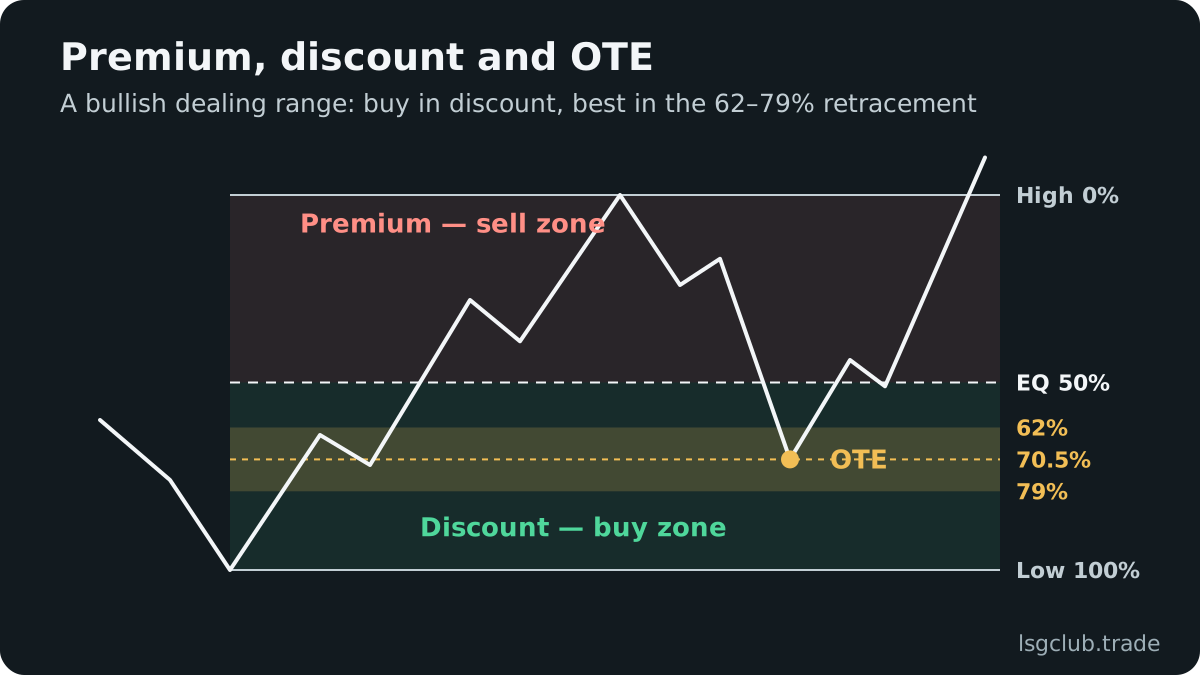
Choose the right swing points
For a bullish range, anchor the swing low that started the current leg and the swing high it made. For a bearish range, the swing high that started the leg and the low it made. Use the wicks, not the bodies. The best ranges are defined by a leg that took liquidity at one end and broke structure at the other, as described in CHoCH vs BOS.
Choose the timeframe
The range should match the trade you plan. For a day trade, the H4 or H1 leg that frames the session is usually right; for a swing trade, the daily leg. A range drawn on M5 changes every hour and filters almost nothing. If you take your bias from the daily chart, check where price sits in the daily range too, so the two do not contradict each other.
Know when to redraw
A range stays valid until price closes beyond either end. When a bullish leg makes a new high, the high anchor moves up and equilibrium moves with it. When price closes below the swing low, the bullish range is broken, and you look for a new bearish leg instead of continuing to buy the old discount.
Equilibrium: the 50% line of the range
Equilibrium is the midpoint of the dealing range: add the high and the low and divide by two. ICT treats it as fair value. Price frequently reacts there, but the main job of the level is to split the range into the half you trade and the half you ignore.
Treat equilibrium as a boundary, not an entry signal. A long taken exactly at 50% has no margin of safety; a long taken deeper in discount gives a tighter stop to the swing low and a longer path to the high. If price trades straight through equilibrium and closes beyond the range, the range was wrong or the leg is over.
Optimal trade entry inside discount and premium
The optimal trade entry (OTE) zone refines where inside discount or premium to enter. It is the 62% to 79% retracement of the leg, with 70.5% as its midpoint. Because these retracements are deeper than 50%, the OTE zone for a long always sits inside discount, and the OTE zone for a short always sits inside premium.
- 62% retracement — the shallow edge of the zone; entries here fill most often.
- 70.5% retracement — the midpoint ICT highlights as the preferred level.
- 79% retracement — the deep edge; beyond it the leg is close to failing.
- Below 100% (for a long) — the swing low is taken and the range is broken.
OTE is most useful when a PD array sits inside it, for example a bullish order block or fair value gap between the 62% and 79% levels. The ranking of those arrays is covered in ICT PD arrays explained.
Buy in discount, sell in premium: the rules
The filter only works when it is applied the same way every time. Here is the sequence for both directions.
Long setup in discount
- Confirm a bullish bias from your daily bias routine and mark the buy-side liquidity price is likely to reach.
- Draw the dealing range from the swing low to the swing high and mark 50%, 62%, 70.5% and 79%.
- Wait for price to trade below equilibrium; ignore every long signal while price is in premium.
- Look for a discount PD array in or near the OTE zone, ideally after a sweep of a short-term low.
- Enter on your trigger, with the stop below the array or below the swing low of the range.
- Target the range high first, then the external liquidity beyond it.
Short setup in premium
Mirror every step. Draw the range from the swing high to the swing low, wait for price to trade above equilibrium, look for a premium array in the 62–79% retracement after a sweep of a short-term high, and place the stop above the array or the swing high. Target the range low, then the sell-side liquidity below it. A liquidity sweep into premium is often the clearest short trigger.
Worked example: measuring the zones (illustration)
This is a teaching example with round numbers, not a trade record. On a currency pair with a bullish daily bias, the H4 leg runs 100 pips from a swing low to a swing high. Equilibrium is 50 pips below the high. The OTE zone runs from 62 to 79 pips below the high, with its midpoint at 70.5 pips.
During the London Kill Zone (02:00–05:00 New York time), price retraces 55 pips. It is in discount but above the OTE zone, so the trader waits. Price then runs a short-term low and reaches 68 pips below the high, where an unmitigated H1 bullish fair value gap sits. The trader buys on an M15 structure shift at that level, places the stop below the range low (32 pips of risk), and targets the range high, roughly 2R away, and the old daily high above it. Had price closed below the range low, the idea would have been abandoned.
Common premium and discount mistakes
- Anchoring random swings — a range must come from a leg with a clear start and end, not two arbitrary candles.
- Mixing timeframes — taking the bias from the daily range and the location from an M5 range.
- Buying premium because the trend is up — a bullish trend still offers discount on every retracement.
- Using 50% as a trigger — equilibrium is a boundary; you still need an array and a trigger.
- Holding on to a broken range — once a close beyond the anchor occurs, the old discount no longer exists.
- Ignoring the draw on liquidity — a perfect discount entry against the day’s target is still a countertrend trade.
To measure whether the filter helps you, tag every trade with its zone at entry (premium, discount or equilibrium) and the retracement level in percent. After a meaningful sample, compare results in R by zone. Trading involves risk, and the filter will not make every trade work; it shows whether your entries are coming from the right place.
Frequently asked questions
How do you calculate premium and discount in ICT?
Mark the high and low of the dealing range and find the midpoint: high plus low divided by two. Above that level is premium, below it is discount. A Fibonacci tool set to 0, 0.5 and 1 does the same on the chart.
Can you buy in premium in an uptrend?
ICT’s rule is to wait for discount, even in an uptrend, because each bullish leg retraces before the next one. Buying in premium usually means a wider stop and a smaller distance to the target.
Is OTE the same as discount?
No. Discount is the whole lower half of the range; OTE is a narrower band within it, the 62–79% retracement, with 70.5% as its midpoint. Every long OTE entry is in discount, but not every discount entry is in OTE.
Which timeframe should the dealing range use?
Use the timeframe that frames the trade: H4 or H1 for intraday trades, daily for swing trades. Check that it agrees with the next higher range so you are not buying discount of a small range that sits in premium of a larger one.