What Is CHoCH in Trading? Change of Character Explained
CHoCH in trading: what a change of character is, how to mark it on the chart, internal vs swing CHoCH, and how traders use it for entries.
CHoCH in trading stands for Change of Character: the first candle close through the swing that was protecting the current trend, the last higher low in an uptrend or the last lower high in a downtrend. It is the earliest structural sign that control may be passing from buyers to sellers, or the other way round. This guide from LSG Club, a journal for tracking CHoCH entries, explains what a CHoCH is, how to mark it step by step, the difference between internal and swing CHoCH, how it relates to ICT’s market structure shift, how to tell a valid CHoCH from a fake one and how traders build entries after it.
The short answer to “what does CHoCH mean in trading” is this: a CHoCH does not mean the trend has reversed. It means the old pattern of higher highs and higher lows (or lower lows and lower highs) has been broken once, against the trend. Whether a new trend follows is decided by what price does next, not by the break itself.
What is CHoCH in trading?
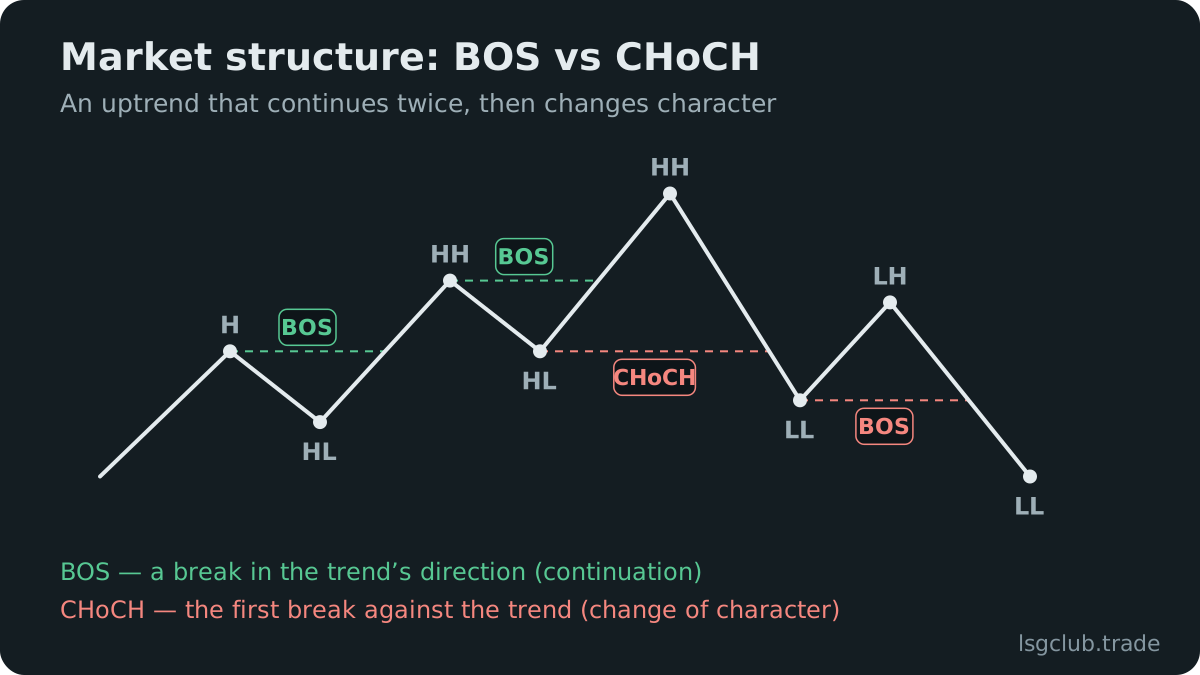
Market structure is read from swing points. A bullish market keeps printing higher highs and higher lows; each close above the latest high is a break of structure (BOS) in the direction of the trend. Behind every new high sits the higher low that launched it. That low is the protected swing: as long as buyers defend it, the uptrend is intact.
A change of character is the moment that protected swing fails. In an uptrend, a candle body closes below the most recent higher low. In a downtrend, a candle body closes above the most recent lower high. The term comes from the Smart Money Concepts (SMC) community, which built its vocabulary on top of the ideas taught by ICT, Michael J. Huddleston. ICT’s own name for the closest event is the market structure shift, covered further down.
Bullish CHoCH and bearish CHoCH
- Bearish CHoCH — the market was making higher highs and higher lows, and a candle closes below the last higher low. Sellers have broken the level buyers had to hold.
- Bullish CHoCH — the market was making lower lows and lower highs, and a candle closes above the last lower high. Buyers have broken the level sellers had to hold.
- What it changes — after a CHoCH you stop treating pullbacks as buying (or selling) opportunities in the old direction and start watching for the first BOS in the new one.
How to mark a CHoCH on the chart step by step
Most disagreements about a change of character are really disagreements about which swings count. If you mark swings loosely, you will see a CHoCH on every chart. Use one fixed procedure and apply it every time.
- Pick the structure timeframe first. Decide where you read the trend, for example H4 or H1, before you look at anything lower.
- Mark confirmed swings only. A swing high is a candle with a lower high on each side; a swing low has a higher low on each side. Count a swing only after price has moved away far enough to form the next swing in the opposite direction.
- Label the trend. Higher highs and higher lows make it bullish; lower lows and lower highs make it bearish. If the sequence is mixed, there is no trend to change and no CHoCH to mark.
- Find the protected swing. In an uptrend it is the higher low that produced the most recent BOS. In a downtrend it is the lower high that produced the most recent bearish BOS. Draw a horizontal line from it.
- Wait for a body close through that line. A wick through the level with a close back inside is a sweep of liquidity, not a CHoCH.
- Note how the close happened. A fast leg of large candles (displacement) and a fair value gap left behind make the CHoCH more meaningful than a slow drift that barely closes beyond the level.
- Mark the new protected swing. After a bearish CHoCH, the high that started the drop becomes the level sellers must defend; a close back above it cancels the idea.
The swing-marking rules are the same as for a break of structure; the full explanation of which swings a break can take out is in What Is BOS in Trading.
Internal CHoCH vs swing CHoCH
Every trend leg contains smaller legs. SMC traders read two layers of structure on the same chart, and a CHoCH can happen on either one. Confusing them is the most common reason traders call reversals that never come.
Swing CHoCH
A swing CHoCH breaks a major protected swing on your structure timeframe, such as a close below the last H4 higher low. It is a significant event. It changes your bias from continuation to “possible reversal” and changes how you read every lower-timeframe signal that follows. Swing CHoCHs are rare; a clean trend may print five or six BOS before one appears.
Internal CHoCH
An internal CHoCH breaks a minor swing inside one leg. During a pullback in a bullish swing trend, the internal structure is bearish by definition: it makes lower highs and lower lows until the pullback ends. The first internal close back above a minor lower high is an internal bullish CHoCH, and it is often the signal that the pullback is over and the swing trend is resuming.
The practical rule follows from this: an internal CHoCH is useful as an entry trigger in the direction of swing structure, or at a strong higher-timeframe level where you expect the swing trend to turn. An internal CHoCH against swing structure, in the middle of nowhere, is mostly noise. Internal breaks also create inducement, small obvious highs and lows that attract early entries before the real move, described in ICT inducement and liquidity pools.
CHoCH vs BOS in one paragraph
A BOS breaks structure with the trend and confirms continuation; a CHoCH breaks the protected swing against the trend and is the first warning of a possible change. A trend prints many BOS and only one CHoCH at the turn, and in a real reversal the CHoCH comes first and the first BOS in the new direction follows. The side-by-side comparison, with the order of breaks in a reversal, is in CHoCH vs BOS: market structure explained.
CHoCH vs MSS: how the ICT version differs
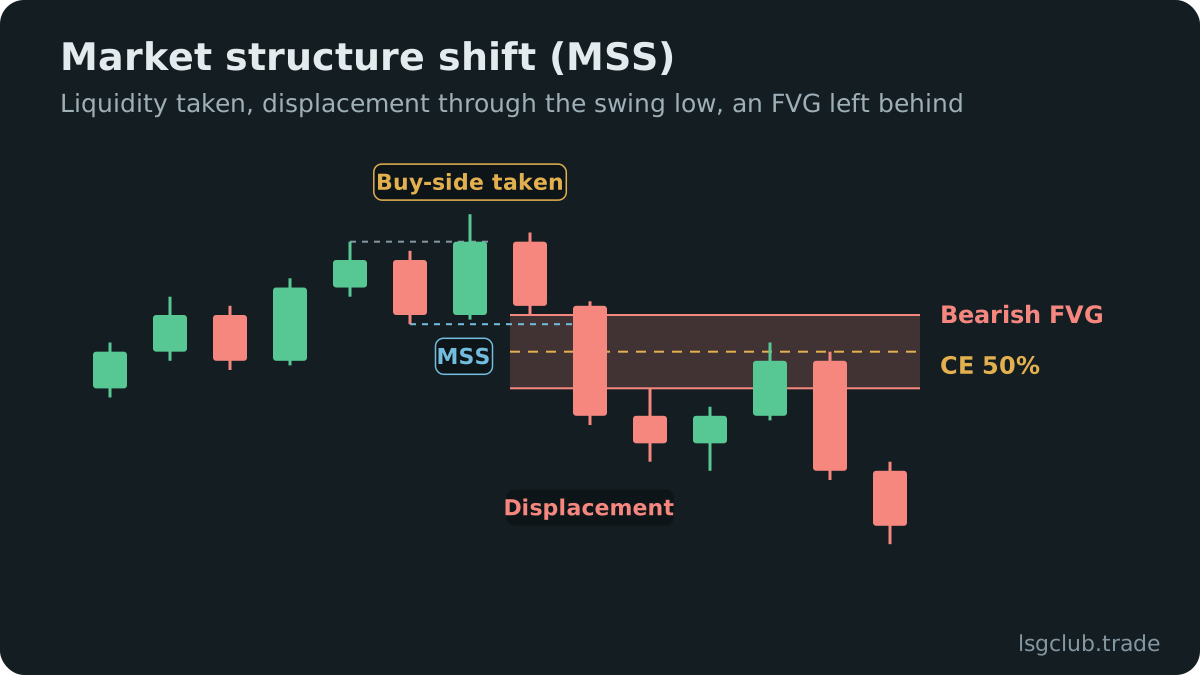
ICT does not use the term CHoCH. He teaches the market structure shift (MSS): a displacement break of the short-term swing that launched the most recent move, printed right after price has swept liquidity on the other side. The two describe a similar event, but the MSS is narrower.
- Context — any first break against the trend can be called a CHoCH; an MSS requires a liquidity sweep before the break, such as a run on the previous day’s high or a cluster of equal lows.
- Speed — a CHoCH can be a slow close; an MSS requires displacement, large-bodied candles that move through the swing with little overlap.
- Footprint — an MSS normally leaves a fair value gap that becomes the entry zone; a plain CHoCH may leave nothing to enter from.
- Use — CHoCH is a structure label; MSS is an entry trigger with a defined sequence of sweep, shift and retracement.
In practice, many traders call every counter-trend break a CHoCH and treat only the ones that meet the three MSS conditions as tradable. The detailed rules are in the ICT market structure shift guide. A related ICT idea, the change in state of delivery, looks at candle bodies rather than swing points and often prints a little earlier; see ICT CISD explained.
Valid CHoCH vs fake CHoCH
Many CHoCHs fail. Price closes through the protected swing, traders flip their bias, and the old trend resumes a few candles later. You cannot know at the moment of the break which kind you are looking at, but you can stack the odds by checking the conditions that tend to separate the two.
Signs of a stronger CHoCH
- It follows a sweep of an obvious pool of liquidity, such as the previous day’s low, the Asian range or relative equal highs. The liquidity sweep guide explains how to spot them.
- It happens at a higher-timeframe level: a daily order block, a weekly fair value gap or the far end of a dealing range.
- The break is displacement, not drift, and it leaves a fair value gap in the leg.
- It breaks a swing on your structure timeframe, not only a minor internal swing.
- It prints during an active session, when real volume is behind the move, rather than in a thin hour.
Signs of a fake CHoCH
- Only a wick crosses the protected swing, and the candle closes back inside.
- The break happens in the middle of a range, with no higher-timeframe reason for the trend to turn.
- The break is slow and overlapping, with no gap, and the next candles drift back toward the level.
- It is an internal break against a strong swing trend, often just the end of a pullback’s own structure.
- The old trend prints a new BOS in its original direction before the new side makes any BOS of its own. That cancels the CHoCH.
How to trade after a CHoCH: entries, stops and targets
A CHoCH is not an entry signal by itself. Buying or selling the break candle usually means taking the worst price of the move, with a stop far away. Traders who use change of character in a plan typically wait for price to come back into the leg that made the break.
Entry options
- Fair value gap retracement — a limit order at the edge of the gap left by the CHoCH leg. The fair value gap trading strategy covers how to grade the gap.
- Order block retracement — an entry at the last opposite-coloured candle before the breaking leg.
- Optimal trade entry — the 62–79% retracement of the breaking leg, often combined with a gap inside that zone; see the ICT optimal trade entry guide.
- Confirmation entry — waiting for the first BOS in the new direction, then entering on the pullback after it. It costs part of the move but filters out many failed CHoCHs.
Stop placement
The natural stop sits beyond the extreme that produced the CHoCH: below the sweep low for a bullish CHoCH, above the sweep high for a bearish one, plus the spread and a small buffer. If price returns there, the change of character has failed and the idea is invalid. A stop placed only beyond the entry zone, with the extreme still untouched, is easy to run.
Targets
The first target is usually the nearest opposing liquidity: the swing high or low that the old trend left behind, or equal highs and lows on the other side of the range. Check that the distance gives a reward-to-risk ratio worth the trade before you place the order, and size the position from the stop distance, not from a fixed lot. The position size calculator does that arithmetic. Trading involves risk; practise any structure-based entry on a demo account first.
Worked example: a bullish CHoCH on GBPUSD H1
Example for illustration only. GBPUSD on H1 has been falling for two days. The latest lower low is 1.2712, and the lower high that launched that drop, the protected swing for sellers, is 1.2768. The previous day’s low is 1.2705.
- Sweep — early in the London session price drops to 1.2698, seven pips below the previous day’s low, taking the sell-side liquidity resting there.
- Break — price reverses with three large bullish candles. One H1 candle closes at 1.2774, above the protected lower high at 1.2768. That close is the bullish CHoCH; the leg tops out at 1.2779.
- Footprint — the impulsive leg leaves a fair value gap between 1.2731 and 1.2745.
- Plan — a buy limit at 1.2745, the top of the gap. Stop at 1.2693, five pips below the sweep low. Risk: 1.2745 − 1.2693 = 52 pips.
- Target — the buy-side liquidity above the last swing high at 1.2850. Reward: 1.2850 − 1.2745 = 105 pips, about 2.0R (105 ÷ 52 = 2.02).
- Size — on a 10,000 USD account risking 1%, the loss at the stop must be 100 USD. At roughly 10 USD per pip per standard lot, 100 ÷ (52 × 10) ≈ 0.19 lots.
- Management — the first bullish BOS, a close above 1.2779, would confirm that buyers are building higher highs. A close back below 1.2698 would mean the CHoCH failed and the downtrend is intact.
Notice what the example does not do: it does not buy the CHoCH candle at 1.2774, which would have required a stop 81 pips away for the same target, a ratio of about 0.9R.
Common CHoCH mistakes
- Calling a CHoCH on a wick. Without a body close it is a sweep, and sweeps often precede continuation.
- Marking unconfirmed swings, so that every small pullback becomes a “change of character”.
- Treating an internal CHoCH as a swing reversal and trading against a clean higher-timeframe trend.
- Entering on the break candle instead of waiting for the retracement, which ruins the reward-to-risk ratio.
- Ignoring the timeframe: an M5 CHoCH inside an H4 trend is usually a pullback inside that trend.
- Keeping the reversal idea after the old trend prints a new BOS. At that point the CHoCH is cancelled.
- Never measuring results. Without tagged trades you do not know whether your CHoCH entries actually pay.
CHoCH checklist before you take a trade
- Is there a clear trend on the structure timeframe, with confirmed swings?
- Did a candle body close through the protected swing, not just a wick?
- Is it a swing CHoCH, or an internal CHoCH in the direction of swing structure?
- Was liquidity swept before the break, and is price at a higher-timeframe level?
- Did the break come with displacement and leave a gap or order block to enter from?
- Is the stop beyond the extreme that produced the CHoCH, and does the target give an acceptable ratio?
- Is the position sized from the stop distance?
- What exactly cancels the idea: a close back beyond which level?
How to journal CHoCH trades
Tag each trade with the type of break (internal or swing CHoCH), the timeframe, whether a sweep came first, whether the break had displacement and a gap, and which entry you used: gap, order block, OTE or confirmation BOS. Record the CHoCHs you skipped as well. After 30 or more trades, filter by tag and compare results in R. Most traders find that one or two variants carry their results and the rest cost money. An ICT trading journal that shows each trade on a real chart with its stop and target makes this review much faster.
FAQ
What does CHoCH mean in trading?
CHoCH means Change of Character. It is the first candle close through the swing that protected the trend: below the last higher low in an uptrend, or above the last lower high in a downtrend. It signals that control may be changing, not that a reversal is confirmed.
Is CHoCH the same as a reversal?
No. A CHoCH is the first step of a possible reversal. The reversal is confirmed only when price pulls back and makes its first break of structure in the new direction. If the old trend breaks structure again instead, the CHoCH was a deep pullback.
Is CHoCH an ICT concept?
The term comes from the Smart Money Concepts community. ICT (Michael J. Huddleston) teaches the market structure shift, a related event that adds a liquidity sweep before the break and displacement through the swing. Many traders use both terms side by side.
What timeframe is best for CHoCH trading?
There is no single best one, but there is an order: read swing structure on a higher timeframe such as H4 or D1, then look for a CHoCH on a lower one, such as M15 or M5, to time the entry at a higher-timeframe level. A lower-timeframe CHoCH against the higher-timeframe trend is usually a pullback.
Does a wick count as a change of character?
Under the stricter convention, no. A wick through the protected swing that closes back inside is read as a liquidity sweep. Some traders accept wicks on higher timeframes; whichever rule you choose, apply it the same way on every chart.