ICT Market Structure Shift (MSS): Definition and Entry Rules
What an ICT market structure shift is, the sweep, displacement and FVG that make it valid, and step-by-step entry, stop and target rules.
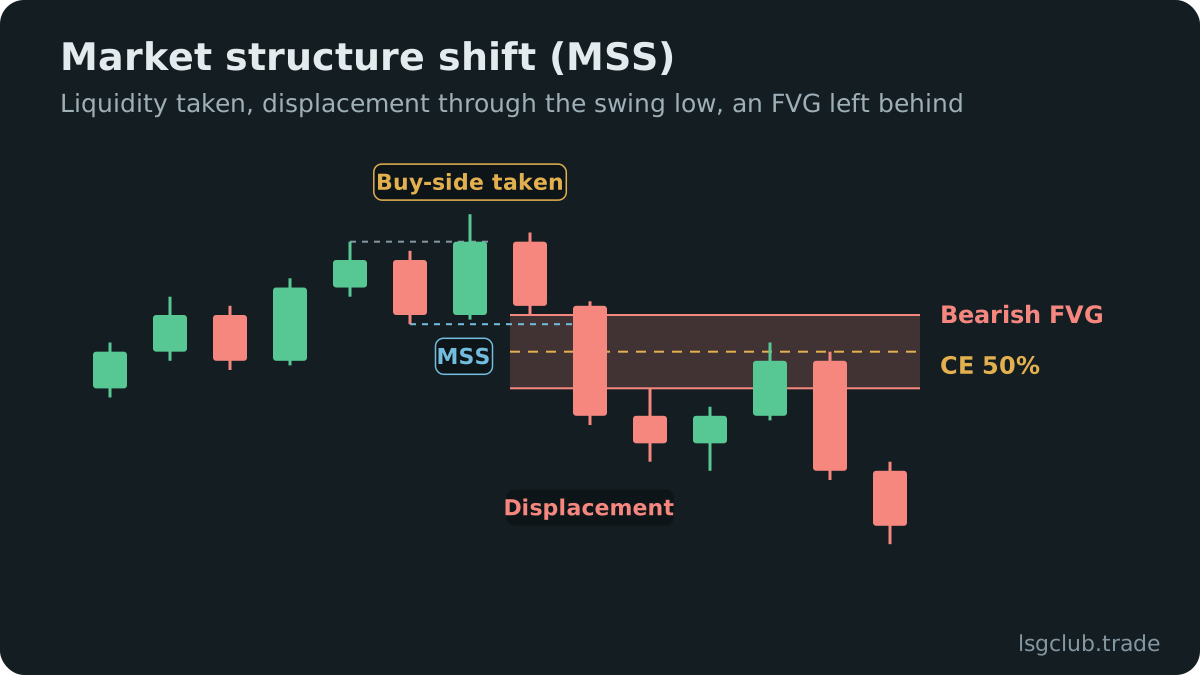
An ICT market structure shift (MSS) is a displacement break of the short-term swing that launched the most recent move, printed right after price has swept liquidity on the other side. It is not a trend label but an entry trigger: sweep, shift, then a retracement into the gap the shift left behind. This guide from LSG Club covers the definition, the three conditions that make an MSS worth trading and a step-by-step set of entry rules.
What a market structure shift is in ICT
In ICT’s model, price moves from one pool of liquidity to another. Before a meaningful reversal it usually runs the stops resting beyond an obvious high or low, then turns. The market structure shift is the moment that turn becomes visible: price breaks the short-term swing that produced the run on liquidity, and does it with force.
For a bearish MSS, price takes out buy-side liquidity above a high, then drops and closes below the short-term swing low that the final push up started from. For a bullish MSS, price runs sell-side liquidity below a low, then rallies and closes above the short-term swing high that the final push down started from. The broken swing is small and local, which is why the MSS is an early signal rather than a confirmed trend reversal.
The three conditions of a valid MSS
Breaks of minor swings happen all day. What separates a tradable market structure shift from noise is the sequence around it.
A liquidity sweep first
The shift should follow a raid on an obvious pool: the previous day’s high or low, the Asian range, relative equal highs or lows, an old session extreme. The sweep is the reason for the reversal; without it, a break of a minor swing is usually just a pullback. The liquidity sweep guide explains how to spot a raid that actually reverses.
Displacement through the swing
Displacement is a fast, one-directional move made of large-bodied candles with little overlap. It shows that one side is executing aggressively. A slow drift that barely closes beyond the swing does not qualify, however neat the drawing looks.
A fair value gap left behind
Real displacement tends to leave a fair value gap, a three-candle imbalance where the wicks of the first and third candle do not overlap. That gap becomes the entry zone on the retracement. If the displacement leg has no gap, there is no clean place to enter. The fair value gap trading guide covers how to mark and grade these gaps.
Market structure shift vs a plain CHoCH
In SMC terminology, a change of character is any first break against the trend. The ICT market structure shift is narrower. The full comparison of trend breaks lives in the CHoCH vs BOS article; the differences that matter for entries are these:
- Context — an MSS requires a liquidity sweep just before the break; a CHoCH can appear anywhere.
- Quality of the break — an MSS breaks with displacement; a CHoCH only needs a close beyond the swing.
- Which swing — an MSS breaks the short-term swing behind the sweep leg, often on M1 to M15; a CHoCH is usually read on the protected swing of the trend you are tracking.
- Purpose — a CHoCH describes structure; an MSS is an entry trigger with a defined entry zone, stop and target.
MSS entry rules step by step
- Set the higher-timeframe bias first. Decide from H4 and D1 which side of the market you expect to be drawn to, as described in the ICT daily bias tutorial. Only take shifts that point toward that draw.
- Mark the liquidity you expect to be raided: the previous day’s high or low, the session highs or lows, equal highs or lows near your bias.
- Wait for the time window. ICT traders look for the raid and the shift inside a Kill Zone, for example London 02:00–05:00 or New York AM 07:00–10:00 New York time.
- Watch for the sweep, then the displacement close through the short-term swing on your execution timeframe (M5 or M15 for most intraday traders, M1 for scalpers).
- Mark the fair value gap created by the displacement leg, and check whether it sits in the premium half of the leg for shorts or the discount half for longs.
- Place a limit order at the gap (its edge or its midpoint, depending on your rules) and wait for the retracement. Do not chase if price runs away without returning.
- Put the stop beyond the swept extreme, the high or low that took the liquidity, with a buffer for spread.
- Target the next opposing pool of liquidity and check that the reward to risk makes sense before the order is placed.
Many traders refine the entry with the optimal trade entry zone, the 62–79% retracement of the displacement leg. When the fair value gap overlaps that zone, the entry has two reasons instead of one.
Stops, targets and trade management
- Stop beyond the sweep — the swept high or low is the logical invalidation; if price trades back through it, the reversal premise is gone.
- Tighter stop variant — some traders place the stop beyond the swing that formed the fair value gap; this improves the ratio but gets hit more often.
- First target — the nearest internal low or high inside the range, where partial profits can be taken.
- Final target — the opposite side of the dealing range or the next external liquidity pool, consistent with your bias.
- Break-even rule — decide in advance when the stop moves to entry, for example after a new BOS in your direction, and journal whether it helps or cuts winners short.
Worked example: a bearish MSS in the New York session
Example for illustration only. The daily bias on XAUUSD is bearish: price is trading in the premium of the H4 range and the draw is a cluster of relative equal lows below. During the London session gold makes a high; early in the New York AM Kill Zone (07:00–10:00 New York time) price spikes above that London high, taking the buy-side liquidity, and stalls.
Within a few M5 candles price reverses with three large bearish bodies and closes below the short-term swing low that the final push up started from. That close is the market structure shift. The middle candle of the move leaves a clean fair value gap.
The trader places a sell limit at the top of the gap, a stop a little above the swept high and a target at the equal lows. Instead of a fixed dollar distance, the trade is sized from the stop: if the stop is roughly a quarter of the daily ATR away, the position size is adjusted so the loss equals the planned risk. If price never retraces into the gap, the trade is missed, and that is acceptable.
When a market structure shift is not worth trading
- No sweep — the break appears in the middle of a range without any liquidity taken first.
- Against the bias — a bullish shift while the higher timeframe is clearly drawing price lower is usually a pullback.
- No displacement — small overlapping candles that close just beyond the swing.
- Outside your session window — shifts printed during low-volume hours tend to be noise.
- Around high-impact news — spreads and spikes can create and erase a shift within a minute.
Journaling MSS trades
Log which liquidity was swept, the timeframe of the shift, whether the gap overlapped the OTE zone or a premium or discount zone, and whether the entry filled. Missed trades belong in the journal too: if most of your skipped shifts would have run to target, your entry rule may be too strict. Over time this tells you which version of the setup fits your market and session.
A change in state of delivery often shows the turn before the MSS does: the ICT CISD guide explains how to mark it and how it differs from an MSS.
FAQ
What is the difference between MSS and BOS?
A break of structure continues the current trend by taking out the latest high or low in its direction. A market structure shift breaks against the move that just ran liquidity, signaling a possible turn. One confirms the existing order flow, the other challenges it.
Which timeframe is best for an ICT market structure shift?
Intraday traders usually read the shift on M5 or M15 after setting bias on H4 or D1; scalpers drop to M1. The key is that the shift timeframe sits well below the bias timeframe, so the small break is placed inside a larger story.
Do I need a fair value gap to trade an MSS?
It is not mandatory, but without one there is no obvious entry zone and the setup often lacks real displacement. Some traders use the order block of the displacement leg instead. Whatever you use, define it in your plan before the session starts.
Can a market structure shift fail?
Yes. Price can shift, retrace into the gap and then continue through the swept extreme, which stops the trade out. That is why the stop sits beyond the sweep and why risk per trade is fixed in advance. No entry trigger removes the risk of trading.