Order Block Trading Strategy: Complete ICT Guide with Entry Rules
The strict ICT order block definition, valid vs invalid blocks, the mean threshold, and three entry methods with stop and target rules.
An order block trading strategy is built on one idea: the last opposite candle before a displacement that breaks structure marks where large orders entered, and price often returns there before continuing. This guide gives the strict ICT definition, the checks that separate a valid order block from a random candle, how to use the mean threshold, and three entry methods with stops and targets. Members of the LSG Club trader community use exactly these fields to log and review their order block trades.
What an order block is in ICT
In ICT terms, an order block is the last down-close candle before a bullish displacement, or the last up-close candle before a bearish displacement, where that displacement breaks market structure. All three parts are required. Without the displacement it is just a candle. Without the structure break it is just a pullback inside a range.
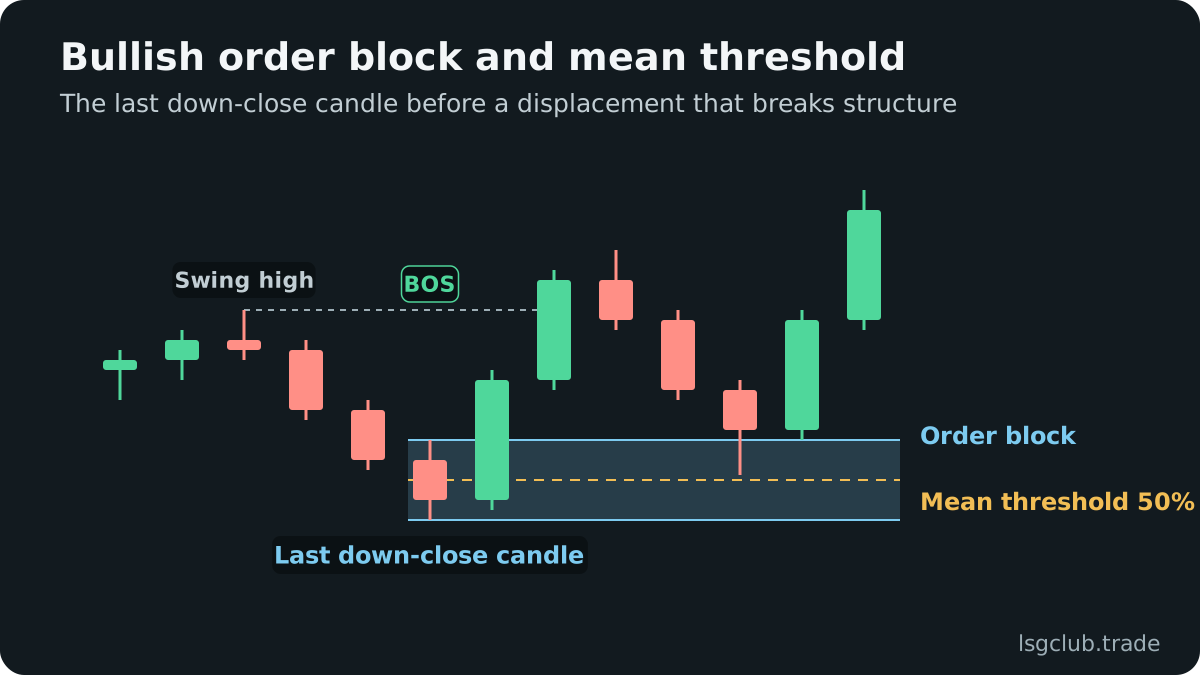
The block is drawn from the candle’s high to its low. The edge closest to current price is the proximal line, where a limit order would fill first. The far edge is the distal line, the level that invalidates the block if price closes beyond it. When several consecutive candles of the same color precede the move, traders treat the whole cluster as one block.
Bullish order block
A bullish order block is the last bearish (down-close) candle before price rallies hard and closes above a recent swing high. When price later drops back into that candle, the zone is expected to act as support, and longs are taken there. The open of the candle is a level ICT pays special attention to.
Bearish order block
A bearish order block is the last bullish (up-close) candle before price sells off and closes below a recent swing low. On the retracement into that candle, the zone is expected to act as resistance, and shorts are taken there.
What makes an order block valid
Every chart has hundreds of last-opposite candles. A block becomes tradable only when it passes these checks:
- Liquidity taken — the move began with a sweep of an old high or low, as explained in the liquidity sweep guide.
- Displacement — the candles leaving the block are large, directional and close near their extremes.
- Structure broken — the displacement closes beyond a swing point; see CHoCH vs BOS for the difference.
- Imbalance left behind — the displacement leaves a fair value gap, which confirms the move was one-sided.
- Right location — a bullish block in discount, a bearish block in premium of the dealing range.
- Unmitigated — price has not returned into the block since it formed.
- Aligned bias — the block points toward the higher-timeframe draw on liquidity.
Invalid order blocks and common look-alikes
Most failed order block trades come from blocks that were never valid. Treat a candle as invalid when the move after it did not break structure, when the candle sits in the middle of a range, or when price has already traded through it and returned. A block that was closed through on the candle body is no longer a block at all.
That last case has its own name. When a bullish order block fails, price sweeps below it and breaks structure the other way, the old block can turn into resistance. This is a breaker block, a different tool with different rules, covered in our article on the ICT breaker block. Do not keep buying a block that has already turned into a breaker.
The mean threshold of an order block
The mean threshold is the 50% level of the order block, usually measured from the candle’s high to its low. When the candle has very long wicks, many traders measure the body instead; pick one method and stay consistent.
ICT’s rule of thumb: a strong bullish block should not see candle bodies close below its mean threshold, and a strong bearish block should not see bodies close above it. Wicks through the 50% are acceptable. A body close beyond it is a warning, and a close beyond the distal line ends the idea. This turns the block from a vague zone into a set of precise lines you can trade and journal.
Order block entry rules
There are three common ways to enter. They trade the same zone but with different trade-offs between fill rate and risk.
Entry at the proximal line
A limit order at the near edge of the block fills on the first touch. It catches fast moves that never go deeper, but the stop has to cover the full block, so the risk per unit is largest.
Entry at the mean threshold
A limit at the 50% level gives a better price and a smaller stop. The cost is missed trades: strong blocks often react from the proximal line and leave the order unfilled.
Entry on lower-timeframe confirmation
Here you wait for price to reach the block, then drop to M1 to M5 and wait for a small market structure shift in your direction. You enter on the retracement into the fair value gap of that shift. Fewer trades fill, but each one has shown a reaction before you commit.
Whichever entry you choose, run the same sequence:
- Confirm the higher-timeframe bias and mark the draw on liquidity.
- Find the sweep, the displacement and the structure break, then mark the block, its mean threshold and its distal line.
- Check that the block is unmitigated and sits in the correct half of the dealing range.
- Choose your entry method before price arrives, not while it is moving.
- Place the stop beyond the distal line with a small buffer for the spread.
- Set the first target at the nearest opposing swing and the final target at the draw on liquidity.
- Calculate the position size from the stop distance, as shown in our position size guide.
Worked example: a bearish order block (illustration)
This is a teaching example, not a trade record. GBPUSD has a bearish daily bias with an untouched old low below. During the New York AM Kill Zone (07:00–10:00 New York time), price trades above the London session high, taking the buy-side liquidity there.
The last up-close M15 candle at that high is followed by three large bearish candles that close below the London low and leave a bearish fair value gap. That up-close candle is the bearish order block. The trader places a sell limit at its mean threshold, a stop above the candle’s high, a first target at the next intraday low and a final target at the old daily low. If a body closes above the mean threshold before the order fills, the plan is cancelled.
Common order block mistakes
- Marking every last opposite candle — without a structure break it is not an order block.
- Trading blocks against the bias — a bullish block in a bearish daily leg is a pullback, not a reversal.
- Buying blocks in premium — the location filter removes many low-quality trades.
- Re-entering a mitigated block — the second and third touches react less.
- Moving the stop inside the block — it turns a defined risk into a hope.
- Ignoring the time of day — blocks tested in thin hours often react weakly.
How to review order block trades in a journal
Record the block’s timeframe, whether a sweep preceded it, the entry method, whether price respected the mean threshold, and the result in R. Over a sample of trades you can see which entry method suits your schedule and whether blocks in your Kill Zone outperform the rest. Trading involves risk; the review does not make any setup certain, but it replaces opinions with your own numbers. Pairing blocks with gaps is covered in the fair value gap trading strategy.
When the reaction sits in the wicks rather than in a candle body, ICT calls the zone a rejection block; its entry and stop work differently from an order block.
FAQ
How do you identify a valid order block?
Look for the last opposite candle before a displacement that breaks a swing high or low, ideally after a liquidity sweep and with a fair value gap left behind. It should be unmitigated and sit in discount for longs or premium for shorts.
Where should the stop loss go on an order block trade?
Beyond the distal line of the block: below the low of a bullish block or above the high of a bearish block, plus a small buffer for the spread. Some traders place it beyond the swing that made the sweep for extra room.
What is the mean threshold of an order block?
It is the 50% level of the order block candle. In a strong block, candle bodies should not close beyond it; a body close past the mean threshold suggests the block is weakening.
What happens when an order block fails?
If price closes through the block and breaks structure in the other direction, the zone can become a breaker block that acts from the opposite side. At that point the original trade idea is over.