AI Forex Trading: What an AI Bot Can and Cannot Do
An honest look at AI forex trading: what AI analysis and trading bots really do, where they fail, the red flags to avoid and how to test a bot on demo first.
AI forex trading means using software models to read the currency market, turn that reading into trade ideas and, in some setups, place the trades through an Expert Advisor in MetaTrader. Done honestly, it saves hours of chart work and applies the same rules at 3 a.m. as at noon. It cannot remove risk, predict the news or turn a strategy without an edge into one with an edge. This explainer from LSG Club, a traders’ club with its own AI, covers what an AI forex trading bot actually does, where it fails, which offers to walk away from and how to test one before it touches real money.
AI analysis is not financial advice. Past results do not guarantee future ones, and any strategy, automated or not, can lose money. Start on a demo account.
What AI forex trading actually means
The phrase covers three different jobs. Some products do all three; many do only one and market it as the whole package.
- Analysis — reading price, structure, sessions and the economic calendar across several instruments and summarising a bias.
- Idea generation — turning that reading into a concrete trade: entry, stop, target and the point where the idea is wrong.
- Execution — software, usually an Expert Advisor (EA) in MT4 or MT5, that places and manages orders with a defined risk.
It is worth asking which part is really “AI”. Sometimes it is a machine-learning model, sometimes a fixed rule set, sometimes a language model writing commentary on top of an indicator. None of these is wrong in itself. The problem starts when the marketing hides which one you are buying.
AI forex trading analysis: where it helps
The strongest case for AI in forex is not prediction. It is discipline and coverage, the things human traders are worst at after a long week:
- Consistency — the same checklist is applied to every chart, without boredom, fear or a revenge trade after a loss.
- Coverage — gold, indices and several currency pairs read across the Asian, London and New York sessions, which one person cannot watch at once.
- A written plan — bias, scenario and invalidation are stated before the move, so there is no hindsight.
- A complete record — every idea is logged, so results can be counted without anyone choosing which trades to show.
What an AI trading bot cannot do
- Predict surprises — a central bank decision or a geopolitical headline moves price faster than any model can react to it.
- Avoid losing streaks — every strategy has them, and a bot will take each loss exactly as its rules say.
- Know your situation — it does not know your account size, your goals or how much drawdown you can live with unless you set those limits.
- Create an edge — automating a strategy that loses money only loses it faster and more consistently.
- Promise profit — any claim of a fixed return is a sales line, not a property of the software.
The real risks of AI forex trading software
Overfitting
A model tuned on past data can fit the noise of that period perfectly and then fail as soon as the market behaves differently. A beautiful backtest is the easiest thing in trading to produce. Ask for results on data the model never saw, and for a forward record that started after the strategy was fixed.
Black boxes
If nobody can tell you in plain words when the bot enters, where the stop goes and when it stays out, you cannot judge whether its current losing streak is normal or a sign that something broke. A description of each strategy, its market and its typical holding time is the minimum.
Scams that promise fixed returns
Offers of “guaranteed” monthly returns, screenshots of only winning months, pressure to deposit with a specific broker, or a request for your trading account password or withdrawal access are the classic signs. Legitimate software runs on your own account, under your own limits, and never needs to move your money.
Prop firm rules on Expert Advisors
Many prop firms restrict Expert Advisors, copy trading or third-party signals, and the rules differ from firm to firm and change often. Check your firm’s rules before you attach any bot to a funded or challenge account; breaking them can void the account even if the trades were profitable.
How to evaluate an AI forex trading bot
Before any AI trading bot for forex gets near a live account, run it through this checklist:
- Unselected statistics — every signal counted, at a fixed risk per trade, without compounding, with the sample size stated. A track record that only shows good months is advertising.
- Losing streaks and drawdown — ask for the longest run of losses and the deepest drawdown, then decide whether you could sit through them.
- Demo first — run it on a demo account with your broker for weeks, not days, and compare its trades with what was promised.
- Your own risk limits — risk per trade, maximum open trades, a daily loss limit and a maximum lot should be set by you, not fixed by the vendor.
- No password requests — a bot that runs as an EA in your own terminal never needs your account password or any access to withdrawals.
- An off switch — you should be able to pause it and close its trades at any moment.
- Plain-language strategies — you should be able to explain to a friend what each strategy waits for.
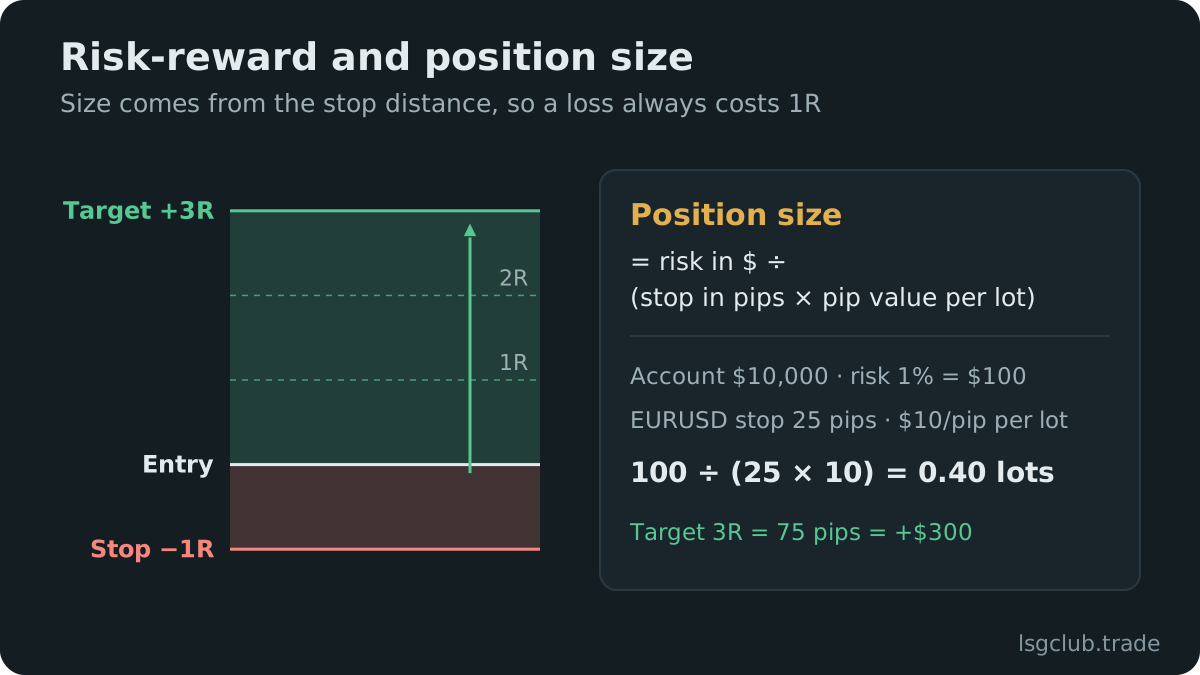
Risk per trade is the one setting that matters most. If you are unsure what number to use, the guides on position size in forex and the risk-reward ratio explain how stop distance, lot size and R fit together.
How the club’s AI and LSGAutoTrader work
LSG Club splits the job in two. The club’s AI reads the market top-down in the ICT style and writes a plan before the Asian, London and New York sessions: the bias, the scenario, a plan B and the point where the scenario is off. When a setup forms, it publishes a trade idea with entry, stop, target and R:R, and then follows it up: filled, target, stop or cancelled.
The execution side is the LSGAutoTrader advisor, an Expert Advisor that runs in the member’s own MetaTrader 5:
- You create a key in the club cabinet and put it into the advisor. Your trading account password is never asked for.
- Risk per trade, maximum open trades, daily loss limits, the maximum lot and the instruments are set in the cabinet. Risk starts at 0.5% per trade and is capped by the club.
- Every order goes to the broker with its stop and target, and the advisor follows the idea’s updates: cancel, close, move to break-even.
- On a real account it trades only after you allow it in its settings; demo and contest accounts work from the start.
- “Close all” in the cabinet closes the advisor’s trades, and the Telegram bot tells you when an order is placed, filled or closed.
Members choose between three strategies, Vega, Pleiades and Range, which run on the same AI model but wait for different markets: Vega trades with the D1 or H4 trend, Pleiades works an H4 range with three limit orders and can hold for weeks, and Range is built for a sideways market. Every strategy can have long losing streaks. The public statistics count every trade idea of the club’s AI with no selection, as a percentage at 1% risk per trade and without compounding, and a sample under 30 trades is flagged as small. They describe the past and are not a forecast.
AI auto-trading is a club feature with its own club contribution, available after approval. The full description of each strategy, the limits and how access works is on the AI trading bot for MT5 page.
Review the bot’s trades like your own
Automation does not end your job; it changes it from clicking to reviewing. Plan the risk, let the strategy execute, log every trade, review the week in R and change one thing at a time.
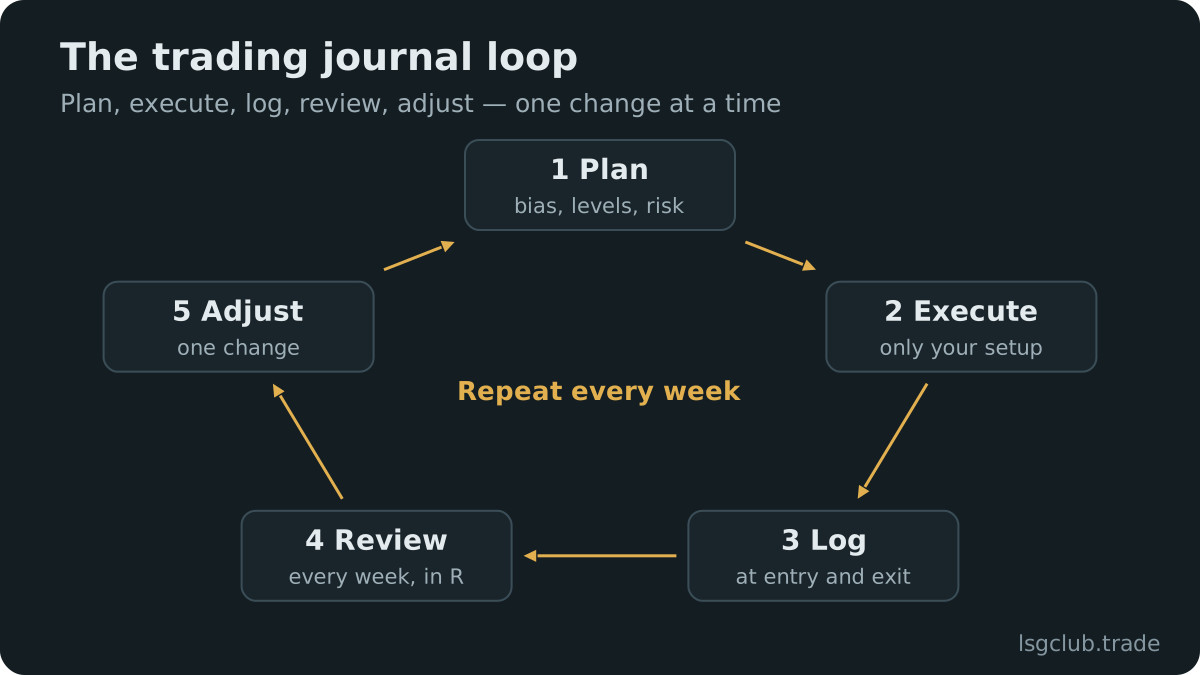
With MT5 auto-sync, trades opened by LSGAutoTrader are marked in the journal, and the Source filter separates them from your manual ones. The MT5 trading journal page explains how the sync works.
Frequently asked questions
Does AI forex trading work?
It can apply a strategy faster and more consistently than a person, which is useful. Whether it makes money depends on the strategy behind it, the costs and your risk settings. Judge it by unselected statistics and your own demo results, never by the marketing.
Is an AI forex trading bot safe?
The software can be safe to run; the trading is never free of risk. A reasonable setup runs in your own terminal, never asks for your password, puts a stop on every order and lets you set the risk and switch it off at any moment.
Can I use an AI trading bot on a prop firm account?
Sometimes. Many prop firms restrict Expert Advisors, copy trading or third-party signals. Read your firm’s current rules before connecting anything, and ask the firm if they are unclear.
What is the best AI forex trading software?
There is no single best one. The best candidate for you publishes every signal without selection, explains its strategies in plain words, lets you set your own limits, works on demo first and never needs your password.