How to Trade XAUUSD Gold with ICT Concepts
Trade XAUUSD with ICT: build a daily bias, use Kill Zones and the news calendar, size gold from a dollar stop and ATR, and avoid the usual mistakes.
To trade XAUUSD gold with ICT concepts, build a daily bias from the dealing range and the draw on liquidity, wait for a sweep and a market structure shift inside a Kill Zone, and size the position from the dollar stop rather than from pips. Gold rewards traders who respect its speed and punishes those who size it like a currency pair. This guide from the LSG Club trader community walks through each step, the news releases that matter most and a worked sizing example.
What makes gold different
Gold trades in the thousands of dollars per ounce, so a move that looks small in percent covers a lot of price. Its intraday swings are large relative to typical stops, and it reacts sharply to US data, the dollar and Treasury yields. The ICT toolkit (liquidity, displacement, fair value gaps, premium and discount) applies unchanged. What changes is how much room each setup needs and how carefully you size it.
- Range — measure it with the average true range (ATR) or in percent, not in fixed dollars; gold’s daily range shifts with the price level and the news cycle.
- Round numbers — whole and half hundred-dollar levels attract resting orders and often act as liquidity pools.
- Dollar sensitivity — gold often moves opposite to the US dollar index (DXY) and to US real yields, though the relationship breaks down at times.
- News reactions — US inflation, jobs and Federal Reserve decisions can move gold several times its normal hourly range within minutes.
- Contract size — on many brokers one lot is 100 ounces, so a $1 move equals $100 per lot. Check your broker’s specification before sizing.
Building a daily bias for XAUUSD
Dealing range and draw on liquidity
Start on the daily and 4-hour charts. Identify the current dealing range, meaning the most recent significant swing high and swing low, and its equilibrium at 50%. Price above equilibrium is in premium, where you look to sell; below it is in discount, where you look to buy. Then name the draw on liquidity: the previous day high or low, the previous week high or low, or an unfilled 4-hour fair value gap.
The dollar as a second opinion
Check DXY before you commit. If your gold bias is bullish while DXY is pushing into its own premium and rejecting, the two reads agree; if DXY is breaking higher with displacement, be more cautious. The daily bias tutorial walks through the full process.
Sessions and Kill Zones for gold
Times here follow ICT’s convention, New York time, and the LSG journal tags its Kill Zones the same way. In UTC they move with US daylight saving: Asia 00:00–04:00, London 06:00–09:00, New York 11:00–14:00 in summer, one hour later in winter.
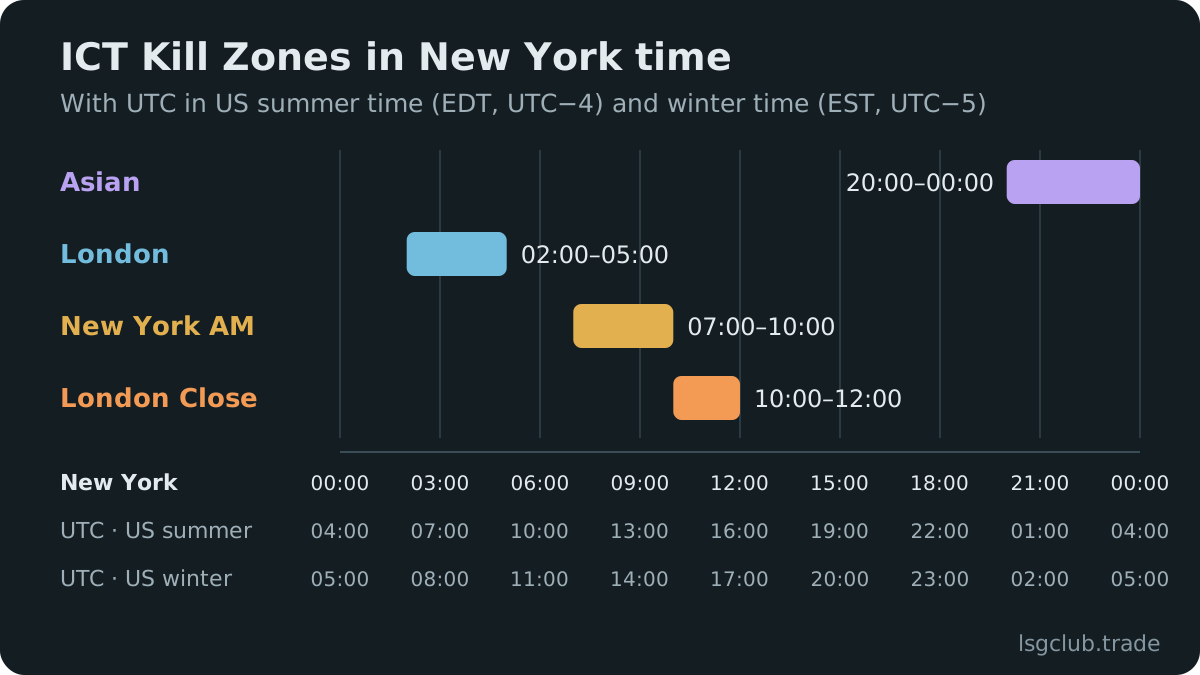
- Asian Kill Zone, 20:00–00:00 — gold often builds a range here that becomes the liquidity for London. Mark its high and low.
- London Kill Zone, 02:00–05:00 — the first raid on the Asian range frequently happens here, sometimes as the Judas swing of the day.
- New York AM Kill Zone, 07:00–10:00 — contains the 08:30 release time of major US data and often delivers the day’s main expansion or reversal.
The gold sessions guide covers how each window behaves for XAUUSD in more detail, and the Power of 3 guide explains how the Asian range, the London raid and the New York expansion fit into one daily cycle.
News: the gold trader’s calendar
Release times that move gold
The US consumer price index and non-farm payrolls are released at 08:30 New York time; Federal Reserve rate decisions come at 14:00 New York time, followed by the press conference. Around these releases spreads widen, stops can slip, and the first spike often sweeps liquidity on both sides before the real direction shows.
Trading around a release
A sensible default is to be flat, or to have your stop already at break-even, before a high-impact release, and to treat the first post-release swing as a possible manipulation rather than a signal. If you trade after the release, wait for a sweep and a market structure shift on the 5-minute chart, exactly as you would on a quiet day.
A step-by-step ICT setup for gold
- Write down the bias and the draw on liquidity from the daily and 4-hour charts.
- Mark the Asian high and low, the previous day high and low, and the nearest round numbers.
- During the London or New York AM Kill Zone, wait for a sweep of a level on the side opposite your bias.
- Confirm a market structure shift on the 5- or 15-minute chart: displacement through the last swing, leaving a fair value gap.
- Enter on the retracement into that gap or into the optimal trade entry zone of the new leg.
- Place the stop beyond the sweep extreme, plus a buffer for the spread.
- Take partial profit at the first internal level and leave the rest for the draw on liquidity.
The heart of this sequence is the sweep. The liquidity sweep guide shows how to tell a raid that reverses from a breakout that keeps going, which matters even more on gold, where breakouts can run a long way.
Worked example: sizing a gold trade
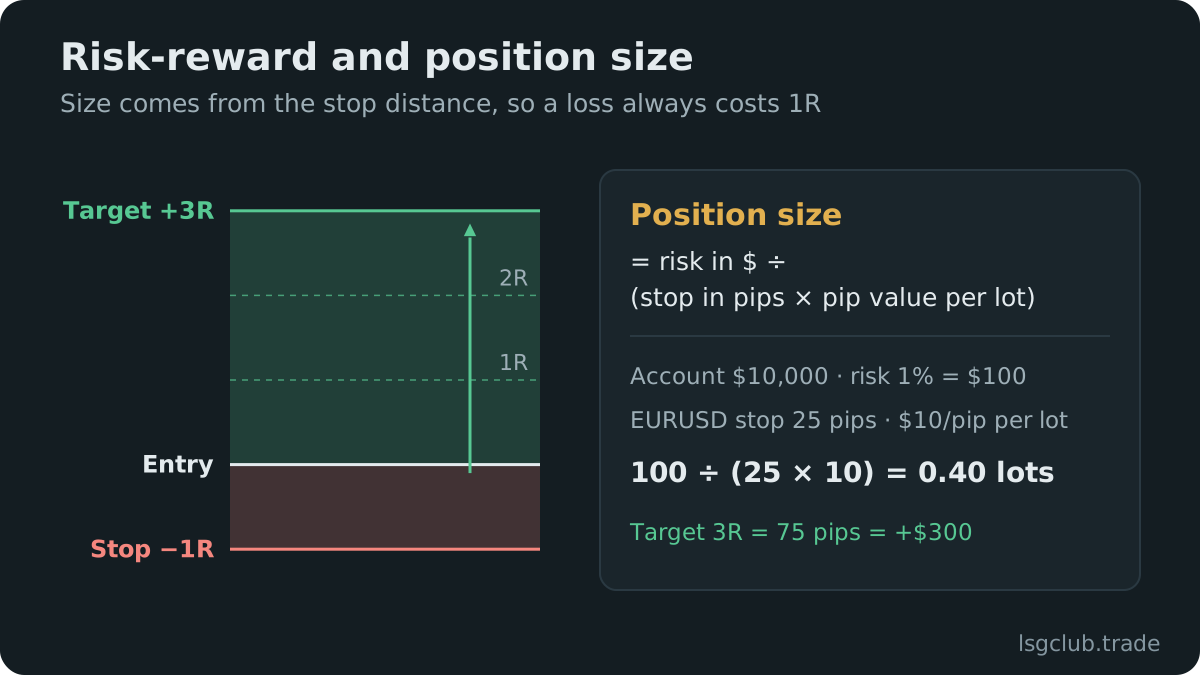
Position size from the dollar stop
Say your account is $10,000 and you risk 1%, or $100. Your broker quotes XAUUSD at 100 ounces per lot, so every $1 move is worth $100 per lot. The numbers below illustrate the arithmetic; they are not a forecast.
Gold sweeps the Asian low in the London Kill Zone and shifts on the 5-minute chart. Your entry sits in the fair value gap, and the stop goes beyond the sweep low plus a small spread buffer, $8 below entry in total. One lot would lose $800 over that distance, so your size is $100 ÷ $800 = 0.125 lots, which you round down to 0.12.
Checking the stop against ATR
Now compare the stop with how the market is moving right now. If the 5-minute ATR is close to the full $8, your stop is only about one bar of normal noise away, and a wider stop with a smaller position is safer. If the ATR is a small fraction of it, the stop has room to breathe. Measuring the stop against ATR rather than a fixed dollar figure keeps the method valid at any gold price. The position size guide has the formula for other instruments.
Managing the trade
Gold can retrace sharply even in a winning trade, so decide management before entry. One workable plan: take part of the position at the first internal high or low, move the stop to break-even only after price has closed beyond that level, and hold the rest for the draw on liquidity. Moving the stop to break-even the moment a trade shows a small profit often just turns a valid trade into a scratch.
If you trade a prop-firm account, size against the daily loss limit as well as the per-trade risk. For example, a typical two-step challenge has a profit target around 10% and a daily loss limit around 5%; check your firm’s current rules, because they change. Two full-risk gold losses on a volatile morning should never put that limit in danger.
Common mistakes on XAUUSD
- Sizing gold like EURUSD — the same lot size carries very different risk. Always size from the dollar stop distance and your contract size.
- Trading the first news spike — the initial move after CPI or payrolls often sweeps both sides before choosing a direction.
- Stops on round numbers — a stop just below a whole hundred-dollar level sits in the liquidity pool everyone can see. Place it beyond the sweep extreme instead.
- Ignoring the dollar — a long gold idea while DXY breaks higher with displacement needs extra confirmation.
- Trading every hour — gold moves outside the Kill Zones too, but many of those moves are drift without a sweep or a shift.
- Fixed-dollar targets — a target that made sense at a lower price level may be too small or too large today. Use liquidity levels and ATR.
Gold pre-trade checklist
- Bias and draw on liquidity written down, and DXY checked.
- Asian range, previous day high and low, and round numbers marked.
- No high-impact US release inside the trade window, or a plan for it.
- Sweep and market structure shift inside a Kill Zone.
- Stop beyond the sweep and compared with the current ATR.
- Position size calculated from the dollar stop and the contract size.
- First target at least 2R away; partial and break-even rules decided in advance.
Track gold separately
Gold behaves differently from currency pairs, so review it on its own. Filter your journal to XAUUSD and compare results by session, by holding time and by whether you traded around news. The LSG behaviour report shows which sessions and holding times cost you money, and the “what if” simulator shows how a different stop or target would have changed the result.
Members can also receive the club’s AI session plan in Telegram before the Asian, London and New York sessions: bias, scenario, plan B and invalidation. It is not financial advice and any plan can fail, so treat it as a second read to compare with your own. Gold carries real risk of loss, and the size of its moves makes that risk arrive faster. You can see how the journal presents trades in the journal demo.
FAQ
Which Kill Zone suits XAUUSD for ICT setups?
The London Kill Zone (02:00–05:00 New York time) and the New York AM Kill Zone (07:00–10:00) are where gold most often raids the Asian range and then expands. The New York AM window also contains the 08:30 US data releases, so it can be the fastest and the most dangerous. Many traders pick one of the two and review it on its own before adding the other.
How much should I risk per trade on gold?
The same percentage you risk on any other instrument, for example 0.5–1% of the account, because the percent is what protects you. What changes on gold is the lot size: a wide dollar stop means a small position. Calculate it from the stop distance and your broker’s contract size every time.
Does gold always move opposite to the US dollar?
No. Gold often moves against DXY and US real yields, but the relationship weakens or reverses at times, for example during risk-off flows when both can rise together. Use the dollar as confirmation of a gold bias, never as the entry signal itself.
Do ICT concepts work on gold the same way as on forex pairs?
The concepts are the same: liquidity, sweeps, displacement, fair value gaps, premium and discount. The difference is scale. Gold needs wider stops measured against ATR, smaller positions and more caution around US news, so copy the logic from your forex playbook but not the numbers.