A prop firm trading journal with a challenge tracker
Link a challenge to a journal account and its balance, daily loss, drawdown and trading days are calculated from your trades — with a warning before a limit is hit.
A prop firm challenge is a test of discipline more than of strategy. Most failed accounts do not die on a bad setup; they die on a daily loss limit hit after a revenge trade, or on a drawdown nobody was watching. LSG Club combines a trading journal with a challenge tracker, so the numbers that decide a challenge are in front of you while you trade. Both are free for club members.
How the challenge tracker works
Create a challenge, pick the firm and the phase, and enter the account size. For a number of well-known firms the rules are filled in as a starting point — FTMO, The Funded Trader, Apex Trader Funding, E8 Funding, Funding Pips, MyFundedFX, True Forex Funds and Audacity Capital — and any firm can be added as a custom one. Every rule stays editable.
- Profit target, with how much is left to go.
- Daily loss limit — today's result against the limit, plus your worst day so far.
- Maximum loss — the balance floor and the deepest drawdown reached.
- Minimum trading days and the deadline in calendar days.
- Phases: Phase 1, Phase 2 and Funded, with "Next: Phase 2" once a phase is passed.
Link the challenge to a trading account in the journal and the balance, the daily loss and the trading days update from your trades by themselves. The tracker remembers the lowest balance, warns when you have used most of a limit and says clearly when a limit is breached or when the target is reached with the rules kept.
Check the rules with your firm
Prop firms change their rules often, and they measure them differently. Some count the daily loss from the starting balance, others from equity including open positions; some reset the day at midnight server time; some use a trailing drawdown. The presets are a convenience, not a statement of any firm's current terms. The tracker works from the rules you enter and from the trades and balance in your journal, so treat your firm's own dashboard as the final word and set the tracker's limits a little tighter than the firm's.
Getting the trades in
You can log trades by hand with the position calculator, import an MT5 or MT4 report, or connect MT5 auto-sync — a $9 monthly club contribution per account — which reads the account with the investor password and never trades. Before connecting anything to a funded account, check what your firm allows; importing a report needs no access at all. The MT5 trading journal page explains both options.
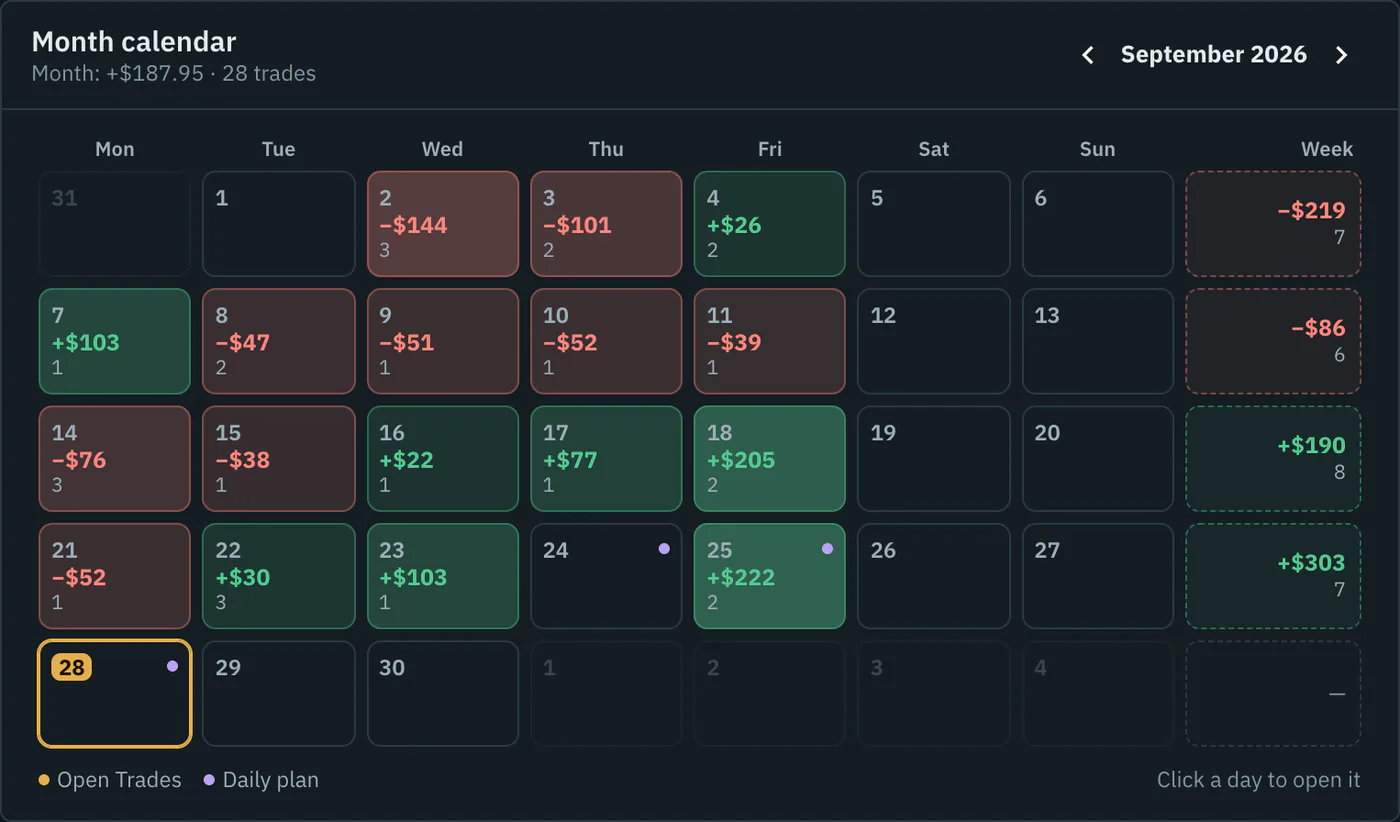
The journal side: rules you can keep
The tracker tells you where you stand; the journal helps you stay inside the lines.
- Daily limits in Goals & Limits: a loss streak, a maximum loss per day and a number of trades per day, each turning amber when close and red when hit.
- Risk per trade from the trade form: the lot is sized from your risk and stop and rounded down, never up.
- The "What if" simulator replays rules such as "stop after two losses a day" on your own history before you adopt them.
- The behaviour report shows what your losing days have in common — often trades taken right after a loss.
For sizing outside the journal there is a free position size calculator, and the blog covers journaling a prop firm challenge in depth.
Frequently asked questions
Is LSG Club affiliated with any prop firm?
No. The firm names are only there to pre-fill rules you can change. LSG Club is a traders' club and a journaling tool; it is not a prop firm and does not sell challenges.
Will the tracker stop me from breaching a rule?
No. The journal never places or closes trades. It warns you when a limit is close and shows when it is breached; stopping is your decision.
Does it support trailing drawdown?
The tracker measures the maximum loss from the rules you enter and the balance in your journal. If your firm uses a trailing or equity-based drawdown, use its dashboard as the source of truth and keep a safety margin in the tracker.
Can I track more than one challenge?
Yes. Active, passed and failed challenges are listed separately, with your pass rate across all of them. The number of active challenges per member is limited.