Prop Firm Trading Journal: How to Pass FTMO and Funded Challenges
How to set up and run a prop firm trading journal: rules and fields per account, a daily FTMO challenge routine from morning plan to evening review, and the numbers to watch.
A prop firm trading journal is a regular trade journal plus the firm’s rules: every trade is recorded against the daily loss limit, the maximum loss and the profit target, and the statistics are read in terms of how close each decision brought the account to failing. This guide covers the whole job in one place — how to set the journal up before day one, the daily routine during a live FTMO-style challenge, which numbers to watch and how to read them, and what changes once the account is funded. The structure works in any journal, including LSG Club’s trade journal, which has a prop-challenge tracker built in.
What makes a prop firm trading journal different
In a personal account, a bad day is part of a drawdown. In a prop account, one day over the limit can end the account, however good the rest of the month was. That changes what the journal must show. Profit statistics still matter, but its first job is distance: how far each account is from each rule at any moment.
Firms also measure the same rule in different ways. Some calculate the daily loss from the balance at the start of the day, others from the higher of balance and equity. Some use a static maximum loss from the initial balance, others a trailing one that follows the equity high. Rules change over time, so for every account copy the current definitions from the firm’s own page. The journal is only as accurate as those definitions.
Whatever tool you use, it must answer three questions at a glance, before every trade: how much can I still lose today, how much can I still lose in total, and how far is the target.
Before day one: set up the journal
One journal account per prop account
Create an account in the journal for each challenge or funded account, and fill in its rules:
- Firm and program — the firm, the account type and the current phase
- Initial balance — the base most limits are calculated from
- Profit target — per phase, in % and in dollars
- Daily loss limit — amount, calculation method (balance or equity) and the time the trading day resets
- Maximum loss — static or trailing, and the equity floor in dollars the account must never touch
- Trading days — the minimum required, what counts as a trading day at your firm, and any time limit
- Other rules — news, weekend holding, instruments, consistency or lot-size rules if your firm has them
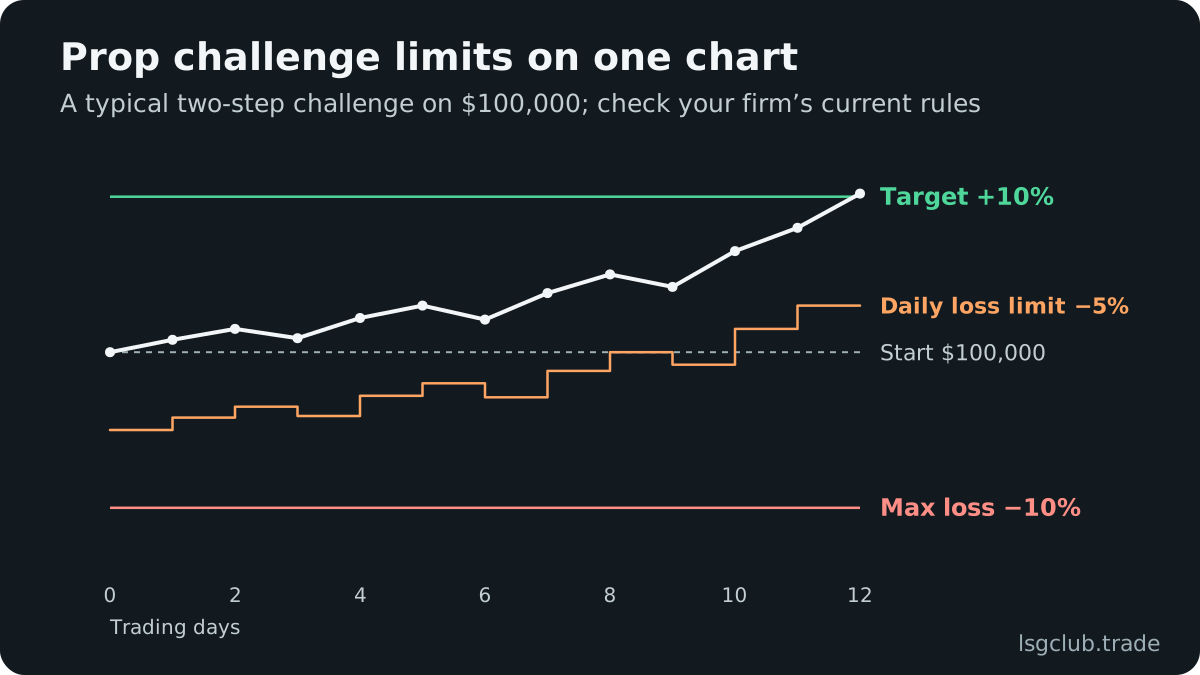
For example, a typical two-step challenge has a profit target around 10% in the first phase and around 5% in the second, a daily loss limit around 5% and a maximum loss around 10% of the initial balance, plus a minimum number of trading days. Check your firm’s current rules and write down the date you checked them.
Keep every challenge and every funded account separate, even at the same firm. A failed challenge and its retry are different datasets, and comparing them is one of the most useful things a journal can do. In the LSG journal the prop-challenge tracker holds the target, daily and maximum loss, and trading days for each account and shows the room left after each trade; you can look at the journal with sample data before setting up your own.
Personal limits inside the firm’s limits
Then set personal limits inside the firm’s limits. Say the account is $100,000 with a 5% daily loss limit: the firm allows $5,000 a day. A personal daily stop of 2% ($2,000) means one bad session costs less than half of the allowance, and slippage in a fast market never decides the challenge. Write both numbers in the journal — the firm’s limit and yours.
A one-page plan and sizing from the stop
Write the trading plan for the challenge on one page: the setups you will take (from your playbook, nothing else), the instruments, the sessions, the risk per trade and the maximum number of trades per day. If you do not have a written plan yet, build a complete ICT trading plan before you pay for the challenge. A challenge is the wrong place to discover what your plan is.
Size every trade from the stop, not from feel. With a $100,000 account and 0.5% risk, the risk is $500. With a 20-pip stop on EURUSD that is 2.5 standard lots; with a 40-pip stop, 1.25 lots. The dollar risk stays the same either way. The position size guide walks through the formula for forex pairs, gold and indices.
Import instead of typing
Get trades in automatically where you can, because manual entry from memory drifts. Importing the MT4 or MT5 statement keeps prices, sizes and commissions exact — the MT5 import guide covers the steps. In the LSG journal, MT5 auto-sync is also available for a $9 monthly club contribution per account; it uses the read-only investor password. Import fills the prices; the context below still comes from you.
What to record for every trade
The broker statement gives you prices and P&L. The journal adds the context that turns them into decisions. For a prop account, record:
- Setup — the name from your playbook, not a description invented afterwards
- Session — the Kill Zone or time window, in one fixed time convention
- Planned risk — in dollars and as % of the initial balance (this is 1R)
- Buffer before entry — daily loss room and maximum loss room left
- Entry, stop and target — with the reason for each level
- Result in R — so accounts of different sizes can be compared
- Checklist — each item ticked or failed, honestly
- Rule flag — any break of your own rules or the firm’s
- State and note — one word (calm, rushed, bored, frustrated) and one sentence on the decision
For the ICT side of the record — bias, liquidity taken, entry array — use the ICT trading journal template and add the prop fields above to it. Record skipped trades too, with the reason. They are the only way to check later whether your filter removes bad trades or good ones.
The daily routine during a challenge
The structure above only pays off if it is filled in every day, at the right moment. The routine has three parts — before the session, during it and after it — and together they take about half an hour.
Every morning: the pre-session entry
The morning entry takes about ten minutes and is written before you open the trading platform. It is short on purpose, and it is the part most often skipped when a challenge is going well.
- Account state — balance, distance to maximum loss, distance to target, trading days done
- Today’s risk budget — your personal daily stop in dollars and how many trades it allows
- Daily bias — the draw on liquidity per instrument and where the idea is wrong
- Session — the Kill Zone you will trade, with its time convention
- News — today’s high-impact releases and your firm’s rule for them
- Yesterday’s lesson — one line copied from last night’s review
For the bias, use the process in the ICT daily bias tutorial: where the nearest obvious liquidity sits on the daily and H4 charts, whether price is in premium or discount of the current dealing range, and what would invalidate the idea. If you cannot write the bias in two sentences, the entry for the day reads “no bias — no trade”, and that counts as following the plan.
Name the session in a fixed convention. ICT defines the London Kill Zone as 02:00–05:00 and the New York AM Kill Zone as 07:00–10:00 New York time. The LSG journal tags trades with the same New York-time windows, so in UTC they move with US daylight saving (London 06:00–09:00 UTC in summer, 07:00–10:00 in winter). Pick one convention and keep it for the whole challenge; the Kill Zone trading guide explains each window.
During the session: log at the moment of entry
Write the trade into the journal when you take it, not in the evening. A trade logged in real time carries information you cannot reconstruct later: the daily buffer that was left before entry (for example, “daily stop $2,000, used $500, left $1,500”), the checklist as it actually was, and how you felt. Logged in the evening, the buffer and the checklist are rebuilt from memory, so they always look fine.
Two rules that end the day
Two rules make this part work. First, if a checklist item fails, the trade is not taken; the journal records it as skipped, with the reason, which later shows how much the filter saved or cost. Second, set a hard end to the day: once your personal daily stop is hit, or after two losses in a row, the session is over. Write “stopped — rule” and close the platform.
An example. Your personal stop is $2,000 and the risk per trade is $500. After two losses the journal shows $1,000 used. The rule says stop, even though the firm would still allow another $4,000. That gap between your stop and the firm’s limit is the margin that keeps one emotional afternoon from ending the challenge.
After the session: the 15-minute review
The evening review compares what you planned with what you did. Grade the day on process, not on P&L. In a challenge, a losing day on which every rule was followed is a good day, and a winning day built on a trade outside the plan is a warning.
- Plan followed — yes or no for each trade, with the rule that was broken
- Result — in R and in % of the initial balance
- Bias — right, wrong, or not tested
- Best and worst decision — one line each
- Tomorrow — one specific thing to repeat or to avoid
Keep the review short so it happens every day, including the good ones: winning streaks hide the mistakes that losing streaks expose. It is also where you write down emotions without judging them; the trading psychology and journal guide shows how to turn those notes into patterns you can act on.
The numbers to watch
Prop accounts reward a small set of numbers. Check them in this order:
- Daily loss room — what you can still lose today before the firm’s limit
- Maximum loss room — distance from current equity to the account floor
- Largest losing day — as a share of the daily limit
- Longest losing streak — in trades and in R
- Average loss in R — close to -1R if stops are respected
- Expectancy in R — average result per trade over a meaningful sample
- Trades per day — and the result of trades taken after a loss
- Progress to target — in % and in trading days used
Example: expectancy over 60 trades
Expectancy combines win rate and the size of wins and losses: (win rate × average win) − (loss rate × average loss). Say that over 60 trades you win 40% with an average winner of 2.2R and an average loser of 1R: 0.4 × 2.2 − 0.6 × 1 = +0.28R per trade. That number, not the win rate alone, tells you whether the approach can reach a target. Win rate vs risk-reward explains the trade-off in detail.
The shape of the equity curve
The equity curve and drawdown chart add the shape behind those numbers. A smooth curve with shallow dips fits prop rules; a curve that reaches new highs through a few large wins after deep dips may have positive expectancy and still be too volatile for a 5% daily limit.
How to read the numbers
Each number points to a specific decision:
- Average loss worse than -1R — stops are moved or sizes rounded up; fix execution first
- Largest losing day above half the limit — your personal daily stop is too loose
- Negative after-loss trades — stop after two losses, or take a break after each one
- One session clearly weaker — stop trading it on prop accounts until the data changes
- One setup carrying the results — trade it, and drop or paper-trade the rest
- Expectancy near zero — the edge is the problem, not the rules; go back to demo
Size from your worst losing streak
Use the losing streak to set risk. Say the longest streak in your journal is six losses and you risk 1% per trade: that streak costs 6%, which against a 10% maximum loss leaves little room for the next streak, which may be longer. At 0.5% per trade the same streak costs 3%. A practical rule is to size so that about one and a half times your worst observed streak still fits comfortably inside the maximum loss, and a single bad day stays well inside the daily limit.
Compare accounts in R
Compare accounts in R, not in dollars. A $200 loss on a $10,000 account and a $2,000 loss on a $100,000 account are the same 2% — and usually the same mistake.
The weekly checkpoint: pace without pressure
Once a week, look at the challenge as a whole. Compare progress with the trading days left, but do not let pace change your risk. A common error is to see +3% after two weeks, feel behind, and double the risk per trade — which also doubles the cost of every losing streak against the same daily and maximum loss.
A worked example shows why patience is affordable. Say you risk 0.5% per trade and your playbook trades average a 2R winner: each winner adds about 1% and each loser costs 0.5%. Four winners and four losers net about +2%. Reaching a 10% target at that pace takes many sessions — and that is the point: the target is reached by repeating a small, controlled process while the drawdown room stays intact. If your firm has a time limit, plan the pace before day one, not in week three.
In the weekly review, read the journal’s statistics too: results by session, by setup and by day of the week, and what the trades taken right after a loss did. The LSG behaviour report groups exactly these, and the weekly review process gives a full template.
Challenge accounts vs funded accounts
In a challenge, the journal tracks two directions: the target above and the limits below. Once funded, there is usually no target, but the limits remain and many firms add conditions around payouts — check your firm’s current terms. The journal’s job shifts from reaching the target safely to never coming near the floor.
- Challenge — pace vs trading days, risk per trade, distance to both limits
- Funded — maximum loss room after each payout, monthly result in R, rule flags
- Both — the same playbook, so the data stays comparable
Compare your challenge statistics with your funded statistics every month. If trades per day, average loss or after-loss results get worse once real payouts are at stake, the journal shows it before the account does. The weekly checkpoint, run across all accounts once a month, is enough.
Common mistakes with prop journals
- Recording only P&L — no R, no buffer, no rule flag, so bad luck and bad execution look the same
- Logging in the evening — the buffer and the checklist are reconstructed from memory
- No personal daily stop — the firm’s limit becomes the target of a bad day
- One journal for everything — demo, personal and prop trades blur every statistic
- Outdated rule definitions — the firm changed a rule and the journal still uses the old one
- Changing the plan mid-challenge — a new setup after two red days has no data behind it
- Judging on 15 trades — streaks look like edges and edges look like streaks
- Ignoring skipped trades — you never learn whether the filter works
Checklists
Setup checklist
- Separate account — for each challenge, retry and funded account
- Rules entered — current definitions from the firm, with the date you checked
- Personal limits — your daily stop and risk per trade next to the firm’s numbers
- Import or sync — trades arrive with exact prices and costs
- Trade fields — setup, session, R, buffer, checklist, rule flag, state, note
Daily challenge checklist
- Morning — account state, risk budget, bias, Kill Zone, news, yesterday’s lesson
- Before each trade — buffer left, checklist passed, size calculated from the stop
- After each trade — logged with setup, R, state and chart
- End of day — plan followed, result in R, one lesson for tomorrow
- Weekly — pace vs days left, statistics by session and setup, no risk increases
Funded trading is still leveraged trading, and losses will happen; no journal or routine guarantees a pass. What it does is make every rule visible before you break it, and show which losses were part of the plan and which were not. How the challenge tracker in LSG Club works, and what to check with your firm, is described on the prop firm trading journal page.
FAQ
How is the daily loss limit calculated in a prop challenge?
It depends on the firm. Some measure it from the balance at the start of the trading day, others from the higher of balance and equity, and the reset time differs too. Copy the current definition from your firm’s own page into the journal, because the daily loss room you see is only as accurate as that definition.
How should I trade the first days of an FTMO challenge?
Trade the smallest size your plan allows. The goal of the first days is a clean start, not a fast one: a handful of trades logged properly, with the morning entry and evening review running, is worth more than an early lead.
What should I do after a drawdown in the challenge?
Cut risk, for example from 0.5% to 0.25% per trade, and keep it there until you have two days of clean execution. Then read the losing trades in the journal and sort them into valid setups and broken rules; only the second group needs a fix.
What changes when I am close to the profit target?
Trade smaller and take only your best setups; there is no reason to force a trade to finish it today. If you reach the target before the minimum number of trading days, complete the remaining days at minimal risk if your firm requires them.
How should I approach the verification phase?
Reuse the phase-one plan unchanged. The journal already holds a record of the setups, sessions and risk that worked, so read it before the first verification session and trade the same way. The lower target is a reason to relax, not to rush; pressure tends to show up as new setups and bigger size, and the journal makes both visible on the first day they appear.
How do I journal several prop accounts at once?
Traders with accounts at more than one firm often copy the same trade into all of them. The journal should make the real exposure visible: one setup on three $100,000 accounts is one decision with three times the risk, and a bad day hits every daily limit at once. Log each account separately, tag copied trades as one idea, and decide in advance whether different accounts run different risk levels or different sessions.
Can I use a free trading journal for a prop firm challenge?
Yes, as long as it records the stop and the result in R, keeps each account separate and shows the room left to the daily and maximum loss. A spreadsheet can do this too, but the limit math has to be updated after every trade, which is exactly when mistakes creep in.