ICT vs SMC Trading: What They Are, How They Differ and How to Start
ICT and SMC trading explained: what each term means, the real differences, the shared core concepts and a step-by-step way to start.
ICT and SMC trading are two names for one family of ideas: price is read through liquidity, market structure and the gaps that fast moves leave behind. ICT is the original teaching of Michael J. Huddleston, the Inner Circle Trader; SMC, Smart Money Concepts, is the wider community version built on it. This guide explains what each term means, where they really differ, which concepts to learn first and how to start without burning an account. It is the path many traders in the LSG Club community of ICT and SMC traders follow before they trade real money.
What ICT trading is
ICT is a body of lessons published by one educator over many years: free videos, mentorship series and a long list of named models. It describes how price is delivered between pools of liquidity and when during the day that delivery is most likely. Its vocabulary is precise and sometimes unusual: displacement, PD arrays, optimal trade entry, Power of 3, Silver Bullet, Judas swing.
Two features make ICT recognisable. First, time: the Kill Zones and macro windows say when a setup is worth looking for, not only where. Second, a top-down process: a higher-timeframe draw on liquidity sets the daily bias, and only then does the trader look for an entry on a lower timeframe. The full glossary is in ICT concepts from A to Z.
What SMC trading is
Smart Money Concepts is the community framework that grew out of ICT and other price action teaching. It keeps the core ideas — liquidity, structure, order blocks, fair value gaps — and packages them into a simpler, more mechanical set of rules. There is no single author, so definitions vary between courses and YouTube channels, but most SMC material agrees on the basics.
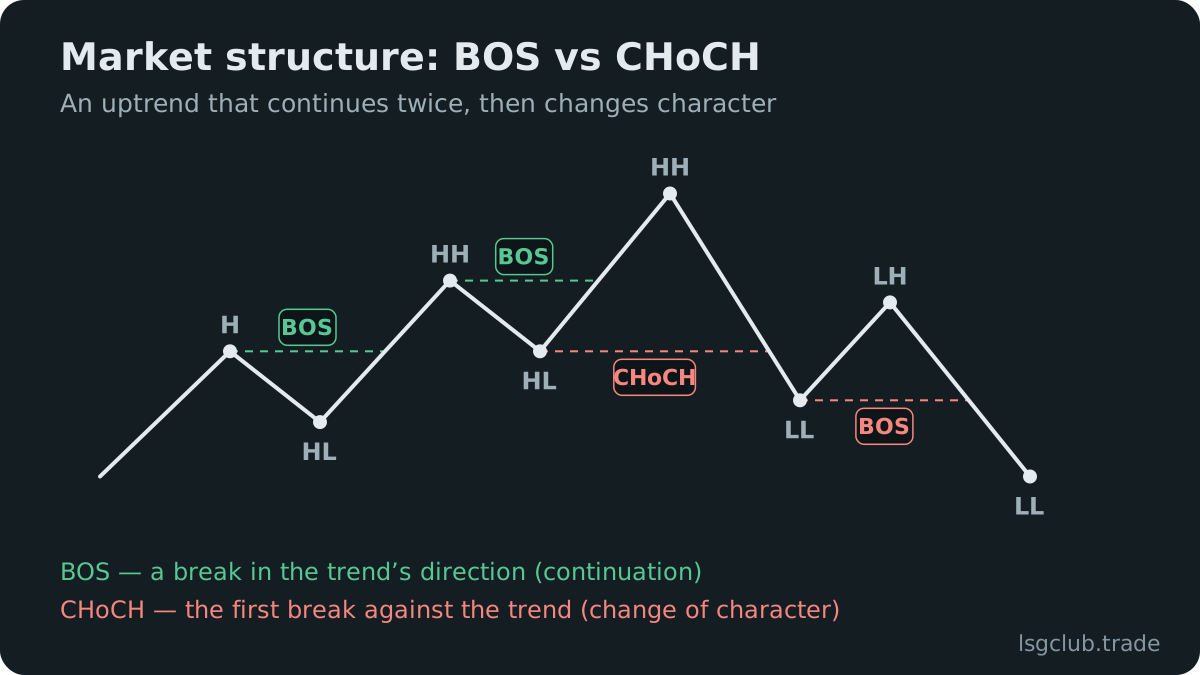
SMC usually puts market structure at the centre: a break of structure (BOS) continues the trend, a change of character (CHoCH) is the first break against it, and entries come from the order block or imbalance left by the move. If you are starting from zero, the Smart Money Concepts beginner’s guide walks through the first five concepts in order.
ICT vs SMC: the real differences
Most arguments about ICT versus SMC are about names, not about how price moves. The differences that matter in practice are these:
- Source — ICT has one author and a consistent vocabulary; SMC is a community remix, so two SMC courses can define the same term differently.
- Time — ICT gives time a central role through Kill Zones, macros and the daily cycle; many SMC systems trade structure at any hour.
- Structure labels — SMC uses BOS and CHoCH; ICT prefers market structure shift (MSS) and adds displacement and a prior liquidity sweep as conditions.
- Entry zones — both use order blocks and fair value gaps; ICT groups them as PD arrays and ranks them by premium and discount within a dealing range.
- Bias — ICT builds a daily bias from the higher-timeframe draw on liquidity before any entry; SMC often starts from the trend shown by recent structure breaks.
- Learning curve — SMC is quicker to start with; ICT is deeper but takes longer because of the number of models and terms.
In short, SMC is the easier entrance and ICT is the fuller map. Many traders begin with SMC structure and gradually add ICT timing and bias. The comparison of the two structure labels is covered in BOS vs CHoCH explained and in the ICT market structure shift guide.
What ICT and SMC have in common
Both rest on the same three ideas, and these are the ones worth learning well before anything else.
Liquidity
Stop orders gather above swing highs (buy-side liquidity) and below swing lows (sell-side liquidity). Price tends to run one of these pools before the move that matters. A wick through an old high that closes back inside is a sweep, not a breakout; the liquidity sweep guide shows how to tell them apart.
Market structure
Higher highs and higher lows define an uptrend, lower lows and lower highs a downtrend. A candle close beyond the last swing confirms continuation; a close through the protected swing on the other side warns of a change. Both schools read this from clear swings on the chart, not from indicators.
Imbalance and order blocks
A fast move leaves a fair value gap, three candles where the first and third do not overlap, and starts from an order block, the last opposite candle before the move. Price often returns to one of them before continuing. They are the entry zones of both ICT and SMC; the fair value gap trading strategy explains how to use them.
Does ICT or SMC trading actually work?
Neither is a guaranteed edge. The concepts describe real behaviour — stops do cluster at obvious levels, and fast moves do leave inefficient prices behind — but a description is not a profitable system. What decides results is a written set of rules, a fixed risk per trade and enough logged trades to see whether the rules have an edge on your instruments and timeframe.
That is why both schools stress journaling. Fifty trades with screenshots, the setup name, the session and the result in R will tell you more than another month of videos. Trading involves risk of loss, and no method removes it; start on a demo account or with a very small risk.
How to start with ICT and SMC
A practical order that avoids the usual overload:
- Learn structure on one timeframe, H1 is a good start: mark swings, BOS and CHoCH on a few weeks of past charts.
- Add liquidity: mark the obvious highs and lows and watch which ones price runs first.
- Add one entry zone, either the fair value gap or the order block, not both at once.
- Add time: trade only inside the London or New York Kill Zone. Convert them to your clock with the Kill Zone time converter.
- Write one setup as rules — bias, sweep, break, entry zone, stop, target — and trade it on demo for at least thirty trades.
- Log every trade with a screenshot and the result in R, then review once a week.
Pick two or three instruments and stay with them; the best forex pairs for ICT trading article explains which ones respond well to this approach. Size each trade from the stop distance, not from a feeling; the position size guide has the formula.
Common mistakes when learning ICT and SMC
- Collecting concepts instead of trading one setup — ten models half-learned are worse than one model followed exactly.
- Marking every wick as a swing — structure should be obvious without zooming in.
- Treating every fair value gap as an entry — most gaps are just part of a move; take the ones that sit in discount for longs and premium for shorts.
- Ignoring time — the same setup at 3 a.m. New York time and inside the New York Kill Zone are not the same trade.
- Moving from demo to real money before the journal shows an edge over a meaningful number of trades.
FAQ
Is ICT the same as SMC?
They share their core ideas — liquidity, structure, order blocks, fair value gaps — because SMC grew out of ICT teaching. ICT is one educator’s complete method with a strong focus on time and daily bias; SMC is the simplified community version with its own labels such as BOS and CHoCH.
Which is better for a beginner, ICT or SMC?
SMC is usually easier to start with because it has fewer terms and more mechanical rules. ICT adds timing and bias, which many traders find useful once structure and liquidity feel natural. The method matters less than writing one setup down and testing it.
What does ICT stand for in trading?
ICT stands for Inner Circle Trader, the name used by Michael J. Huddleston, whose free lessons introduced most of the concepts used by ICT and SMC traders today.
Can ICT and SMC be used on gold, indices and crypto?
Yes. The concepts describe how liquidity is taken, not a particular market, so they are applied to forex, gold, indices and crypto. Each market has its own active hours and volatility, so test your setup separately on each one.
How long does it take to learn ICT or SMC?
Expect a few weeks to read structure and liquidity confidently and several months of demo trading and journaling before one setup is tested well enough to trade with real money. There is no shortcut around the logged trades.